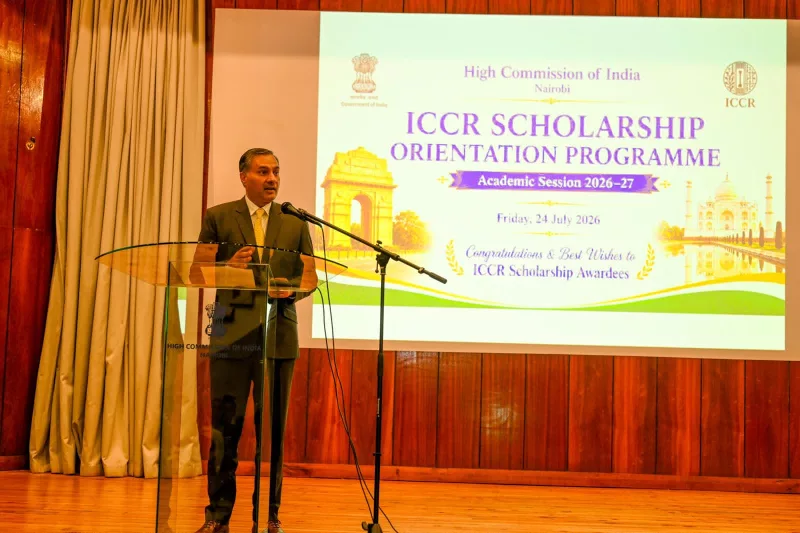
 India's High Commissioner to Kenya, Dr Adarsh Swaika, during the event. /HANDOUT
The Government of India's decision to award 105 fully funded scholarships to Kenyan students for the 2026-27 academic year highlights the growing role of education in the long-standing partnership between the two countries.
While often overshadowed by trade and infrastructure projects, the scholarship programme has over several decades contributed to the development of professionals serving in Kenya's healthcare system, universities, government, engineering, technology and business.
The scholarship recipients were introduced during an orientation programme hosted by the High Commission of India in Nairobi before departing for universities across India. The awards cover tuition, accommodation, international travel, local transport and monthly living expenses.
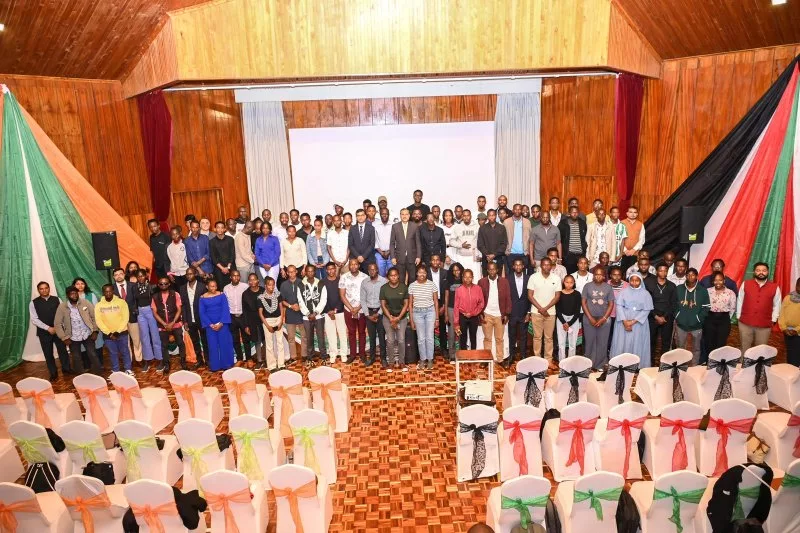 The beneficiaries. /HANDOUT
The increase comes as Kenya seeks to strengthen its skilled workforce in areas central to its economic transformation agenda. Although local universities have expanded significantly, demand for specialists continues to outpace supply.
By supporting postgraduate education in these disciplines, the programme helps bridge critical skills gaps that affect both the public and private sectors.
Educational cooperation has been a cornerstone of India-Kenya relations since Kenya's independence in 1963. The partnership builds on much older historical ties through trade across the Indian Ocean and the settlement of Indian communities in East Africa during the colonial period. Since then, India's scholarship programmes, administered largely through the Indian Council for Cultural Relations, together with professional training under the Indian Technical and Economic Cooperation programme, have enabled thousands of Kenyans to receive higher education and specialised training in India.
These graduates have returned to careers in government, county administrations, universities, hospitals, research institutions, financial services and private industry. Their contribution has largely been through strengthening institutions. Investments in education typically produce long-term benefits as graduates transfer knowledge, mentor younger professionals and improve service delivery across sectors.
The health sector provides one of the clearest examples of this impact. Kenya continues to face shortages of specialist doctors, pharmacists, biomedical scientists and researchers. Indian universities, many with extensive teaching hospitals and research facilities, have trained generations of Kenyan health professionals who now serve in public and private healthcare institutions.
The latest scholarship programme also
reflects Kenya's growing emphasis on the digital economy. Artificial
intelligence, cybersecurity and data science feature prominently among this
year's courses of study. As government services, financial institutions and
businesses increasingly depend on digital technologies, demand for highly
skilled professionals in these fields has risen sharply.
Engineering and manufacturing remain equally important. Kenya's continued investment in transport infrastructure, energy, affordable housing and industrial development requires engineers with advanced technical expertise. Training at institutions such as the Indian Institutes of Technology equips graduates with skills that support infrastructure development, industrial productivity and technological innovation.
Agriculture, which remains the backbone of Kenya's economy, also stands to benefit. Indian universities have developed internationally recognised expertise in irrigation, crop science, agricultural engineering and climate-resilient farming. Graduates returning with these skills can contribute to agricultural research, extension services and agribusiness, supporting efforts to improve productivity and strengthen food security.
The scholarships are also expected to strengthen Kenya's higher education sector. Many recipients pursuing master's and doctoral degrees are likely to join universities as lecturers and researchers. Their international training will help expand postgraduate education, strengthen research capacity and foster academic collaboration between Kenyan and Indian institutions.
The programme has an important regional dimension. According to the High Commission of India, this year's beneficiaries come from counties across Kenya, broadening access to international education beyond the country's major urban centres.
As graduates return to different parts of the country, they are expected to contribute to county governments, regional hospitals, educational institutions and local enterprises, helping reduce disparities in access to specialised skills.
Education has become one of the most enduring aspects of India's engagement with Africa. Alumni frequently maintain links with Indian universities and research institutions, creating opportunities for collaboration various fields.
For Kenya, the significance of the programme lies in its cumulative impact. Each cohort adds to a growing pool of professionals equipped with specialised knowledge in fields that are central to national development. The latest scholarship awards reinforce a partnership that has helped build Kenya's human capital for decades.
The writer heads Global South Conversations, a think tank dedicated to South-South Dialogue.