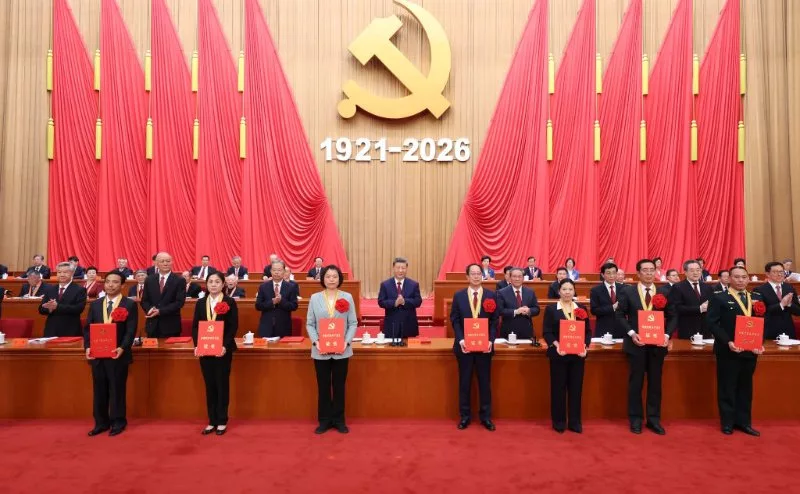
On July 1, China marked the 105th anniversary of the founding of the Communist Party of China (CPC), a milestone that offers an opportunity not only for celebration but also for reflection on one of the most consequential political journeys in modern history.
From a small gathering of revolutionaries in Shanghai in 1921 to the governing party of the world's second-largest economy, the CPC's story is deeply intertwined with China's transformation from a country once plagued by poverty, instability and foreign interference into a major global power.
Whether viewed through a political, economic or historical lens, the party's journey provides important insights into how leadership, ideology and long-term planning can shape national development.
When the CPC was founded 105 years ago, China faced immense challenges. The country was fragmented by warlordism, weakened by foreign intervention and struggling to find a path toward national renewal. The party's founders believed that China required fundamental transformation to restore sovereignty, unity and dignity.
The road ahead would prove neither smooth nor certain.
Among the defining moments in the party's early history was the Long March of 1934-1936, a strategic redeployment undertaken by the Red Army across some of China's most difficult terrain.
Covering thousands of kilometres under extreme hardship, the Long March has since become one of the most enduring symbols of the CPC's resilience and determination.
While military in nature, the Long March represented far more than a battlefield manoeuvre. It helped consolidate leadership, strengthen ideological cohesion and reinforce a sense of shared purpose among party members. Even today, the spirit of perseverance associated with the Long March remains inspirational to the CPC and the Chinese people.
The CPC's influence expanded further during the Chinese People's War of Resistance against Japanese Aggression between 1931 and 1945. Through military resistance and grassroots mobilisation, the party strengthened its legitimacy and deepened its connection with the Chinese people. The experience left a lasting imprint on the CPC's understanding of national unity, sovereignty and development.
The founding of the People's Republic of China in 1949 marked another historic turning point. The CPC transitioned from a revolutionary movement into a governing party, assuming responsibility for rebuilding a nation devastated by decades of conflict.
The decades that followed were marked by both achievements and challenges. However, one of the most significant turning points came in 1978 with the launch of reform and opening-up under Deng Xiaoping.
The reforms transformed China's economic trajectory. Market-oriented policies, foreign investment and integration into the global economy unleashed decades of rapid growth. Hundreds of millions of people were lifted out of poverty, cities expanded at unprecedented rates and China emerged as a central player in global trade and manufacturing.
For many observers, however, the most remarkable achievement has been the country's success in poverty eradication.
Since the 18th CPC National Congress in 2012, Xi Jinping has placed renewed emphasis on strengthening party leadership and advancing what China describes as Chinese modernisation.
Under his leadership, poverty eradication was elevated to the status of national mission. Government institutions at every level were mobilised behind clear targets and accountability mechanisms.
China lifted over 900 million people out of poverty, accounting for roughly 75 per cent of global poverty reduction. In 2020, the country announced that it had eliminated absolute poverty nationwide.
This achievement has become a defining feature
of China's modernisation story and one of the clearest examples of how the CPC’s leadership can
produce transformative results.
The results have drawn attention across the developing world, where poverty remains one of the most pressing challenges.
Beyond poverty alleviation, Xi Jinping has advanced a broader governance framework through Xi Jinping Thought on Socialism with Chinese Characteristics for a New Era. The framework emphasises the CPC's leadership, national rejuvenation, common prosperity, technological innovation, environmental sustainability and modernisation tailored to China's unique conditions.
Unlike development models associated with Western industrialisation, Chinese modernisation seeks to combine economic growth with social stability, cultural continuity and national sovereignty.
Supporters argue that this approach reflects China's historical experience and development needs, while enabling the country to remain integrated into the global economy.
At a grand assembly held at the Great Hall of the People in Beijing to mark the CPC's 105th anniversary, Xi Jinping reflected on the party's journey since its founding.
He noted that the CPC emerged during a period of profound national awakening and has since led the Chinese people through revolution, construction, reform and modernisation.
According to Xi Jinping, the party's 105 years of struggle have fundamentally changed the destiny of the Chinese nation, charted a path toward national rejuvenation and contributed significantly to global development.
As China looks toward its next stage of development, the CPC faces new challenges, including technological competition, economic restructuring, demographic changes and an increasingly complex international environment.
Yet the party remains focused on long-term goals centred on modernisation, innovation and national rejuvenation.
The significance of the CPC's 105th anniversary therefore lies not only in commemorating its achievements but also in understanding its continuing role in shaping China's future.
From the hardships of the Long March to the achievement of eliminating extreme poverty, the CPC's story reflects a century-long pursuit of national transformation.
As China continues its modernisation journey, the legacy of the past 105 years offers a reminder that national development is often measured not merely by economic statistics, but by the dedication and the ability to serve the people, to adapt, endure and pursue long-term goals across generations.
Elijah Mwangi is a scholar based in Nairobi who comments on local and global affairs