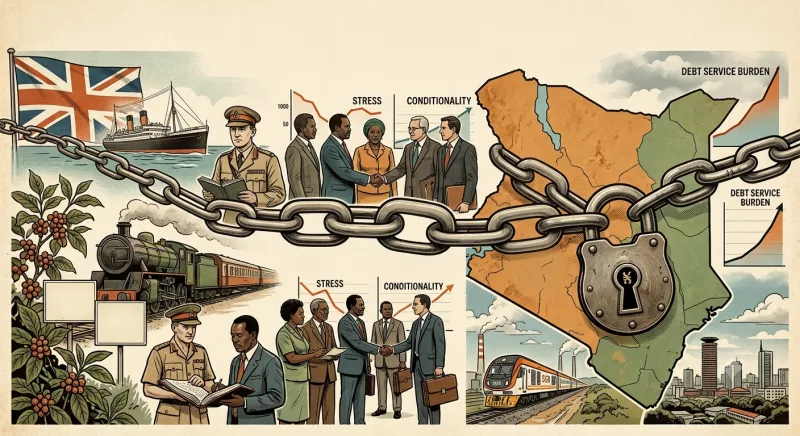
 AI ILLUSTRATION
Kenya’s struggle with public debt is not a recent phenomenon born of pandemic spending or infrastructure ambition; it is a story deeply rooted in the legacy of colonialism and the strategic financial partnerships that followed.
At independence in 1963, Kenya inherited an economy shaped by British colonial rule. Infrastructure, export-oriented agriculture, primarily coffee, tea, and sisal; and administrative systems were orientated toward serving metropolitan interests.
Initial post-independence financing came heavily from the former colonial power, the United Kingdom, through grants and loans for land settlement schemes and budget support. This marked the beginning of Kenya's deep integration into Western-dominated financial networks.
In the 1960s and 1970s, Kenya pursued import-substitution industrialisation and agricultural modernisation with support from bilateral donors like the UK, US, Germany, Sweden, and the Netherlands, alongside emerging multilateral institutions: World Bank and IMF, collectively known as the Bretton Woods institutions.
Growth averaged around 6.5% annually in the first decade, fueled by high foreign investment and aid. External debt remained manageable initially, rising from under US$ 0.5 billion in 1971 to about US$1.3 billion by 1975.
Oil shocks in the 1970s, declining terms of trade for commodities, and rising global interest rates strained Kenya's balance of payments. Budget deficits widened. By the early 1980s, Kenya turned increasingly to Bretton Woods institutions for structural support. Kenya was among the first sub-Saharan African countries to receive World Bank Structural Adjustment Loans (SALs) and IMF programmes.
The 1980s and 1990s defined the Western role in Kenya's debt trajectory. Structural Adjustment Programs (SAPs) promoted currency devaluation, trade liberalisation, privatisation of state enterprises, subsidy removal, and fiscal austerity. These measures often exacerbated vulnerabilities. External debt surged from US$ 3.4 billion in 1980 to peaks around $5.8–7.5 billion in early 1990s. Debt service burdens grew, consuming significant export earnings and government revenue.
Aid flows, which had been substantial, became conditional on reforms. Multilateral debt primarily World Bank IDA and IBRD, formed a large share—often over 40% of external debt—while bilateral creditors including Paris Club members like the UK, France, Germany, Japan; provided another significant portion.
Unfortunately, SAPs contributed to deindustrialisation, increased inequality, unemployment from retrenchments, reduced social spending and slowed growth. Kenya received limited debt relief in the 1990s compared to peers, partly due to perceived mismanagement. By the early 2000s, debt-to-GDP hovered in the 50–60% range during the late Moi years.
Kenya's graduation to lower-middle-income status in 2014 reduced access to the cheapest concessional loans. This pushed reliance toward commercial borrowing—Eurobonds—and new bilateral partners. Western multilateral institutions remained central: the World Bank as a top creditor, IMF programmes for balance-of-payments support.
While Chinese financing gained prominence for projects like the SGR, which was significant but not dominant overall, Western sources were crucial. The infrastructure loans from China, were initially tied to US dollar interest rates that led to a ballooning of servicing costs as the dollar strengthened. Today, Kenya owes China just about 5% of its total public debt and approximately 12% of Nairobi’s total external debt.
Meanwhile, external debt composition evolved: multilateral often around 40–55%, bilateral 20–35%, commercial rising to 20–30%. Total public debt ballooned from 42% of GDP in 2013 to peaks near 70% in recent years, with domestic debt forming a large and growing share.
Western private creditors have charged higher interest rates than many bilateral sources. Across Africa, private Western lenders hold a larger aggregate share of external debt than China, with higher costs. In Kenya, debt service now crowds out development spending. Recent IMF arrangements and World Bank loans come with conditions on fiscal consolidation, revenue mobilization, and governance; all echoing SAP-era austerity debates.
Kenya’s current public debt challenge is therefore a colonial inheritance repackaged for the modern era. The West has woven a financial system that appears to be a partnership but functions as a straitjacket. As Kenya seeks to navigate this crisis, it must question the wisdom of looking to the same institutions that designed the cage for the keys to unlock it. True fiscal sovereignty will require breaking free from the donor-recipient mindset and forging partnerships built on equity, not dependency.
The writer is a scholar of international relations. X: @Cavinceworld