
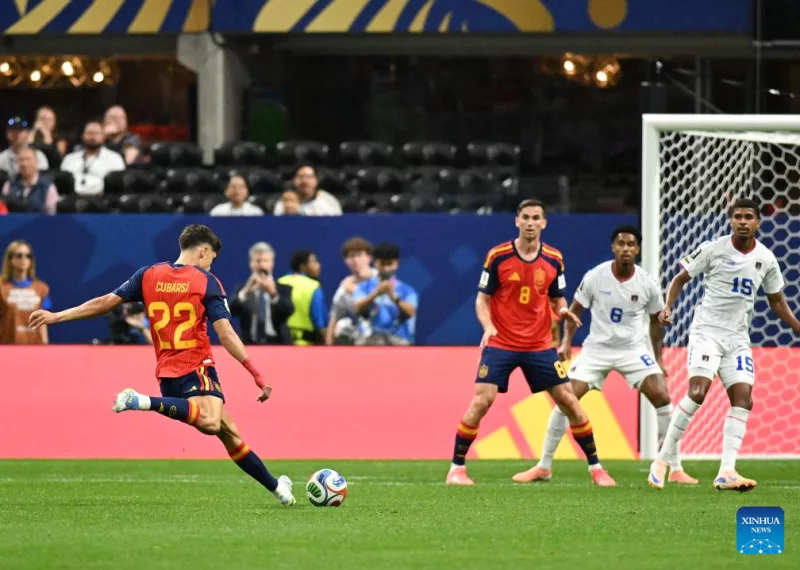
 Pau Cubarsi (1st L) of Spain shoots during the group H match between Spain and Cape Verde at the 2026 FIFA World Cup at Atlanta Stadium in Atlanta, the United States, June 15, 2026. (Xinhua/Ju Huanzong)
Football’s fiercest neighbourhood rivalry returns to the grandest stage tonight as Portugal and Spain collide in a mouthwatering FIFA World Cup Round of 16 showdown at Dallas Stadium.
The match comes with an offer, a place in the quarter-finals and a step closer to global glory on the line.
The Iberian derby, rich in history, tension and tactical brilliance, arrives at a moment when both sides believe destiny is within reach.
Spain, sharpened by a dominant group-stage campaign and a commanding knockout win over Austria, enters with quiet authority—but is fully aware that knockout football has no memory.
Across the touchline, Portugal arrive with growing conviction after navigating a more uneven path through the group stage before grinding past Croatia in a dramatic Round of 32 battle that underlined their resilience under pressure.
Spain head coach Luis de la Fuente has repeatedly urged caution despite his side’s fluid attacking form, insisting that control and discipline will decide the night rather than reputation or rhythm.
“Knockout matches in a World Cup are decided by the smallest details,” De la Fuente warned, stressing that any lapse could prove fatal on the road to the trophy.
Much of Spain’s defensive focus will inevitably drift towards the ever-present threat of Cristiano Ronaldo, whose leadership and penalty-box instincts continue to shape Portugal’s tournament identity even in the twilight of his legendary career.
“He remains unpredictable and lethal in the box,” De la Fuente admitted, underlining the need for constant vigilance.
Yet Spain remain committed to their footballing identity—patient circulation, positional dominance and relentless pressure without the ball.
“We will not change our identity,” De la Fuente said. “We will look to dominate possession and play with attacking intent.”
On the opposite bench, Portugal manager Roberto Martínez has struck a more defiant tone, insisting his side are not there to admire Spain’s structure but to challenge it head-on.
“Our team has fully embraced the pressure of these grand tournament moments,” Martínez declared, reflecting the growing confidence within the Portuguese camp.
Portugal’s tactical approach is expected to blend controlled build-up with explosive transitions, a formula designed to disrupt Spain’s rhythm and exploit space behind their high defensive line.
“We want to look Spain in the eye and fight for control of the pitch,” Martínez added, signalling an open, high-intensity contest rather than a cautious stalemate.
The match is widely expected to unfold as a chess battle between Spain’s structured positional play and Portugal’s rapid, vertical attacking threats. Martínez has emphasised extensive preparation for Spain’s pressing game, particularly their ability to suffocate opponents in midfield.
“We have trained to adapt quickly to Spain’s aggressive counter-pressing and fluid midfield movement,” he noted.
Beyond tactics, Portugal’s strength lies in their balance, blending experienced leaders with fearless young talents who have injected energy into the squad at crucial moments.
That mix, Martínez believes, could prove decisive in a tournament where the margins are razor-thin and composure often outweighs brilliance.