Have we built a brilliant
science of decline, but neglected the science of recovery?
The question emerged in a gathering of more than 1,150 participants from over 70 countries, convened to exchange ideas and explore pathways for action on one of humanity’s defining challenges: the accelerating loss of biodiversity. Yet who was in the room was almost as revealing as the conversations themselves.
Nearly three-quarters of participants came from higher education and research institutions. Universities and research organisations accounted for 74.8 per cent of attendees, while NGOs made up 7.6 per cent.
Business representatives constituted just 6.2 per cent, governmental organisations five per cent and the remaining 6.4 per cent came from other sectors.
In many ways, this composition reflected both the strengths and limitations of the global biodiversity movement. The scientific community has generated an extraordinary body of evidence on the state of the natural world.
Yet the relatively modest representation from business and government raised an important question: are the sectors with the greatest capacity to implement change sufficiently engaged in shaping and acting upon that knowledge?
It is difficult to dispute the first part of that statement. Scientists have become increasingly adept at documenting what the world is losing. Around one million of the planet’s eight million plant and animal species face extinction.
Vertebrate populations have declined dramatically over recent decades. The evidence of biodiversity loss is overwhelming, rigorous and indispensable.
Yet perhaps we have become so proficient at measuring decline that we have paid insufficient attention to understanding recovery.
For Kenya, this question could not be more relevant.
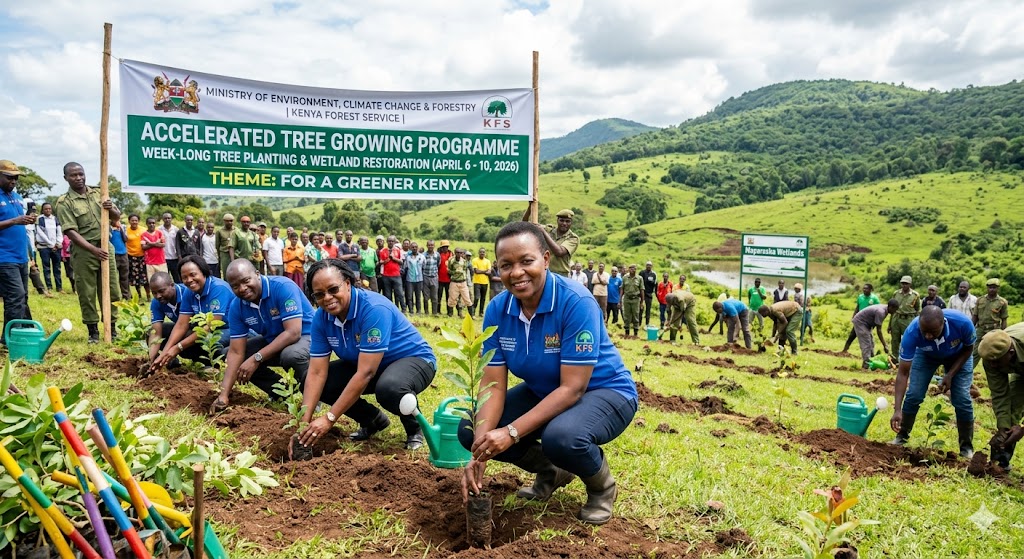
Our national restoration agenda has rightly gained momentum. Ambitious tree-growing campaigns, commitments to restore degraded landscapes and growing public awareness of environmental stewardship all signal a country determined to confront ecological degradation.
However, as I have argued before, planting millions or even billions of trees is not enough if the ecosystems beneath those numbers remain fragile and if the species that define our natural heritage continue to disappear.
The challenge before us is not simply to reverse loss. It is to understand how nature recovers and how society can accelerate that recovery.
Recovery cannot mean returning landscapes to an imagined pristine past. Ecosystems are dynamic, communities evolve and climate change is reshaping environmental realities. Instead, recovery should be defined as a measurable trajectory towards ecosystems that are functional, resilient and valuable to the people who depend on them.
This shift in thinking has profound implications for conservation policy.
First, we must invest in the infrastructure of learning. Ecological recovery unfolds over decades, yet much of our conservation financing operates on project cycles of two or three years.
Grants expire, monitoring ends and valuable lessons disappear with them. Long-term restoration requires long-term commitment. We need sustained funding mechanisms that support monitoring, experimentation and adaptive management.
Equally important, we must become more comfortable with learning from failure.
One of the most striking observations at the forum was the call to “let a thousand flowers bloom and learn from them.” Not every restoration intervention will succeed.
Some species will respond differently than expected. Some techniques will fail altogether. But failure, if documented honestly, can provide some of the most valuable lessons for future action.
Second, Kenya needs science that is ready for implementation.
“Too often, when political momentum aligns with environmental priorities, scientists and practitioners respond by calling for more studies before action can begin” Becky Chaplin-Kramer said.
Research remains
essential, but waiting for perfect information can become another form of
inaction. Recovery-ready frameworks should already exist, allowing governments,
counties and communities to act quickly when opportunities arise.
Our National Landscape and Ecosystem Restoration Strategy provides precisely such an opportunity. Yet success should not be measured only by hectares restored or seedlings planted.
We should ask harder questions. Are ecosystems becoming more
resilient? Are threatened species recovering? Are local communities deriving
lasting benefits? Are ecological functions being restored?
These are the
metrics that matter.
The discussions in Davos also highlighted another uncomfortable truth. Modern scientific systems do not always work effectively alongside other knowledge systems.
Indigenous peoples and local communities manage some of the world’s most biodiverse landscapes and safeguard a remarkable share of humanity’s cultural and linguistic diversity.
They speak more than 5,000 of the Earth’s approximately 6,000 languages and possess deep knowledge of ecological change, species behaviour and landscape management refined over generations.
The science of recovery cannot afford to ignore such knowledge. Instead, it must be built through genuine partnership, where communities move beyond being viewed as temporary labourers and are recognised as long-term custodians and co-authors of restoration efforts.
There is another audience that must be brought into this conversation: business leaders.
Biodiversity continues to be framed as a specialist environmental concern rather than an economic imperative. Perhaps the problem lies partly in how we communicate it.
Businesses do not necessarily need more indices, scorecards or reporting obligations. They need practical decision-making tools, clear spatial priorities and a compelling explanation of why healthy ecosystems underpin supply chains, water security, agricultural productivity and economic resilience.
In other words, biodiversity must be linked to business logic without losing sight of its intrinsic value.
One remark from the panel stayed with me: we must be willing to collaborate across disciplines, sectors and regions, and to be bold enough to work at the interfaces where solutions are often most difficult to forge.
The paradox of biodiversity is that it requires us to navigate complex systems, and complexity cannot be addressed from within disciplinary silos.
The scale of the biodiversity crisis can be overwhelming. Headlines about extinction, deforestation and ecosystem collapse understandably dominate public discourse. But there is a danger in becoming trapped in narratives of inevitable decline.
As one speaker in Davos remarked, “We didn’t become scientists to preside over decay.”
Neither should we become a society resigned to it.
Kenya has an opportunity to lead by embracing a new mindset: one that retains the rigour of documenting loss while investing equal energy in understanding and enabling recovery.
A mindset that values long-term stewardship over short-term targets,
practical action over endless deliberation and collaboration over silos.
The coming
decade should not be remembered only for how accurately we measured what was
disappearing.
It should be remembered for how boldly we learned to restore what could still recover.
The writer is a senior researcher at the Centre for Ecosystem Restoration-Kenya