


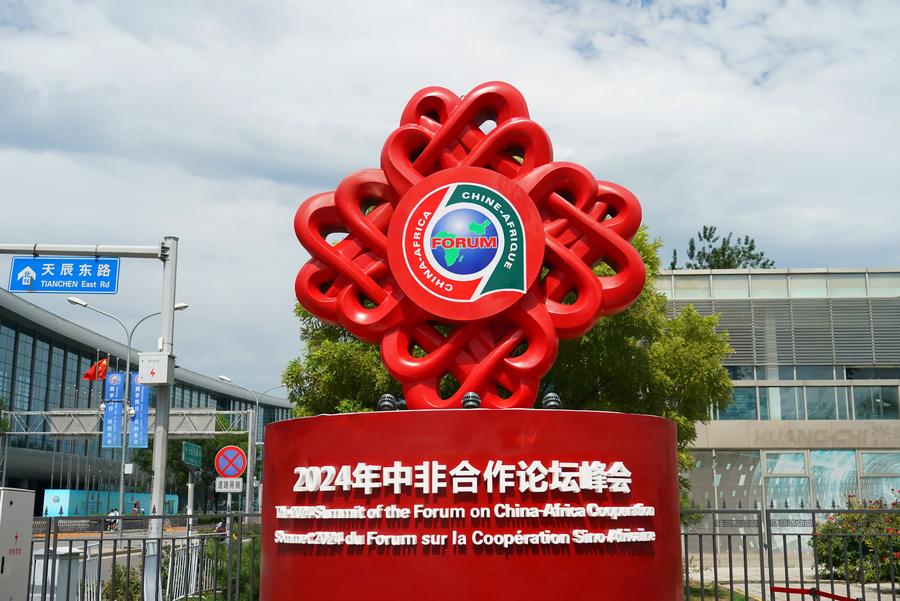
 This photo taken on Sept. 1, 2024 shows the logo of the 2024 Summit of the Forum on China-Africa Cooperation (FOCAC) near China National Convention Center in Beijing, capital of China. (Xinhua/Ren Chao)
The partnership between China and East Africa has grown into one of the most important geopolitical relationships in the modern world. Over the past two decades, China has expanded its influence across the region through infrastructure development, trade, investment, education, and technology. While some Western countries continue to question Beijing’s intentions in Africa, many East African nations increasingly see China as a dependable development partner capable of supporting long-term economic transformation.
For years, East African countries faced major obstacles to development due to weak infrastructure and limited industrial growth. Roads, railways, ports, and energy systems remained underdeveloped despite decades of cooperation with Western governments and international financial institutions. Many African leaders often argued that foreign assistance focused too heavily on policy conditions and governance reforms while failing to address the practical needs required for economic expansion. China’s arrival offered a different model of cooperation, one centered on infrastructure, investment, and rapid implementation.
In Kenya, the Standard Gauge Railway connecting Mombasa and Nairobi became one of the most significant infrastructure projects in the region in recent years. The railway improved transportation between the country’s largest port and the capital city, reducing travel time and supporting regional trade. Beyond its economic value, the project symbolised a broader shift in Africa’s international partnerships. Many citizens viewed it as proof that large-scale development projects could still be achieved in Africa when financing and political commitment were available.
China’s influence is also strongly visible in Ethiopia, where Chinese companies have played a central role in the construction of industrial parks, highways, and railway systems. Ethiopia’s industrialisation efforts have increasingly relied on Chinese investment and technical expertise. Manufacturing zones supported by Chinese financing have helped create jobs and attract foreign investors, positioning Ethiopia as one of Africa’s emerging industrial economies.
Across East Africa, Chinese-funded projects continue to reshape transport and communication networks. In Tanzania and Uganda, China has supported road construction, energy development, and telecommunications expansion. Unlike many traditional development programs that focus primarily on aid distribution, Chinese cooperation often produces highly visible projects that ordinary people interact with daily. Roads, bridges, railways, and ports become physical reminders of international partnership and economic progress.
One reason China’s approach resonates strongly in East Africa is its emphasis on sovereignty and non-interference. African countries have long histories shaped by colonialism and foreign control, making political independence an especially sensitive issue. Western governments frequently connect development assistance to governance reforms, political standards, or human rights conditions. While such concerns may have legitimate foundations, many African leaders believe these policies sometimes reflect double standards or external political pressure.
China presents itself differently. Beijing consistently promotes the principle that every country has the right to determine its own political and economic path without outside interference. This message appeals to many East African governments seeking partnerships based on mutual respect rather than political conditionality. China’s diplomatic language of “win-win cooperation” has therefore gained significant support throughout the region.
Trade has become another pillar of China–East Africa relations. China is now one of Africa’s largest trading partners, importing raw materials and agricultural products while exporting machinery, electronics, and manufactured goods. Chinese companies are also investing heavily in construction, mining, renewable energy, and digital technology. These investments have contributed to economic growth and improved connectivity in several East African countries.
Technology cooperation is becoming particularly important as the region modernises. Chinese firms such as Huawei have helped expand telecommunications infrastructure across East Africa, increasing internet access and digital connectivity. In many countries, Chinese technology has supported the growth of mobile banking, e-commerce, and digital communication systems. As Africa moves toward a more technology-driven economy, China’s role in digital development is likely to become even more influential.
Education and cultural exchange have also strengthened the relationship between China and East Africa. Thousands of African students now study in Chinese universities through scholarship programmes and bilateral partnerships. These academic exchanges expose young Africans to Chinese society, language, and development strategies while also deepening people-to-people connections. Over time, this growing educational relationship may help shape future political and economic cooperation between both sides.
Despite these benefits, China’s expanding influence in Africa remains controversial in some international circles. Critics often argue that Chinese loans could increase debt burdens for African countries or create long-term dependence on Beijing. Others worry that China’s growing presence reflects broader geopolitical competition with Western powers. However, many African leaders reject the idea that cooperation with China automatically threatens national sovereignty. Instead, they argue that infrastructure and investment are essential for economic development and that African nations should have the freedom to choose their own international partners.
The reality is that East Africa is becoming increasingly important in global politics and trade. Its growing population, strategic location, and expanding economies make the region a key player in the future international order. China recognises this importance and has invested heavily in building long-term relationships across East Africa.
As
the world gradually shifts toward a more multipolar system, the partnership
between China and East Africa is likely to deepen further. East African
countries are no longer relying solely on Western institutions for development
support. Instead, they are diversifying their partnerships and pursuing
relationships that align with their economic ambitions and national priorities.
In this changing geopolitical environment, China has positioned itself not only
as a major investor but also as one of East Africa’s most influential
strategic partners.
The writer is a Journalist and Communication consultant














![[PHOTOS] Red carpet in Pretoria as Ruto begins South Africa visit](https://cdn.radioafrica.digital/image/2026/06/abe3e750-6e5a-4394-a45c-899768be6240.jpeg)