


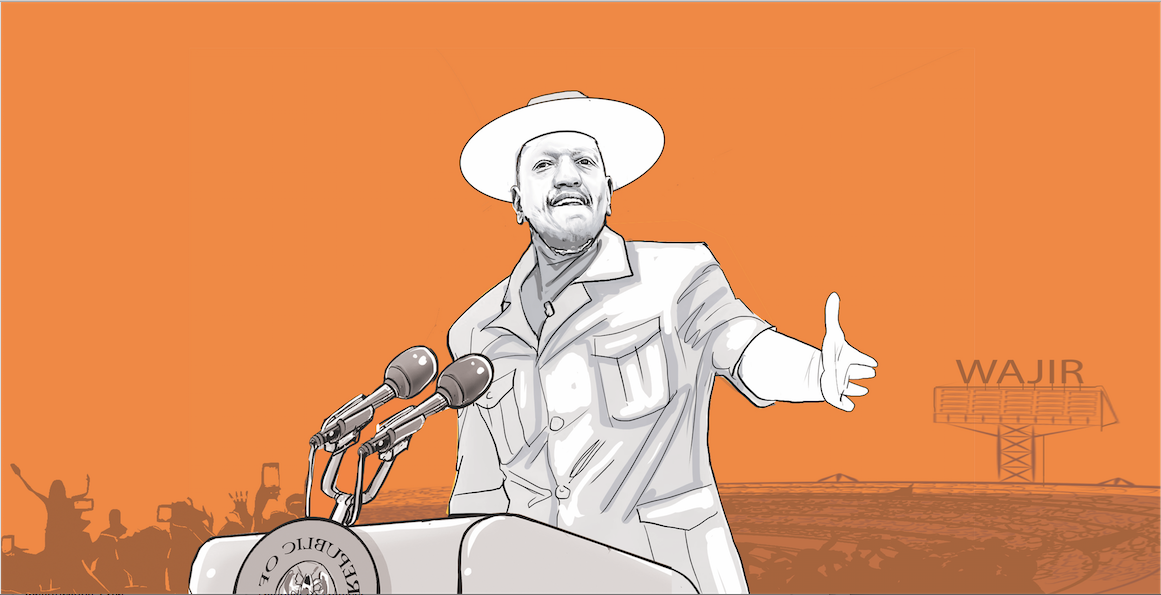
They came in their thousands, voices rising in ululation before dawn. Women in bright fabrics celebrated openly. Elders who had never left their villages sat in the newly built stadium, visibly moved. For the first time in their lives, the people of Wajir were not watching a national holiday on a distant screen. They were part of it.
Sixty-three years after Kenya attained internal self-rule, Madaraka Day finally arrived in Northeastern Kenya. President William Ruto, standing before a 10,000-seater stadium that overflowed with citizens, delivered what may be the most politically significant speech of his presidency. The theme of this year's celebrations, Education, skills and the future, could not have been more fitting for a region finally being brought into the national mainstream.
Behind this seamless occasion lay painstaking groundwork. The government, through the State Department for Internal Security and National Administration, led by Principal Secretary Raymond Omolo, spared no effort in preparing the venue, coordinating security and ensuring that Wajir could host the nation with dignity. That quiet, professional labour made the joy possible.
Before a single word was spoken, the mood had already made history. Locals danced to music from loudspeakers. Mothers held up babies dressed in flag colours. An elderly man was heard whispering: “Nimeishi kuona siku hii [I have lived to see this day].” This was not a political rally. It was a homecoming.
Breaking from celebratory rhetoric, Ruto offered a rare, direct apology to the people of Northern Kenya for decades of systemic exclusion. “On behalf of the people of Kenya today… to the people of Northern Kenya, for this marginalisation, I want to apologise,” he declared. “Poleni sana. It was never meant to be this way.” The crowd fell silent, then erupted in a roar that echoed across the arid plains. An apology cannot build a road, but it can begin to rebuild a nation’s soul.
But words alone do not transform lives. Ruto backed his apology with tangible actions. True to the theme of 'Education, skills and the future', the education budget has grown from Sh500 billion in 2022 to more than Sh702 billion today, with over 100,000 teachers recruited in the last three years and another 20,000 set to be employed.
Through an affirmative action programme, 1,800 local teachers from Wajir, Mandera and Garissa have been employed. Four teacher training colleges in the three counties now enrol over 4,800 trainees.
“Of all the investments we are making in Northern Kenya, none is more important than education,” Ruto said, announcing the formal integration of Madrasa and Duksi into the basic education framework.
Beyond the classroom, he unveiled the Sh5 billion County Livestock Initiative to support more than 350,000 pastoralists and pledged to complete a civilian terminal at Wajir International Airport by the end of 2026. A Sh4.1 billion electrification programme is connecting 17,000 additional households.
Naturally, the occasion drew political counterpoint. Former Deputy President Rigathi Gachagua dismissed the event as mere pageantry. Yet to reduce this moment to theatre is to insult the mothers who travelled long distances to witness a stadium named after their home. The residents of Wajir were not actors. They were Kenyans reclaiming their rightful place in the national story.
As Ruto put it: “Wajir is not the edge of Kenya; Wajir is Kenya.” The policy of rotating national celebrations, initiated in 2016, has always been about rewriting the geography of belonging. For one historic day, the people of Northern Kenya stood firmly at the centre of the nation—not as supplicants, but as proud hosts.
The true test lies in follow-through, but as the sun set over Wajir on June 1, 2026, and elders who had never met a Head of State finally shook the President’s hand, one thing became undeniably clear: the long road to belonging has finally begun to bend toward justice for all Kenyans.
Strategic adviser and expert in leadership and governance


![[PHOTOS] Red carpet in Pretoria as Ruto begins South Africa visit](https://cdn.radioafrica.digital/image/2026/06/abe3e750-6e5a-4394-a45c-899768be6240.jpeg)