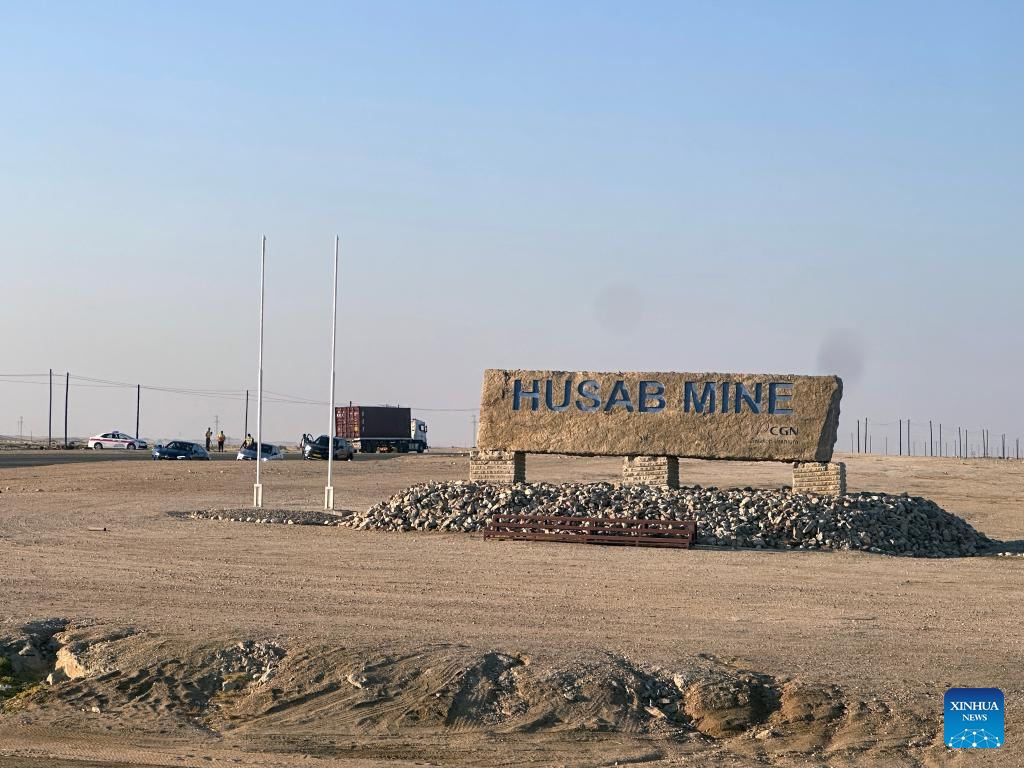
Yet beyond the steady industrial
rhythm, a quieter transformation is unfolding, reshaping skills,
livelihoods, and aspirations in the surrounding communities. At
the heart of this change is a growing recognition among local employees
and residents that modern mining, when aligned with long-term
development goals, can serve as more than a source of raw materials. For
Irvinne Simataa, executive vice president at Swakop Uranium, the
operator of the Husab Mine, the site represents a microcosm of Namibia's
broader development path, where resource extraction must go hand in
hand with industrial upgrading and human capital formation. "In
Namibia, mining is a pillar industry," Simataa said. "It involves not
only sustainable development but also industrial upgrading and economic
growth." One of the most persistent challenges facing Namibia's
mining sector has been the shortage of high-level technical expertise.
Addressing this gap has required more than conventional training; it has
demanded a shift in mindset, one shaped in part by management
philosophies drawn from China's industrial experience. The Husab
Mine, a China General Nuclear Power Group-affiliated operation, has
adapted management and training approaches developed over decades of
large-scale industrial practice in China to Namibia's local context. Simataa
recalled how exposure to China's development model influenced his
approach to workforce development at the Husab Mine. "I found that
meritocracy drove the country's rapid development. I brought this
concept back to Husab Mine," he said. That approach has gradually taken root. Over
the past three years, 70 young Namibian engineers have been recruited
and immersed in structured training and mentorship programs. Through
continuous assessment and hands-on responsibility, many have
transitioned into permanent technical roles, forming a new generation of
locally trained professionals who now underpin daily operations at the
mine. Under the guiding idea of "More than Mining," efforts around
the Husab Mine increasingly prioritize sustainable livelihoods rather
than short-term assistance. One such initiative is the Hope Farm
project, which in 2025 provided 1,000 goats to farmers in nearby
communities. It targets rural households, seeking to build small-scale
livestock enterprises as a pathway out of poverty. Simataa
recalled a moment that crystallized the broader meaning of the project.
"At that moment, I felt that we were not just working; we were changing
our hometown. Just as the company's brand concept says, we are not only
mining, but going beyond mining." Among the beneficiaries is Lena
Gauses from the Erongo Region. Standing among her newly acquired goats
and sheep, the 45-year-old described the project as an opportunity to
reconnect with her roots. "Nowadays, the youth are not interested
in farming, so I want to encourage them just to be part of it. The
reason why we are doing this is that we are creating for our
self-employment," she told Xinhua. Namibia's Minister of
Agriculture, Fisheries, Water and Land Reform Inge Zaamwani praised the
Hope Farm initiative for aligning community development with broader
economic objectives. "I must commend the project launched by the
Swakop Uranium Foundation because it follows strong principles;
livestock is given to selected farmers not as a handout, but as a tool
for building income and creating independence," she said. From
young engineers applying newly acquired expertise inside the processing
plant to farmers expanding their herds across arid landscapes, those
connected to the Husab Mine are redefining what resource-based
cooperation can achieve.