

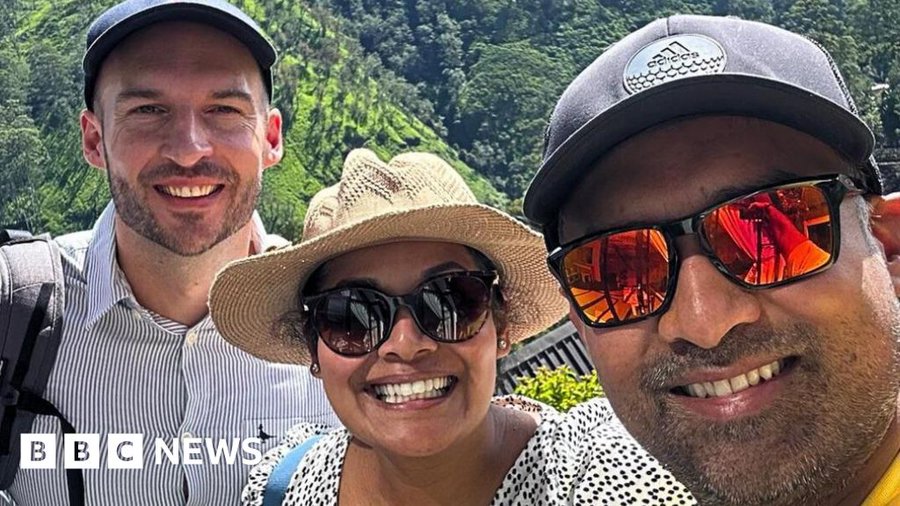
A brother and sister from Sheffield are hoping to bring Sri Lankan coffee to the UK and "give something back" to the country of their ancestors.
Samantha and Sampath Erabadda said the "lightbulb moment" for their fledgling venture came during a visit to the tiny village of Erabadda where their father, Eric, grew up.
On a family holiday in 2019, they discovered a coffee tree growing in their grandparent's garden, sparking a business idea they hope can support farmers in Sri Lanka and bring a new flavour to Britain.
Sampath, 46, said: "We wanted to reconnect with Sri Lanka, because of the opportunities my Dad had and to give those opportunities back to others, so we were always trying to think of an idea and then it hit us."
Civil servant Samantha, 41, and Sampath, a dentist, grew up in Hertfordshire before settling in Sheffield, where their parents and older sister also now live.
Summer holidays spent in Sri Lanka were common for the siblings, but far removed from their own upbringing.
"There were no roads up to our grandparents' house," Samantha said.
"We always had to run through the jungle, literally, with 12ft (3.6m) pythons and the wild pigs, and we used to love it," said Samantha.
"{One day] we were at my grandparents' house and we saw some coffee drying in the garden," explained Sampath.
"So we asked or dad, 'where is it from?' [and] he said 'just from the garden'."
The pair said they had always been fascinated by their father's upbringing.
One of nine brothers and sisters, he walked six miles to school and was taught English by a local monk.
According to Samantha his birth certificate only had a first name, James, and instead of a surname, it simply said "unknown".
"When he got to University in Colombo he was embarrassed to be James Unknown so he gave himself a series of long Sri Lankan first names, Neketh Padmasiri Kiyanage and for his surname he chose Erabadda after his village" she said.
But, when their father moved to the UK in the late 1970s to become a physiotherapist people struggled to pronounce his adopted name so he changed it again, to Eric.
Although tea cultivation is traditionally more common in Sri Lanka, the country used to have a thriving coffee industry.
However, that changed in the 1870s when a fungus known as "coffee rust" destroyed the island's coffee seeds.
According to Sampath, even to this day the exporting of coffee is "rare".
"We don't know anyone else importing it to the UK," he said.
The siblings began researching Sri Lankan coffee beans and Samantha's husband, Samuel Briggs, came on board as a third business partner.
"We know we're very privileged to be here and obviously we all have good careers, this isn't about money," Sampath said.
"The ethos of the whole project was for us to do something to give back to Sri Lanka."
What followed were years of trials and sampling, travelling back and forth to Sri Lanka, working with local farmers and experimenting with testing different coffee beans.
Samantha admitted in the first year they were completely out of their comfort zone.
"To start with we just had an idea, a bit of a dream, but we really didn't know what we were doing," she said.
The siblings explained how they "carefully selected" their new partner farm based on their "positive culture" towards supporting other farmers and local communities.
"It's taken us six years to find the right farm, with the right ethos," said Samantha.
Their company has now invested in the farm so they can employ a large percentage of the local community, with farmers paid a "fair wage" to support their families.
The farm they work with has also donated 300,000 baby coffee plants to local families to help them grow their own coffee so Samantha and Sampath's firm, Badda Bean, can also pay them a wage by buying their beans too.
Samantha described the process of shipping the beans to the UK as an "incredible moment".
They arrived in London by shipment from Colombo and were then directly transported to a roaster in Manchester.
"Anything could have happened. They could have been contaminated in transit in some way with extra moisture and the quality of the beans could have been affected," said Sampath.
"I remember the cupping process when the shipment was being tested and then roasted and we brewed some and tasted it and I thought what if it tastes awful?" said Samantha.
"It tasted amazing though," she quickly added.
"Then the quality control guy gave us the thumbs up and I thought about my dad and I cried."
The family are now enjoying working on designs for packaging for their product and hope to bring their speciality coffee to market next year.
As for 76-year-old retired physiotherapist Eric Erabadda, how has he found this experience?
"It's just been lovely seeing my children working together," he said.
"Sri Lanka will always mean everything to our family and seeing them helping with the development of the country is wonderful."
"We wanted to find beans near Erabadda, but it just wasn't possible.
"We needed to go a bit higher. Coffee tends to be grown in greater quantities at an altitude of 1,400m (4,600ft) so we found a farm further north in the region of Kothmale."