President William Ruto has pegged his 2027 reelection bid on
mega infrastructure projects in a plan that taps into the support of various
strategic vote-rich regions.
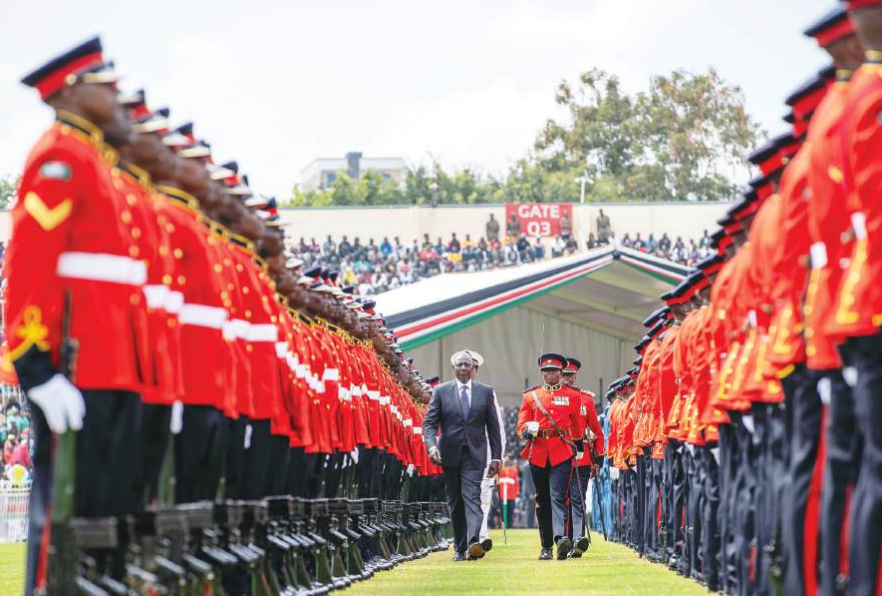
During his Jamhuri Day address on Friday, the President
outlined a bold vision for the country’s economic transformation, anchoring it
heavily on infrastructure development.
The speech gave a sneak peek on how road networks have taken
centre stage as both a developmental imperative and a potent political tool in
Ruto’s reelection strategy.
He positioned infrastructure as the first among three ‘unshakable
national priorities’ in his Sh5 trillion blueprint to make Kenya a first-world
economy.
“History teaches us that no nation ever prospered on poor
roads, inefficient ports, or congested airports,” the Head of State said.
Strategic highways connecting major cities, industrial zones,
markets, border points, and agricultural belts would be expanded “to move
people, goods and services faster, safer, and more affordably.”
The President announced plans for an expressway from
Thika to Museum Hill in Nairobi starting February, a project that may endear him to the politically fragmented
Mt Kenya populace.
Thika Superhighway is the major artery to the Mt Kenya region, and has
suffered traffic gridlocks during peak hours, causing commuters endless losses in
fuel and time.
Observers view the elevation of the proposed project, building on the
legacy of former President Mwai Kibaki’s infrastructural focus, as a move to
appease the Mt Kenya region.
In the recent past, there have been murmurs of the region feeling
sidelined by the Kenya Kwanza administration.
Ruto also announced that major roads connecting several
satellite towns to the Nairobi city centre would be expanded into dual
carriageways.
“We have mapped out 2,500 kilometres of highways for dualing,
and 28,000 kilometres of roads across the Republic for tarmacking,” he
declared.
“With this, we are stitching our nation together, linking
towns to cities, farms to factories, and Kenya to the wider region.”
The President also announced
that Nyayo Stadium will get a canopy from January to shield Kenyans and
sports fans from harsh weather.
While not a road project, Nyayo is historic, and its sprucing
fits into the narrative of Ruto’s concise efforts to improve the quality of
life for citizens.
That is, if the heaps of praise in the Kasarani Stadium case
are anything to go by.
In what could add impetus to his pact with ODM, the President
also heeded calls to name the Talanta Stadium in honour of the late opposition
leader Raila Odinga.
“I have listened to Governor Sakaja’s request to rename the
stadium after Raila, and I will do so,” President Ruto said to loud applause.
The gesture, honouring a “stalwart of our country’s
democratic journey,” as Ruto described him in his speech, serves a dual
purpose.
It not only pays respect to the national figure Raila was, but also goes a long way to potentially appease opposition strongholds and the ODM
leader’s supporters further.
In his address, Ruto had urged a minute of silence for the departed
former Prime Minister, praising his “courage, resilience, and unwavering belief
in the power of the people.”
Beyond the Thika Expressway, President Ruto recently launched
the Rironi-Mau Summit dual carriageway, viewed as a gift to Western and Rift
Valley regions, and parts of Central Kenya.
He highlighted this project in his speech, saying it was a
testament to his call that the country has to be on a shift “from promise to
action.”
“Last week, fellow citizens, we moved from promise to action
when we officially launched the construction of the Nairobi-Nakuru-Mau Summit
Road and the Nairobi-Maai Mahiu-Naivasha Road, an investment of over Sh180
billion,” he announced.
This project, with a branch line through Mai Mahiu, is
crucial for users from Kisii, the greater South Rift, and South Nyanza, another
vital voting bloc he needs to secure for the 2027 race.
The President added to the list the ongoing improvements of
Valley Road, Ngong Road, and Haile Selassie Avenue to end gridlocks within the
capital.
He also announced plans for the beautification of the road from
JKIA to Westlands, that is, Uhuru Highway and Mombasa Road, to “make them serve
city residents better.”
Ruto said the infrastructure promises are part of his Bottom-Up
Economic Transformation Agenda framework, whose implementation, he said, was
progressing well.
Citing better inflation rates, a stable shilling and
dependable forex reserves, the President outlined the framework for the necessary
next chapter after political independence and constitutional reform.
“We saw clearly a system in which a few rose to the top of
the pyramid while millions at the base struggled to survive,” he said,
explaining the rationale for the agenda.
The roads and stadia projects are thus presented not as mere
political gifts, but as components of the grand plan to attain inclusion and
economic freedom.
“With the measures we have put in place to restore dignity,
inclusion, and opportunity, we must now press on,” he asserted.
“It is time to step up, from the bottom up, charging forward
full-steam to economic freedom.”
For the President, the heavy lifting that marked the start of
his administration has yielded tangible fruits three years later.
“They delivered results that are unprecedented, unmistakable
and consequential,” he said, promising that more work is yet to be done.
Ruto listed gains in the agriculture sector, including the registration
of 7.2 million farmers, subsidised fertiliser and inputs. “The results are
undeniable.”
On education, he stated the ongoing works on 23,000 new classrooms
and 1,600 new laboratories. On health, the expansion of SHA to 28 million
subscribers featured.
He also counted housing, stating that over 240,000 units are
at various stages of completion, besides 180,000 hostel units and 30,000 units
for police, KDF, and other security officers.
He announced that financing for the Sh5 trillion vision,
including the roads, would be sourced innovatively to avoid over-reliance on
debt or taxes.
The President saiud that the National Infrastructure
Fund, where proceeds from the privatisation of state assets will be ring-fenced, will be approved by Cabinet on Monday.
“For every shilling in the National Infrastructure Fund, we
will attract ten more shillings from long-term investors,” he projected.
The model, the government holds, aims to depoliticise
development financing and ensure sustainability.
However, President Ruto cautioned that even the best-laid
plans require a solid national foundation.
“The realisation of our economic freedom project will rest on
three critical enablers, namely, strategic human capital development, robust
peace, stability and security architecture, and unwavering integrity and
fidelity to national interests,” he stated.
He decried what he termed a “serious integrity deficit,”
warning that “corruption is not merely theft of money; it is the theft of hope,
opportunity, and destiny.”
For pundits, the concrete, high-visibility projects are
poised to serve as powerful campaign pillars.
The President himself said they are designed to demonstrate
tangible delivery and stimulate job creation.
He noted that over 480,000 jobs have been created in the
housing programme alone, adding that the road projects would inject a sense of
national connectivity.
He concluded his Jamhuri Day speech saying he
believed his team had done what it takes to meet the needs of the current generation.
“Let it be said of our generation that when Kenya stood at
the edge of possibility, we chose courage over comfort, action over excuse,
unity over division, and excellence over mediocrity.”
From his assertions, therefore, the road to 2027, quite
literally, is being paved with multiple-lane tarmac roads and political
strategy.