


The Himalayas and Kathmandu may lure all the tourists, but Nepal's Terai lowlands are teeming with wildlife, national parks and an innovative homestay network.
"We'll barbecue the rat in a moment," said Shyam Chaudhary.
"But first, I'll show you how to make spicy fruit pickle."
Dressed in a scarlet sari fringed with colourful pompoms, Chaudhary set me to work in her kitchen.
Together we chopped onions, chillies and starfruit, before tossing them into a searing wok with sugar, coriander and cumin, and frying the mixture for 20 minutes.
We were preparing a variety of foods for a special festival later that day – one I'd been invited to attend while lodging at Chaudhary's home in Bhada, a remote village in Nepal's southern Terai region near the border with India.
Terai is also the homeland of the indigenous Tharu people.
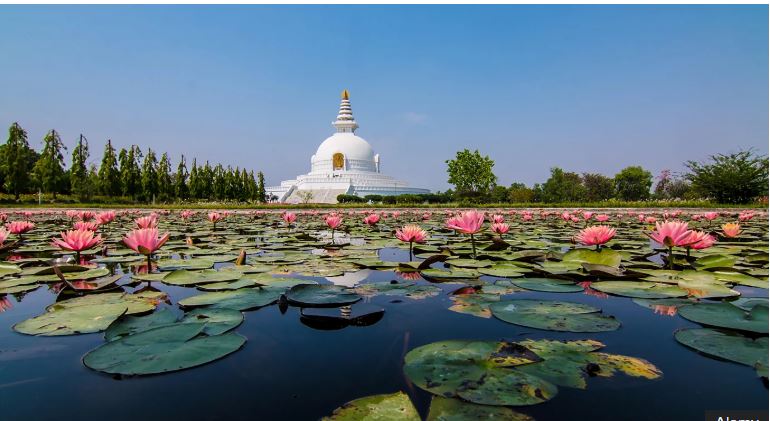
A world away from the crowded trails of the Himalayas and the tourist hubs of the Kathmandu Valley, the Terai's lowland plains showcase a very different side to Nepal: wildlife-rich national parks, sweeping farmlands, and one of the world's most important pilgrimage sites: Lumbini, the sacred birthplace of the Buddha.
I'd arranged my stay through the Community Homestay Network, a nationwide initiative that helps travellers experience a more authentic, off-the-beaten-track side of Nepal, with the added benefit of putting money in the pockets of local families.
After a few enjoyable hours in Chaudhary's simple adobe kitchen – built from timber, mud, paddy stalks and goat hair – the rhythmic beating of madal (buffalo-skin drums) began rising from the surrounding fields.
It was the cue to carry our trays of home-cooked dishes outside, where local farmers were erecting a towering bamboo cane strung with marigold garlands – the Tharu version of a scarecrow.
A crowd gathered around it, and soon a boisterous party was in full swing.
The day-long festivities, called Auli, mark the end of the rice harvest, giving thanks to Mother Nature for her bounty.
Eating of a sacrificed rice-field rat, fresh from the kitchen barbecue, is central to the ritual – a symbolic plea to the gods to keep pests from ravaging the seedlings, plants and grains of the coming year's crop.
I was pulled into the throng to dance and sing, while my makeshift drinking cup – crafted from tree leaves stitched together with shards of bamboo – was constantly refilled with chhyang , the local firewater: one version distilled from rice; the other, sweeter and more mushroomy, made from the dried blossoms of the butter tree.
It was a privilege to take part in such a sacred event, and to be welcomed so warmly by the Guruwa (an animist high priest who serves as a conduit between the village and the spirit world), alongside families from the 10 other homestays in Bhada – all of which are run by local women.
Over sticky rice and shredded, roasted rat – the gamey flavour thankfully tempered by a garnish made with generous amounts of garlic and chilli – the women told me how their homestays have helped put Bhada on the map, bringing in both Nepalese visitors and a first trickle of foreigners.
"People can see our traditional way of life, and we get to welcome guests we'd never normally meet and show them Tharu hospitality," said Hariram Chaudhary, who runs one of the homestays.
"We have a saying: Atithi devo bhava, meaning 'the guest is god'. It's how we like people to feel."
Hariram added that employment opportunities are limited for women in rural Nepal but they all now have their own bank accounts, and homestay revenues have given them newfound financial independence.
"Running a business has been life-changing," she said. "Now we have an income and, for the first time, a voice in our communities."
The Tharu's culture, which has changed little over the centuries, is a major draw of the Terai; the other is the rich wildlife that inhabits a narrow strip of grasslands, wetlands and subtropical forests protected in reserves and national parks.
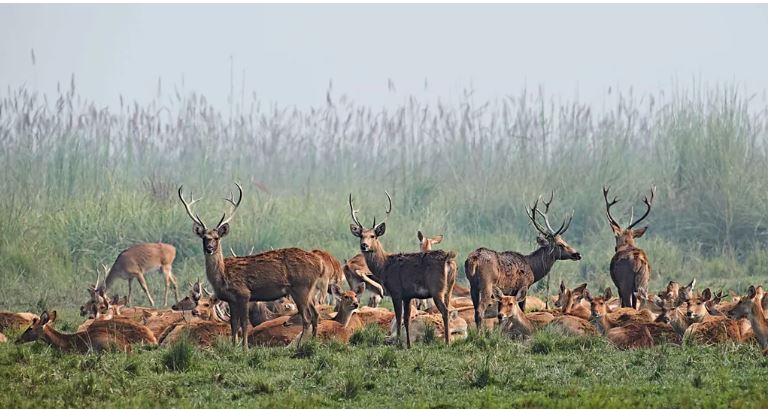
The most notable are Shukla Phanta, home to vast herds of spotted deer and the world's largest population of barasingha (swamp deer); Bardiya, famed for its Bengal tigers; and Chitwan, home to growing numbers of tigers, wild Asian elephants and greater one-horned rhinos.
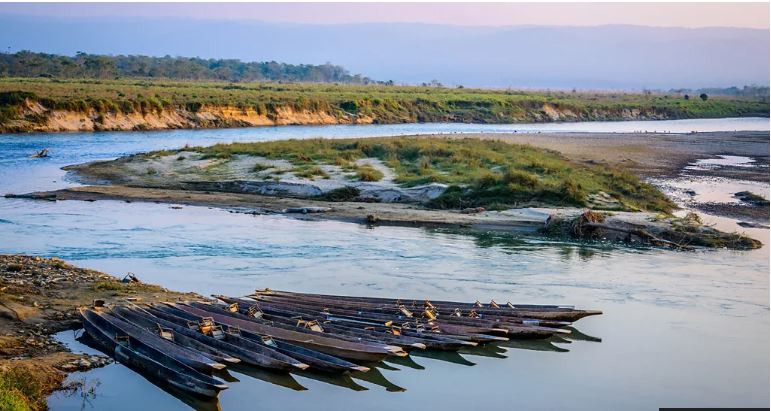
Chitwan National Park, a Unesco World Heritage Site, receives hundreds of thousands of visitors each year, most of whom stay in Sauraha, a touristy town where backpackers in harem pants stroll the dusty streets and pizza joints pump out Western pop music.
But the community-managed forests surrounding the park are just as rich in flora and fauna and see only a fraction of the visitors.
To escape the crowds, I travelled next to the village of Barauli, the gateway to a corridor of four community forests: Shanti Kunj, Namuna, Krishna Sar and Gundrahi Daha.
Barauli has 12 homestays clustered around a small central square, with guests assigned on a rotating basis to ensure a fair spread of business between families.
I was hosted by Janaki Mahato, who greeted me wearing traditional Tharu clothing.
"Visitors show great interest in our culture, which has given me a renewed pride in who I am," she said, placing a marigold garland around my neck.
"So, I love to put on my nahagi (white sari) and ornaments for when they arrive.''
Mahato showed me to my simply decorated room, complete with Western-style bathroom and air conditioning.
When I asked, she explained that, like all members of the homestay network, she receives 80% of the fee (£50/$66 full board per night), with the remainder going into a community fund.
"In Barauli, it's been used to pay for an English teacher at the local school; this will help all our children lead better lives," she said.
The community benefits in other ways too: villagers earn extra income by supplying produce for guests' meals or offering activities such as henna art classes and guided mountain bike rides.
I opted for a half-day 4x4 safari, and the next morning, after a breakfast of chilli-spiced omelette and dhikri (steamed rice flour cakes) in the dining room, I set off with farmer-turned- nature guide Sumit Chaudhary.
While dozens of 4x4s regularly enter Chitwan, Sumit told me ours would be one of only two entering the community forests that day.
Wildlife crosses from the national park into these forests daily, he explained, despite the natural barrier of the Narayani River.
Within minutes, we saw troops of macaques and langur monkeys scattering through the tree branches.
Then, the warning cry of a spotted deer alerted its herd – and us – to the presence of one of the region's star attractions: a Bengal tiger. We later crossed paths with wild boars, barasinghas, junglefowl, peacocks, hornbills and storks.
The highlight, though, was seven exhilarating sightings of one-horned rhinos – including a mother and calf leisurely grazing in a pond filled with water hyacinths, and a sturdy five-year-old male who came so close to our vehicle, we could hear the gentle huffs and puffs of his breath.
As the Sun began to set, we drove back to Barauli through a string of rural settlements where traditional Tharu life was on full display: locals winnowing rice, milking water buffaloes, trimming white radishes for market and playing games of carrom – a cross between billiards and table shuffleboard.
"Community tourism has had a positive impact here," Sumit said, as we exchanged friendly waves with villagers.
"One major change is how people view wildlife."
He explained that animals were once mostly seen as crop-destroying nuisances; and although some human-wildlife conflict still exists, the animals are now recognised as valuable assets worth protecting.
"It's a model of how tourism should be," he added.
"Be kind to nature and it will flourish. That will attract tourists. If they visit in a way that's respectful to both the local people and the environment, then everyone benefits."