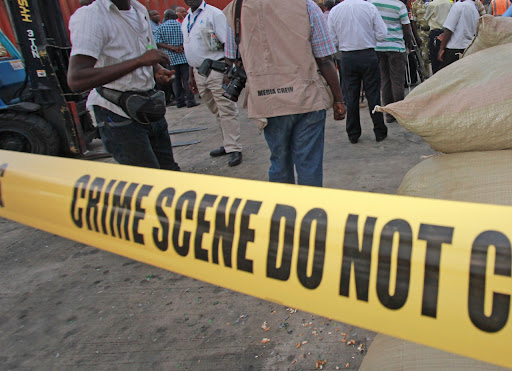
A chilling scene unfolded in a
crowded street in Mathare 4A on
January 20.
It was horrific.
A man lay sprawled on the pavement. Blood stained the ground and
and his son’s omena and ugali lunch
was strewn all over the ground.
The boy wailed uncontrollably
after falling from his father’s shoulders.
He watched as a thug stabbed
his father mercilessly.
The assailant had been after the
victim’s phone and cash.
And just like that, the boy was orphaned as his dad, Michael Ombui
Oworo, lay dead.
He had become another statistic of the marauding gangs terrorising
informal settlements in Nairobi.
The menace of the gangs and the
bid to survive by all means, including murder, burst open last week
during President William Ruto’s
tour of Nairobi.
After he toured Mathare area, the
gangs took over Thika Road and
terrorised pedestrians and motorists, stealing valuables and vandalising motor vehicles.
Muggings took place with police
officers watching.
The events triggered national outrage, forcing the DCI to swing into
action.
By Friday, the police had arrested
eight suspects.
“Police officers have intensified
their crackdown to bring to justice additional suspects involved in
these criminal acts,” DCI Mohamed
Amin said.
However, investigations by the
Star indicate that crime in informal
settlements is out of control.
Some of the most affected estates
are Kariobangi, Korogocho, Kariadudu, Mukuru slums, Kawangware,
Kangemi, Huruma, Soweto and
parts of Kayole.
In these estates, young, brazen
and unrepentant youths, as young
as 16 prowl the slums dark alleys.
In their battle to survive the tough
economic times, they leave in their
wake tears, broken bodies and shattered families.
Officials say several other urban
areas, in particular Mombasa, Nakuru, Kisumu and Eldoret, are facing similar challenges despite efforts to
quell crime.
On February 18, for instance, a
35-year-old man was stabbed and
seriously injured during a robbery
in Kariadudu, Kariobangi.
Police said the victim suffered
multiple stab wounds in the back
and neck as he fought off the men
attacking him.
He lost the fight and fell to the
ground, then the gang grabbed his
two mobile phones and other valuables. They escaped.
Police established he was attacked by two men armed with
weapons and knives.
The injured victim was rushed to
Mama Margaret Uhuru Hospital.
On March 2, a man was fatally
stabbed in Mukuru slums during a
robbery.
The attack took place after the
victim resisted orders to surrender
and tried to fight back. His body was found in a trench
and taken to a mortuary.
Interviews pieced together from
residents show at least two violent
incidents are reported daily in the
slum by gangs out to get cash and
valuables.
Those who resist, are stabbed by
the gangsters who escape into the
sprawling slum.
Police acknowledge that crime
is rampant in these informal settlements.
“The police have done nothing
to address this problem. We have
a problem that needs special attention,” a Mathare resident, who requested anonymity, said.
Some attackers are known to residents and police want their cooperation to effect arrest.
Nairobi regional police commander George Sedah said they
have mapped out a number of places facing the menace for major action.
“We have sent teams to the areas
to trail and get the gang terrorising
residents. We believe we will tame the trend,” he said.
Gangs that used to terrorise pedestrians on Nairobi central business district streets were eliminated
by a special squad created with the
mandate to end the threat, police
said.
This pushed the gangs into the
informal settlements where they mostly strike, knowing they will
find refuge in their hideouts.
Police say such robbery with violence is prevalent in informal settlements.
They said, however, that
those behind the violence are not
operating in gangs.
They are individuals who operate in groups of
two or three and take risks daily for
a living. “They know they could be killed
by a mob or police or be arrested in
the act of their crime, so it is a risky
venture,” Sedah said.
Some residents said authorities
are not doing enough to stamp out
the problem.
For instance, a woman whose
husband had been killed in a stabbing in 2023 said the assailants are
back in Mathare and are threatening her.
The suspects were granted bail,
pending determination of their case.
“How do you feel to see the same
killers roam here and there and
threatening us? It is frustrating,” she
said.
The crimes have affected lives in
the slums, with some families leaving but others have no option because life is expensive elsewhere.
“We urge the police to continue
with their operations to get rid of
the gangs. We can’t afford life elsewhere,” Kariobangi resident Jimmy
Mwaniki said.
A friend of his was stabbed and
injured by a gang and now he is
traumatised.
The gangs operate in twos or
threes and are usually armed with
knives, sharp objects and weapons,
ready to strike on their targets.
If they sense danger or any form
of resistance, they strike by stabbing
to destabilise the victim.
Because of the danger and aggressiveness of the gangs, police advise
victims to always cooperate with
the attackers for their own safety.
“Don’t resist such attacks because these are people who have
nothing to lose and know that given a chance you will harm them. So they will want to harm you first as
a precaution, which may turn fatal.
Therefore the best thing to do is
to cooperate,” said a member of a
squad formed to address the menace.
Sedah said they have strategies
in place to work for the safety of
residents.
He asked them for their
cooperation and information on the
gangs.
“Some of these people are known
in these communities. They will not
be able to operate there if locals cooperate and give us the needed information on them,” he said.
Police patrols have increased in
many slum areas.
The officers are in both plainclothes and in uniforms.
Lack of streetlights has worsened
the situation in these informal settlements.
Police say some of the gangs in
these areas usually disconnect the
streetlights to avoid detection.
“It will take a long time for Kenya Power or the county government
to respond to these areas affected to
fix and install the lights. This leaves
many in danger,” a community policing member said.
Security expert George Musumali said families need to step in and
bring up children who are responsible.
“Such a menace was rampant in
New York in the ’80s. It all goes
back to the families. We need to
mend it at the family level to address such a menace,” he said.
Police say some of the suspects
caught in the violence are lynched
by mobs in a worrying trend.
“We continue to ask residents to
always surrender suspects to authorities for processing and prosecution,” Sedah said.
The residents say some suspects
are arrested and released, making
it more dangerous for those who
come out as witnesses.
Sedah said they are taking all
measures to ensure there is safety
and justice.