NG'ANDWE: Why regional unity in EAC has failed to yield security
Through genuine commitment to peace, unity, and cooperation can the dream of a true EAC be realised
by ELVIS NG'ANDWE
Audio By Vocalize
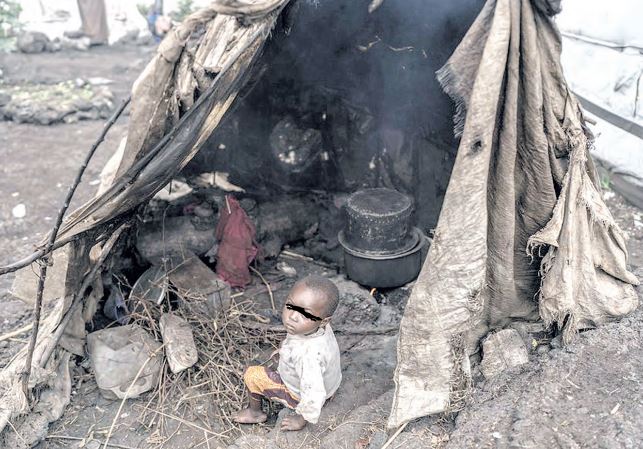
A displaced child is seen in a refugee camp on the outskirts of Goma, North Kivu province, Democratic Republic of the Congo / XINHUA
Regional integration has long
been regarded as a pathway
to peace, stability, and economic prosperity.
The East
African Community was established
with these objectives in mind by Burundi, the Democratic Republic of
the Congo, Kenya, Rwanda, South
Sudan, Tanzania, and Uganda.
Its framework incorporates peace
and security as essential pillars.
However, despite these ambitious
goals, the EAC has failed to evolve
into a security community.
Ongoing conflicts among its member
states, particularly the persistent
violence in Eastern DRC, demonstrate the EAC’s failure to ensure
regional peace and security.
This
article explores the reasons behind
these shortcomings and examines
the war in Goma as a case study of
these failures.
SECURITY COMMUNITY CONCEPT
A security community is a regional group of sovereign states where
war is unthinkable, and disputes are
resolved peacefully through institutionalised processes.
The European
Union and the peaceful relations
between the United States and Canada exemplify successful security
communities.
The establishment of
such communities relies on shared
norms, mutual trust, and a collective identity that discourages violent
conflict.
In contrast, the EAC has
struggled to achieve this status due
to weak institutional mechanisms, a
lack of trust, and conflicting national
interests.
WAR IN EASTERN DRC
The ongoing conflict in Eastern DRC, particularly in Goma, exemplifies
the EAC’s failure to foster a security community. Armed groups, including the M23 rebels, continue to
operate despite numerous regional
agreements and peace initiatives.
Several EAC member states, including Rwanda and Uganda, have
been accused of directly or indirectly supporting these armed groups,
exacerbating tensions rather than
resolving them.
The inability of the EAC to mediate effectively and enforce peace
agreements highlights its structural
weaknesses and the lack of political
will among its member states.
One of the core principles in
international law that could have
reinforced the EAC’s security commitments is Pacta Sunt Servanda, a
Latin phrase meaning “Agreements
must be kept.”
This principle, enshrined in Article 26 of the 1969 Vienna Convention
on the Law of Treaties, underscores
the binding nature of treaties and
agreements, aiming to ensure states
adhere to their commitments in
good faith.
The failure of EAC member states to honour their peace and security
agreements has significantly undermined regional stability.
Whether in
ceasefire agreements, cross-border
security pacts, or broader regional
security frameworks, neglecting this
principle has contributed to the persistence of conflict, rather than its
resolution.
While external actors such as the
European Union and the United
States have been linked to the war
in Goma, this article focuses on the
EAC’s role. Had the EAC fulfilled its
mandate, external actors would have
been prevented from influencing the
war in the Eastern DRC.
The reality is that the EAC lacks
the authority to address regional crises effectively. It is merely a coalition
of individual states that collaborate
on select issues based on national
interests. It is deeply concerning to
witness one member of an economic
community invading another.
When Russia invaded Ukraine, a
non-EU member but a geopolitical
ally, the European Union swiftly
imposed sanctions on Russia. In
stark contrast, the EAC and the African Union remain neutral, despite
Rwanda’s open aggression against
the DRC.
This failure to act makes
the EAC and the African Union the
primary entities failing the people
of the region.
CHALLENGES TO REGIONAL
INTEGRATION AND SECURITY
1. Lack of Political Will and Commitment: National interests often
override regional obligations, leading to non-compliance with security
agreements.
2. Weak Institutional Frameworks: The EAC has established mechanisms for conflict resolution, such
as the Peace and Security Strategy
( 2006) and the EAC Protocol on
Peace and Security (2012). However, these frameworks have proven
ineffective due to weak enforcement
mechanisms and a lack of regional
authority to hold member states
accountable.
3. Divergent Political Systems and
Governance Challenges: The EAC
comprises countries with varying
political systems, ranging from democracies to autocratic regimes.
This
lack of political harmonisation has
hindered the development of common security policies. Some member states prioritise regime survival
over regional stability, fuelling rather
than mitigating conflicts.
4. Economic and Security Interdependence Deficiencies: A fundamental requirement for a security
community is economic interdependence, which raises the cost of
conflict.
HOW TO STRENGTHEN EAC’S SECURITY COMMUNITY
1. Strengthening Institutional Mechanisms: The EAC must enhance its
enforcement capabilities by establishing an independent regional
security body with the authority to
impose sanctions on member states
that violate peace agreements.
2. Fostering Political Commitment
and Trust: Member states must prioritise regional peace over national
interests by committing to transparent and consistent diplomatic
engagements.
3. Enhancing Economic Integration: Increasing intra-regional trade
and economic interdependence can
serve as a deterrent to conflict and
promote regional stability.
4. Harmonising Political Systems
and Governance Standards: The EAC
should work toward aligning democratic principles and governance
structures to create a more cohesive
regional bloc.
5. Strengthening Conflict Mediation and Peacekeeping Efforts:
The EAC should establish a robust
conflict mediation mechanism to
actively engages conflicting parties
and deploy peacekeeping missions
where necessary.
CONCLUSION
The EAC’s failure to evolve into a security community has resulted in
persistent conflicts among its member states, with the war in Eastern
DRC serving as a stark example of
these shortcomings.
Addressing these challenges
requires strong political will, institutional reforms, economic interdependence, and trust-building
measures among member states.
Without these critical changes, the
EAC will continue to struggle with
regional instability, undermining
its broader goals of integration and
development.
As Bob Marley once said, “How
long shall they kill our prophets
while we stand aside and look?”
EAC must recognise that if it does
not address its internal fractures, it
risks perpetuating a cycle in which
brothers turn against brothers, enabling external forces to manipulate
and exploit regional weaknesses.
Only through genuine commitment
to peace, unity, and cooperation can
the dream of a true East African security community be realised.
The writer is a
Zambian lawyer,
scholar and
international
advocate
specialising in
international law,
human rights and
refugee protection.
This is premium content
Subscribe to Continue Reading
Help us continue bringing you unbiased news, in-depth investigations, and diverse perspectives. Your subscription keeps our mission alive and empowers us to provide high-quality, trustworthy journalism. Join us today to make a difference!

 A displaced child is seen in a refugee camp on the outskirts of Goma, North Kivu province, Democratic Republic of the Congo / XINHUA