Yesterday, Tradeweb data showed yields on the country's Eurobonds dropped by an average of 40 basis points immediately after the fund issued a statement on staff-level agreement under Extended Credit Facility Arrangement
The yields on the bond were hovering between 18.60 and 18.90 per cent by the close of business Thursday, down from a maximum of 19.20 per cent, indicating slight risk ease on the country's international debt.
Yields on Eurobonds have been rising in the past 13 months as the government fumbled to illustrate how it was planning to clear the inaugural Eurobond worth $2 billion (Sh300 billion) due June next year.
This was worsened by President William Ruto's statement on the Eurobond buyback that saw credit rating agencies downgrade the country's creditworthiness.
Moody's vice president and senior credit officer, David Rogovic was quick to comment that ''redeeming the bonds at a price below par value would constitute an economic loss to investors''.
Investors were concerned that the government didn’t have enough money to settle the payment due to competing priorities and a drop in its foreign exchange reserves.
However, last week, the government committed to pay $300 million (Sh45.6 billion) in December as the initial instalment to pay the $2 billion Eurobond.
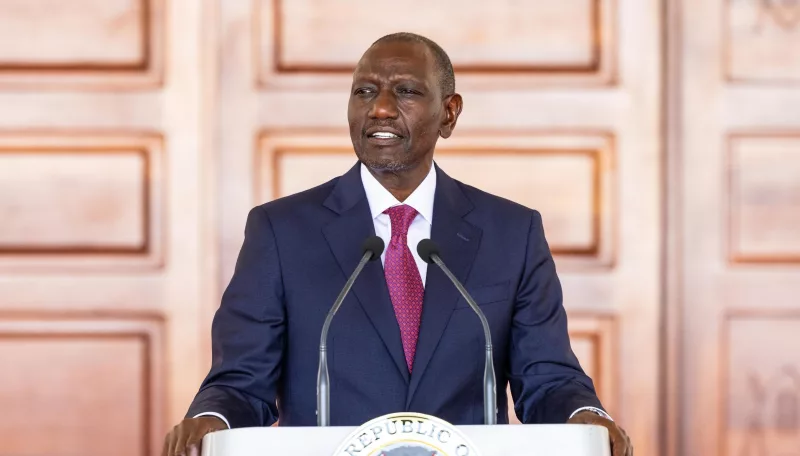
Speaking during the State of the Nation address in parliament, President William Ruto said the payment would ease the concerns caused by the debt that was issued in 2014.
“The debt has since become of much concern to the citizens, markets and our partners,” Ruto said.
Early this week, Kenya appointed Citi and Standard Bank as joint lead managers for a potential dollar-denominated debt in what experts view as a possible return to the Eurobond market.
"We should expect the country's creditworthiness to improve in the coming months as the government becomes clear on how it is going to repay the inaugural Eurobond. Investors are watching,'' Eliud Mbai of Standard Capital told the Star.
He added that the IMF staff agreement on a $938 million facility, a commitment by the government to pay $300 million in December and a positive microeconomic outlook have calmed investors' nerves.
"They were worried that Kenya would default,'' he said.
The 10-year bond priced at 6.78 per cent was issued in 2014 to fund infrastructure projects under the then-Jubilee administration.
Kenya took up $2.75 billion in two tranches – a 10-year paper at a 6.78 percent interest rate and a five-year issuance at 5.87 per cent.
The five-year paper was repaid partly using the proceeds of another $2.1 billion Eurobond issued in May 2019.
Yesterday, the IMF praised the country's economy for displaying resilience, with real GDP expanding by 5.4 per cent in the first half of 2023, primarily due to a robust recovery in the agriculture sector following the return of rains.
"In the fiscal year 2022/23, the primary deficit came in as expected at 0.6 percent of GDP, reflecting tight expenditure management in light of tax revenue shortfalls,'' IMF said.
It added the external current account deficit has narrowed, driven by a recovery in the tourism sector to pre-Covid-19 levels, resilience in remittances reductions in imports and real exchange rate depreciation.
"Headline inflation has fallen within the target range of 2.5–7.5 percent since July,'' IMF said.
Subject to the approval of the Washington-based fund's executive board, Kenya will have access to a total of $3.88 billion (Sh590 billion), which would bring its total funding under the existing Extended Fund Facility and Extended Credit Facility arrangements to $4.43 billion (Sh673 billion), the IMF said.
The current programme, agreed upon in April 2021, was first bumped up in May by an extra $1 billion, including $544 million under the IMF's Resilience and Sustainability Facility (RSF), and a new arrangement under the same RSF.
The fund will immediately disburse $682.3 million or Sh103.7 billion once the board approves the facility.
“The agreement is subject to IMF management approval and consideration by the Executive Board, which is expected in January 2024".