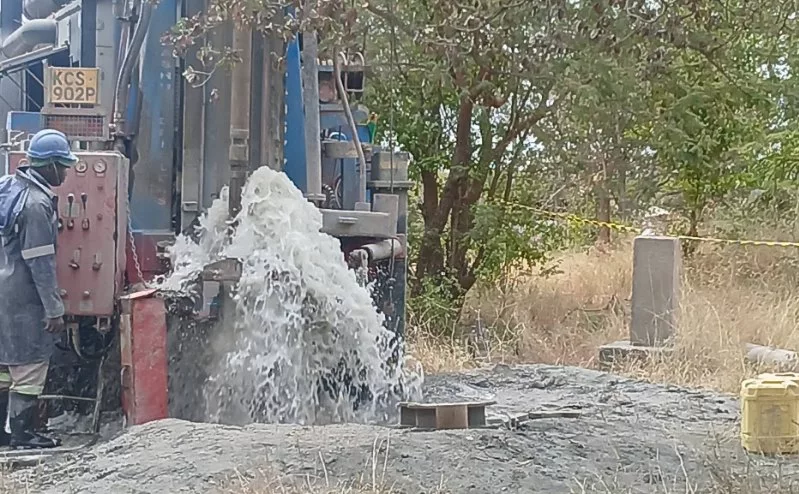
 The drilling of the borehole at Kyuasini Primary and Junior School in Masinga, Machakos county, on July 1, 2026 /GEORGE OWITI
For more than six decades, access to clean and safe water was a pipe dream for the residents of Masinga in Machakos county.
This was, however, resolved by an exercise that took just three days—the drilling of a borehole.
On July 1, residents, young and old, trooped to Kyuasini Primary and Junior School to witness the commissioning of a public borehole drilled by Habitat for Humanity Kenya, an NGO that implemented the Federal Ministry for Economic Cooperation & Development (BMZ) project.
For many residents in their seventies, this was their first time seeing clean water in a long time.
The 250 metre-deep borehole will supply the entire community of Kyuasini village with water for domestic use and irrigation.
It ends the 15-kilometre trek in search of water that has been the residents’ daily reality for decades.
"We are happy to see clean water today. We last saw clean water a long time ago when the only earth dam in this area dried up in 1970," Edward Nzioka said.
Since then, he said, residents have been walking more than 14 kilometres in search of water.
"Clean and safe water is seven kilometres from this village in a place called Thatha town. Residents trek at least 14 kilometres to and fro every single day. This borehole is a blessing. We are relieved of the hustle. God has answered our prayers after years of agony," Nzioka said.
Nzioka said before the borehole they relied on an earth dam that served livestock, wildlife and humans. This had made the water unsafe for domestic usage.
"We don't have clean and safe water for the public. Hundreds of residents are suffering. Our efforts to get a water source have been futile for ages. We are grateful for Habitat for Humanity Kenya for making this a reality," the 71-year-old Nzioka said.
Lucy Kakoi, another elderly resident, said the community had depended on Iuma River for water since she was young.
"My husband used to collect water from the river when I was young, married and pregnant. He used to carry a jerrycan of water on his back, trekking several kilometres to the water point and back home. I am grateful to the NGO as I will no longer struggle to get clean water," she said.
Born in 1955, Fransisca Kisili has watched generations of children, including her own, carry water from home to school. She hopes this will now be a thing f the past.
"We say ‘thank you’. I will no longer be collecting water from far, trekking many kilometres each day despite my old age, since this borehole will be connected to kiosks near our homes," she said.
Kisili said residents would carry water on their backs, or use donkeys and oxen.
"Our donkeys are relieved now. They won't be used to ferry water. We will sell them," she said.
Kyusini Primary and Junior School head Juliana Nzongoi said they were delighted to have the borehole drilled at the institution.
"As you can see, parents have come in large numbers since they are happy about this project. I am hopeful that this water will be of great help to us as a school," she said.
Nzongoi said the school had been struggling to grow trees, fruits and vegetables since the area is very dry.
She said often many children would miss school as a result of drought and its attendant challenges.
Nzongoi said some of their parents also find it difficult to buy their children the necessary items for the Competency Based Curriculum.
She said they will grow fruits and vegetables through the kitchen garden model to sell to support vulnerable children.
The head teacher said learners used to carry water from home to school for irrigating trees, crops and cleaning the school.
"Some of the learners trek about seven kilometres from their homes, making two trips in a day. This is 14 kilometres with jerrycans of water on their backs. By the time they get to class, they are tired and unable to concentrate on their studies. This affected their performance in class," Nzongoi said.
Once back home from school, the children would not get to rest as they would have to go looking for water for the home.
Sanitation was equally a challenge at the school for lack of water.
"We give girls sanitary towels daily. They should be bathing at midday, but they don’t since we do not have water. Girls get embarrassed whenever they are on their menses. Low self-esteem makes them fail to concentrate in their studies, and they end up performing poorly," Nzongoi said.
She said the school had been getting its water from an earth dam that is five kilometres away.
"Since we now have water in our school, we will educate parents on how to wash their hands. I hope that even diseases caused by dirt will be an issue of the past," Nzongoi said.
Masinga BMZ project coordinator Stellamaris Mumbua said the initiative was informed by the fact that Masinga subcounty continues to experience recurring drought, water scarcity, inadequate sanitation and limited livelihood opportunities.
She said access to safe water remains a significant challenge, with only 59 per cent of households accessing improved water sources.
"Poor sanitation infrastructure further exposes communities to health risks, while women and girls bear the greatest burden of water collection, often sacrificing time for education, economic activities and personal well-being,” Mumbua said.
“To address these challenges, Habitat for Humanity Kenya, in partnership with INADES Formation Kenya and Eastern Community Development Programme, is implementing the BMZ Machakos Integrated WASH and Livelihoods project."
She said the organisation carried out research that established that women, girls and men in Masinga walked at least more than a kilometre in search of water, children missed school to go fetch water, and the water problem had resulted in hunger due to lack of food.
"From that research, we saw the need to bring water in this area," Mumbua said.
The initiative combines water, sanitation and hygiene interventions with climate -smart livelihood strategies to build resilient and self-sustaining communities.
The project targets 14,652 residents across Thatha, Mukusu and Musingini sublocations. It seeks to improve public health outcomes, strengthen resilience to climate shocks, enhance household incomes and promote gender responsive development.
The initiative, which commenced in November 2025 and is expected to end in November 2028, also seeks to increase sustainable access to safe water, improved sanitation, hygiene and resilient livelihood opportunities.
"Under the water access component, the project aims to ensure that 3,325 households gain access to safe and reliable water by drilling three new boreholes and rehabilitating two existing boreholes, extending 16 kilometres of water pipeline infrastructure, improving community water governance and management," Mumbua said.
Mumbua said the drilling of boreholes marked a significant milestone in expanding access to safe and reliable water for communities in Masinga Subcounty.
The boreholes have been drilled in Kyusini Primary and Junior School, Mukusu Secondary School and Mukaleni Primary and Junior School.
Ukambani, consisting of Machakos, Makueni and Kitui counties, is a semi-arid region and lack of water for years has hit it hard.