It banks on volumes after founders' lessons from airtime vending project
by The Star
Audio By Vocalize
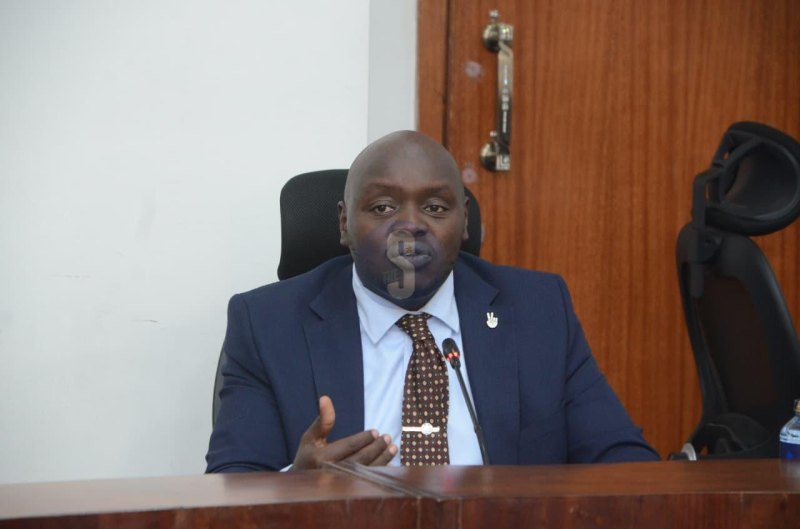
Kyanda Africa CEO and co-founder Collins Kathuli speaks during an interview at Kyanda offices on Thika Road in Nairobi
As an alumnus of Lukenya Boys High School, Collins Kathuli said that he regretted dropping business studies for computer studies.
“I didn’t know that computer would become a gateway to growing my skill in programming, although the choice was not well received by my principal and class teacher back then,” Kathuli said.
Kathuli is a 21-year-old inventor who saw an opportunity in the fintech space right from high school.
Right from presenting a telephone booth invention together with his partner turned co-founder Emmanuel Manani, at the first Young Scientist Kenya exhibition, to creating an airtime vending machine project.
“We started the airtime vending project but decided to hold on to it until when we finished our final exams,” Kathuli said.
“I started learning how to set up an app purely from online and embarked on doing everything necessary to make the project successful and ready to roll out.”
Kathuli and Manani successfully established an app for their airtime vending proposal, and this idea is what gave birth to their brainchild, Kyanda Africa.
Kathuli, the CEO and co-founder, is currently a third-year software engineering student at KCA University, while COO and co-founder Emmanuel Manani is a third-year business management student at Kenyatta University.
Kyanda Africa is a fintech startup that offers an app solution that aims to help users make all sorts of transactions at a low cost.
Kathuli spoke to the Star’s MELINDA KIRWA.
What was the motivation behind establishing Kyanda, and what does it mean?
Kyanda is a Kamba name that means a stream of a river. I grew up in a rural setting, next to a river, and here is where I always found my peace, whether it was swimming or relaxing on the river bank.
It is a stream of a river and now it is a stream of financial services. It just made sense to name it that way.
Kyanda Africa enables people to digitally send and receive money, pay bills as well as pay for goods and services.
We have a pre-existing ecosystem that we use to serve clients, which includes an API gateway, an agency network and a B2C mobile app that can be accessed by anyone.
We also have online and offline channels that we use to serve customers, which include a WhatsApp chatbot and a USSD code.
Initially, when we developed the app from our airtime vending proposal, it was not meant for commercial purposes.
The whole idea was to have our close friends utilise the platform to send each other airtime.
On the first day, we had 50 clients use the platform. It was a motivation to scale up so as to reach a wider audience.
We officially launched the platform in February 2020, and when Covid hit and things were closing down, we decided to add a wallet feature that would enable people to send money from wherever they were just to buy airtime.
Time went by and then we started seeing a lot of people sending and receiving money and realised that we had actually created an e-wallet for users to transact.
The numbers on the platform went up and the transactions were crazy.
We had sleepless nights as most of the transactions were being done manually.
When someone wanted to send money, we were seated on our computers, making sure that the transactions were complete despite still being fresh in the programming field.
It got to a point where we couldn’t handle the numbers, which forced us to source for external skillsets and automate our systems all over again.
In May 2020, we automated the process and people used the platform to send monies back and forth.
We aim to give customers access to financial services without having to incur high transaction costs
As a startup that is still growing, how is the support to upscale looking like so far?
We have a customer base of 5.7 million users from both Kenya and South Africa, but most of them come from Kenya.
We have never done any external fundraisers because we work with and around the profits we generate.
We are currently working on our agency network so that Kyanda will be in every corner of this country, ready to serve everyone.
I remember the first time when we started out, I only had Sh15,000, where Sh5,000 was for float.
When the numbers started growing, we were forced to source funds from family and friends, who willingly came on board, and we made sure that cash flows through the ecosystem.
It is only recently that we have started applying to different accelerators, applying to different competitions so we can get the funds to scale up quickly because technology is ever-changing.
We are currently reaching out to investors as well so as to keep up.
One of the main things I have learnt with investors is that they want to support someone who has participated in at least one accelerator programme.
Among the numerous accelerator programems we applied to last year was the Africa Startup Initiative Programme powered by Startupbootcamp Afritech.
We flew to Senegal but unfortunately out of three Kenyan startups that were present, we were the only group that was not chosen to proceed, but we did not give up.
We reapplied to the same accelerator programme and lucky enough, we are now among 10 other African startups that will be going through the boot camp that will be held in Dakar, Senegal.
We plan to explore the Senegalese market and possibly see if we can expand to West Africa as well as gain access to different mentors and investors.
Kyanda Africa team: COO and co-founder Emmanuel Manani, software developer Vincent Odhiambo, customer support representative Almaz Kireki, software developer Victor Githinji and CEO and co-founder Collins Kathuli pose for a photo at Kyanda offices in Nairobi
How did you end up launching in South Africa?
It all started when we were invited to the Kenya-South Africa Business Forum Pretoria, which took place in November 2021.
We attended and during interactions, we pitched our idea to delegates from both states, and we explained the solutions that we offer.
One thing we observed while we were there is that almost everyone we interacted with used debit cards to make transactions.
Someone walks into a barbershop, gets a haircut, and pays for it using their card.
For us, this was an opportunity.
We engaged with different sector players within the SA market to find solutions and ways to replicate the use of mobile money and make it suitable for their market.
We started talking to banks and relevant telcos, including Vodacom, MTN, Telkom and Cell C.
We approached the First National Bank as well as other smaller banks, who were welcoming and even took time to understand our solution because it was unique for them.
Another thing that we noted is that in SA, when someone had 10,000 ZAR and wanted to go and deposit the amount at the bank, they would get charged for the deposit.
As Kyanda, we introduced into the SA market a cheaper solution, where we don't charge to deposit.
We even developed Visa-enabled cards so they could match what was being used in the market.
The solution was very unique and new to them, such that a few months down the line, we got the support we needed, and in mid-June of 2022, Kyanda Africa officially launched in SA.
We have pending plans to open our physical offices in Mayfair, Jo’burg, in South Africa later this year.
For our skillset, in Kenya, we are currently a team of 10, while in SA, they are only five.
We have a very young team for both Kenya and SA, as 40 per cent of the workforce has graduated, while the 60 are yet to graduate.
What makes you different from other mobile money platforms?
We are a low-transaction cost model.
We aim to give customers access to financial services without having to incur high transaction costs.
If the other already existing players in the market lower their transaction costs, this will likely affect their business models.
From the word go, we have been wanting to give people the opportunity to save that extra coin.
With a lot of money being transacted online, the fees charged should make sense to the customer, and this is our biggest selling point.
Our other selling point is that we have an online and offline channel that is available to users with or without a Kyanda account.
If you are not a user, any Kyanda agent can transact money on your behalf.
We are looking to make the solution internationally available so that users can send and receive money abroad.
In a day, we make an average of 70,000 to 100,000 transactions across our entire ecosystem.
How does Kyanda operate?
A Kyanda user can go to any Kyanda-enabled merchant and give them money, which is then credited to their wallet.
This is also a unique selling point for us because we can even have the agent transact on behalf of the user in cases where a user is abled differently or is elderly.
Once the money is credited to a user's wallet, they are free to make use of the funds however they wish.
Transactions include transferring money from one Kyanda user to another Kyanda user, depositing at a Kyanda outlet, sending money through Kyanda or withdrawing money through Kyanda.
All this is done without a third party.
We have different low-cost transaction charges for different transactions.
For example, sending Sh 0-1,000 from Kyanda to Kyanda is free, while withdrawing at an agent costs Sh10.
If you send Sh 70,000 via Mpesa, you are charged Sh105, but as Kyanda, we will charge you Sh70. This is what we use to pay the agent. To us, the volumes are what matter most.
For our agents, we are creating a source of employment for them as we diversify their income. For each transaction, an agent is paid a certain commission.
Kyanda Africa makes money through transaction costs and commissions.
If money is flowing in the ecosystem, then that means that transactions are being carried out.
For our audience reach, we are targeting the youth most, especially university students who are trying to save up that little money they have, as well as low-income generating individuals in the informal sector.
We rolled our agency model last year and currently, we have Kyanda agents located in Naivasha, Nanyuki, Machakos, Mombasa and some parts of Nairobi, like Eastleigh.
We are trying to get as many physical agents to help us roll out this solution.
Our API gateway solution applies to any organisation that requires a payment solution.
Businesses can feel free to approach us so we can customise the solution for them.
Once we have received adequate support and licensing, expect us to be colouring Kenya with hot pink, our signature colour.
Kathuli during the interview
To the young innovative minds out there, if you have an idea that you know will be the ultimate solution to a problem, go ahead and start it. There is nowhere that is written a CEO must be 30 or 40 years old
What are some of your achievements and shortcomings, and what does the future hold for Kyanda?
We have won a number of awards, like the Fintech Innovator of the Year award at the AfricaCom event, and we have also received a number of local recognitions and awards from local organisations.
I have been honoured to represent Kyanda in a number of international events as well as boot camps, and I currently have an ongoing submission for the Forbes 40 under 40, among other nominations.
Governmental regulations have, however, become a challenge for us.
It got to a point where we were shut down by CBK because we were moving huge amounts of money and yet we were not licensed.
We did not have the knowledge that in order to operate, we required a number of special licences.
We were shut down for a while, and it was a lesson for us.
We were later introduced to authorities that issue the Payment Service Providers (PSP) licences we were looking for, and we are almost through with the acquisition of relevant licences.
Another challenge we face is explaining and convincing customers how our platform is different and efficient, as well as how they can utilise it.
We almost always prefer doing a demo so they can understand.
Eventually, we are determined to continue having Kenya as our HQ, but we want to be well-established in Kenya.
It all narrows down to how we can restructure ourselves and ensure we have the same vision.
To the young innovative minds out there, if you have an idea that you know will be the ultimate solution to a problem, go ahead and start it.
There is nowhere that is written a CEO must be 30 or 40 years old.
Explore and take advantage of the different hubs set up to support startups, pitch those ideas and make sure you leverage those opportunities because they are there for you.
This is premium content
Subscribe to Continue Reading
Help us continue bringing you unbiased news, in-depth investigations, and diverse perspectives. Your subscription keeps our mission alive and empowers us to provide high-quality, trustworthy journalism. Join us today to make a difference!