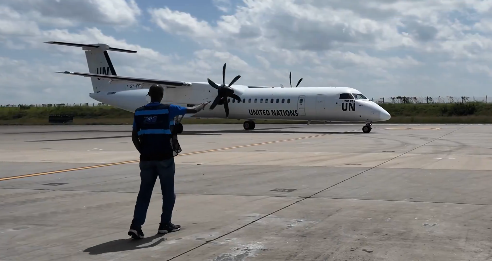
 UN aircraft leaving JKIA in Nairobi heading to DRC/ SCREENGRAB
The World Health Organization has airlifted nearly 11 tonnes of emergency medical supplies and equipment from Nairobi to support response efforts against the fast-spreading Ebola outbreak in the Democratic Republic of the Congo.
The supplies were dispatched from the WHO Emergency Preparedness and Response Hub in Nairobi with support from the United Nations Organization Stabilization Mission in the Democratic Republic of the Congo.
The shipment included personal protective equipment, diagnostic materials, sample collection kits and medical tents destined for Bunia in Ituri Province, the epicentre of the outbreak.
The emergency deployment comes as WHO intensifies international response efforts after declaring the outbreak a Public Health Emergency of International Concern.
WHO said the outbreak is linked to the rare Bundibugyo strain of the Ebola virus, for which there is currently no licensed vaccine or approved treatment.
According to the WHO, more than 500 suspected cases and about 130 suspected deaths have been reported in the DRC, although only 30 infections have so far been laboratory confirmed.
The outbreak has spread from Ituri Province to parts of North Kivu, including Butembo and Goma, while neighbouring Uganda has already confirmed imported cases.
At Nairobi’s Jomo Kenyatta International Airport, cargo handlers worked to secure and load the emergency supplies onto aircraft for immediate transit to eastern Congo.
Among them was Milton Oloo, a cargo loading agent who has worked at the airport for three decades.
Oloo said handling humanitarian cargo during health emergencies gives him a sense of purpose.
“What we are doing here today is to ensure that the cargo proceeding to the Democratic Republic of Congo is well handled and loaded carefully so it is not damaged,” Oloo said in a video shared by WHO Africa.
“I feel very proud because when lives are saved, I also feel happy,” he added.
WHO representative in DRC Anne Ancia said health workers are racing against time to contain transmission amid uncertainty over how widely the virus may already have spread.
She noted that early detection was slowed because initial tests focused on the more common Zaire strain of Ebola and returned negative results.
The outbreak was eventually confirmed after further testing in Kinshasa identified the Bundibugyo virus.
Health officials say symptoms including fever, vomiting, diarrhoea and fatigue initially resembled other illnesses, complicating diagnosis.
WHO said vaccines are still under evaluation, and any potential rollout could take at least two months.
The agency warned that controlling the outbreak will largely depend on community cooperation, awareness campaigns and adherence to public health measures, particularly around funerals and handling of bodies.
WHO has deployed more than 40 health professionals to support the government-led response in affected areas.
The outbreak is unfolding in a region already affected by insecurity, displacement and weak healthcare systems.
The United Nations High Commissioner for Refugees has warned that more than two million internally displaced people and returnees living in Ituri and North Kivu remain highly vulnerable as humanitarian agencies scale up response efforts.
![[PHOTOS] The new Ngong –Naivasha Road viaduct](https://cdn.radioafrica.digital/image/2026/06/64d4f771-4432-4aee-ba3c-2f304c4436ec.jpg)