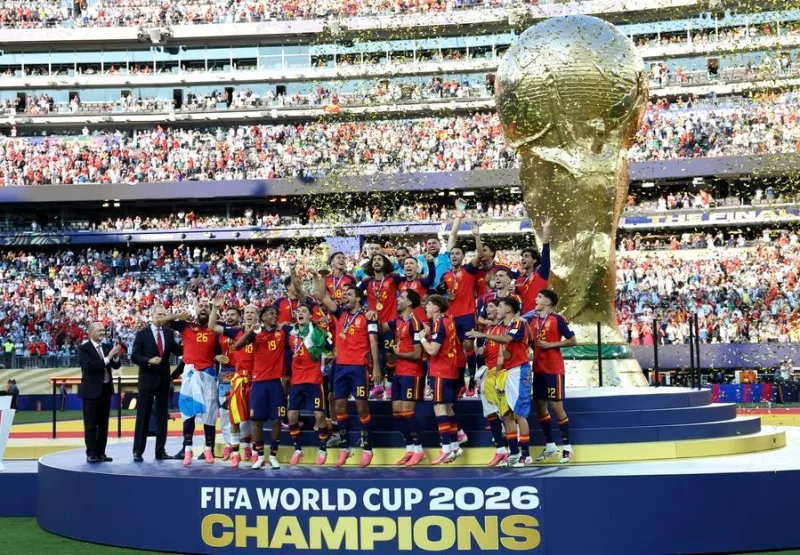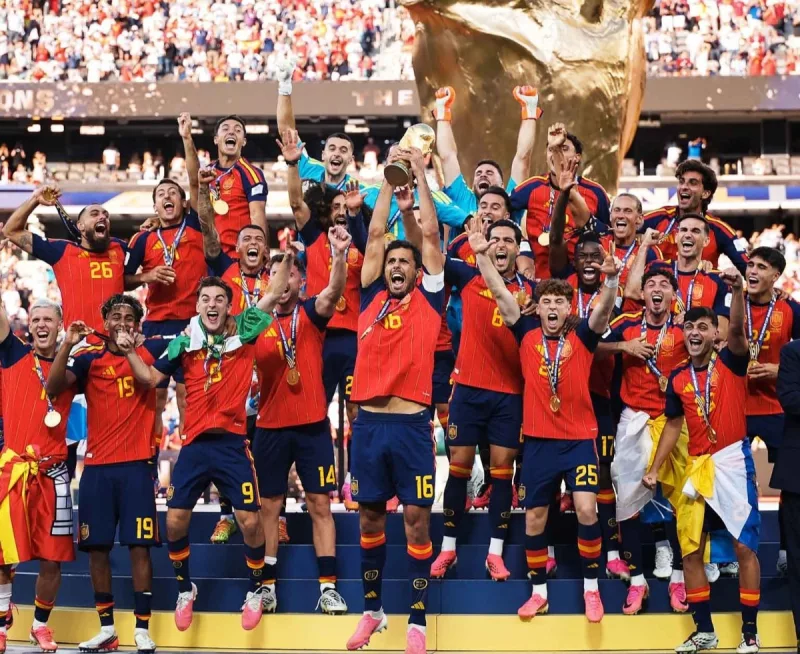


Spain have been crowned FIFA World Cup champions for the second time in their history after edging defending champions Argentina 1-0 in extra time in a gripping 2026 final at New York New Jersey Stadium on Sunday.
Substitute Ferran Torres emerged as Spain's hero, firing home the decisive goal in the 106th minute to cap a dominant performance and end Argentina's hopes of retaining the title they won in Qatar four years earlier.
Torres latched onto a clever-headed layoff from Nico Williams before drilling an unstoppable finish beyond goalkeeper Emiliano Martínez, finally breaking the resistance of an Argentine side that had defended resolutely for more than 100 minutes.
The triumph marked Spain's first World Cup title since their historic success in South Africa in 2010 and confirmed the country's return to the summit of world football following their UEFA Euro 2024 triumph.
Argentina's task became significantly more difficult moments before the end of normal time when midfielder Enzo Fernández was sent off after receiving a second yellow card for a reckless challenge on Pau Cubarsí. The dismissal forced Lionel Scaloni's side to play the entire period of extra time with 10 men.
Spain controlled possession for much of the contest, dictating the rhythm with patient passing and relentless attacking pressure. Luis de la Fuente's men enjoyed 65 percent possession and produced 20 shots compared to Argentina's two attempts, with the South Americans failing to register a single effort on target throughout the match.
Despite the defeat, Martínez delivered one of the finest goalkeeping displays ever seen in a World Cup final. The Aston Villa goalkeeper made a tournament-final record 11 saves, repeatedly frustrating Spain with a series of spectacular interventions.
Among his finest moments was a remarkable late stop to deny teenage sensation Lamine Yamal from a curling free kick in the closing stages of normal time, ensuring the match went into extra time.
Argentina's defensive problems mounted as the match progressed. Central defender Lisandro Martínez limped off shortly before half-time before fellow centre-back Cristian Romero was forced off with an injury in the 70th minute, leaving the reigning champions increasingly vulnerable to Spain's relentless attacks.
The victory completed a memorable campaign for Spain, who navigated the expanded 48-team tournament unbeaten and showcased the depth of a new generation combining youthful brilliance with tactical maturity.
For Argentina, the defeat brought an emotional end to another remarkable World Cup journey led by Lionel Messi. Having guided his nation to glory in 2022, the eight-time Ballon d'Or winner was unable to script one final triumph as Spain denied Argentina back-to-back world titles.
Spain's success also continued Europe's recent dominance on football's biggest stage. European nations have now won the last five FIFA World Cups, extending a run that began with Italy's triumph in Germany in 2006, followed by Spain in 2010, Germany in 2014, France in 2018, and now Spain again in 2026.
Historically, Brazil remain the most successful nation in World Cup history with five titles, followed by Germany and Italy with four each. Argentina remain on three championships, while Spain's latest triumph moves La Roja level with France and Uruguay on two World Cup crowns.
The 2026 edition also marked a new chapter for international football as the first World Cup to feature 48 teams. Co-hosted by the United States, Canada, and Mexico, the tournament expanded the global stage while delivering a final worthy of its historic occasion.
As Spain's players celebrated beneath the lights of MetLife Stadium with the famous trophy in their hands, a new golden generation etched its place in football history, ending a 16-year wait for another world title and reaffirming La Roja's status among the game's greatest international teams.