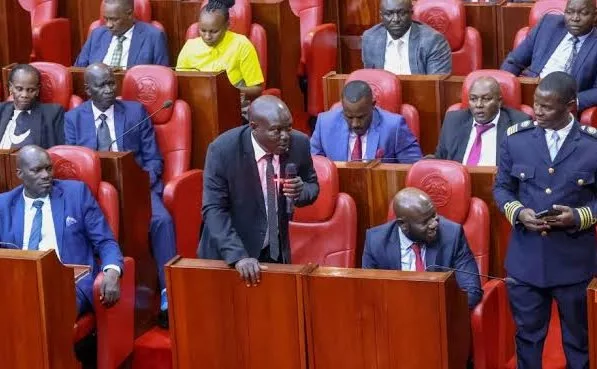
A fresh petition before the Senate is seeking a law to limit nominated MCAs to a single term.
The petition argues repeated nominations have turned affirmative action positions into political rewards instead of opportunities for marginalised groups.
The petition, presented by Senate Speaker Amason Kingi and sponsored by Nakuru resident Laban Omusundi, asks senators to enact legislation imposing a strict one-term limit on all nominated MCAs, without exceptions or transitional loopholes.
Omusundi argues the Constitution created party-list nominations to expand representation for marginalised groups, not to allow the same individuals to occupy the seats repeatedly.
The petition states that repeated nominations amount to "a deliberate subversion of the Constitution" by converting nomination slots into "a closed system of political reward and patronage".
It further argues the practice has denied opportunities to thousands of qualified Kenyans, particularly women, youth and persons with disabilities, who rely on the nomination system to access political leadership.
According to the petition, the continued recycling of nominated MCAs has four major consequences.
It allegedly turns public office into personal property, locks out deserving candidates, defeats the purpose of affirmative action and erodes public confidence in democratic institutions.
The petitioners also fault the absence of an express legal term limit for nominated MCAs, saying it has created a legislative gap that political parties have exploited.
"The absence of a statutory term limit for nominated MCAs has created a dangerous legislative vacuum, being exploited to capture and privatise constitutional opportunities," the petition says.
The petition compares nominated positions with elective offices, noting the President, governors and other elected leaders are subject to constitutional term limits to prevent the concentration of power.
It argues that it is "constitutionally inconsistent" for positions created to promote inclusion to become what it describes as lifetime entitlements through repeated nominations.
The petition warns that unless Parliament intervenes, nomination slots risk being permanently controlled by a small political class.
"Unless urgently addressed, nomination slots risk being captured permanently by a small, self-serving political class, thereby transforming a progressive constitutional safeguard into a tool of exclusion and injustice," the petition states.
The petition cites Articles 56 and 90 of the constitution as the legal basis for the proposed reforms.
Article 56 requires the state to establish affirmative action programmes that give minorities and marginalised groups greater opportunities in political representation.
Article 90 provides for party-list nominations to promote inclusive representation in elective bodies.
The petitioners argue these constitutional provisions were intended to broaden participation in leadership rather than benefit a few politically connected individuals.
They also told the Senate the matter is not before any court or constitutional body, making Parliament the appropriate institution to address the issue.
The petition therefore asks senators to enact legislation introducing a mandatory one-term limit for all nominated MCAs and make any additional recommendations necessary to uphold constitutionalism and the rule of law.
In a communication to the House, Speaker Kingi formally reported the petition and referred it to the Senate Justice, Legal Affairs and Human Rights Committee for consideration.
"Pursuant to Standing Order 238(1), I commit the petition to the Standing Committee on Justice, Legal Affairs and Human Rights," he said.
The committee has 60 calendar days to examine the petition, receive public views where necessary and table a report before the Senate for debate.
The debate is expected to reignite discussion over whether political parties have faithfully implemented the constitution's affirmative action provisions or instead used nomination slots to reward loyal supporters at the expense of broader representation.









![[PHOTOS] Ruto hosts Bungoma delegation at State House](https://cdn.radioafrica.digital/image/2026/07/38c18064-4bd7-4a52-9171-4dcce631a74b.webp)