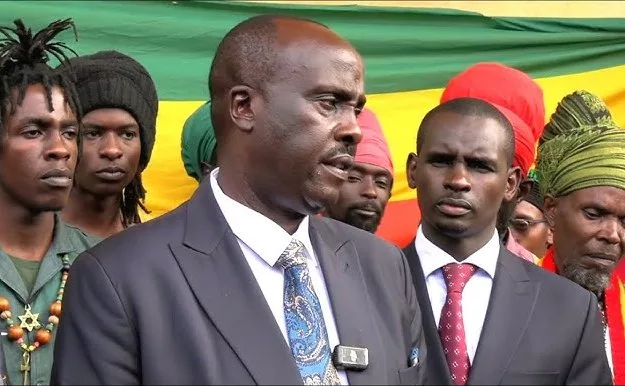
 Lawyer Danstan Omari addressing the media outside the High Court on Wednesday, July 15, 2026 /Handout
Lawyer Danstan Omari has said the High Court decision dismissing a constitutional petition seeking a religious exemption for Rastafarians to use cannabis will be challenged at the Court of Appeal.
Speaking after the ruling, Omari said his legal team disagreed with the decision but would first study the judgment before taking the next legal step.
"We don't agree with the decision of the learned judge, but we respect the decision that the judge has given," Omari said.
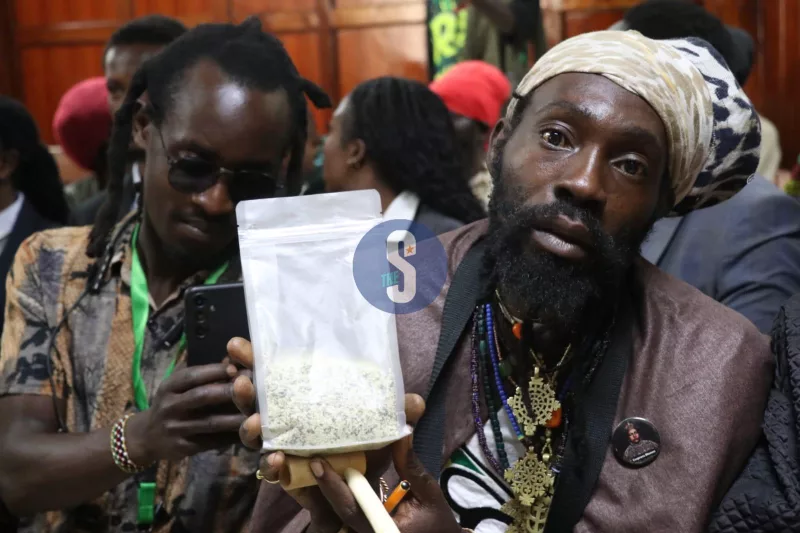
The petition had sought to protect what the lawyers described as the constitutional, statutory and fundamental rights of members of the Rastafari faith to practise their religion.
Omari said the legal team had not yet reviewed the court's reasoning at the time of his remarks, noting that the judgment would be examined in detail before formal instructions were taken from their clients.
"We'll go by word by word, paragraph by paragraph, page by page until the last page. Then we will get instructions from our clients, but definitely this matter is adding to the Court of Appeal," he said.
He argued that the case raises significant constitutional questions and indicated that the legal battle could ultimately reach the country's highest court.
"The jurisprudence in this country is that this matter raises serious constitutional issues, and we are determined to get the final decision from the Supreme Court," Omari said.
He added that they would seek to have the appeal heard by a seven-judge bench of the Court of Appeal.
"In our instructions, we shall be seeking that the President of the Court of Appeal... panels this matter with seven judges of the Court of Appeal so that they can hear this matter exhaustively," he said.
Omari also referred to decisions from other jurisdictions, saying similar issues had been addressed elsewhere.
"The jurisprudence from the South African Court of Justice and the Constitutional Courts and several countries have allowed what we are seeking," he said.
He further stated: "Kenya cannot be a barrier country. Kenya cannot be the only country that is harassing the Rastafarian people."
The High Court had earlier dismissed the constitutional petition filed by the Rastafari Society of Kenya, which sought a limited religious exemption allowing members of the faith to use cannabis as a sacrament during worship.
In its judgment, the court upheld the constitutionality of the Narcotic Drugs and Psychotropic Substances (Control) Act. It found that the petitioners had not proved that the challenged provisions violated their constitutional rights.
The court also held that any limitation of those rights was reasonable and justifiable in protecting public health and safety.
Although the court dismissed the petition, it observed that Kenya should begin a broader national conversation on the country's approach to cannabis, while maintaining that any policy changes should be made by the appropriate institutions rather than the judiciary.
Despite the setback, Omari maintained that the legal team would continue pursuing the matter through the appellate courts.
"We are ready and determined to pursue the ends of justice," he said.
He added that the case had remained before the High Court for more than seven years and expressed hope that the Court of Appeal would hear it within a shorter period.
"So the war is on. We are not covered by the decision of the judge, but we are determined to reverse that and bring the respect and dignity of the Rastafari movement in the Republic of Kenya," Omari said.