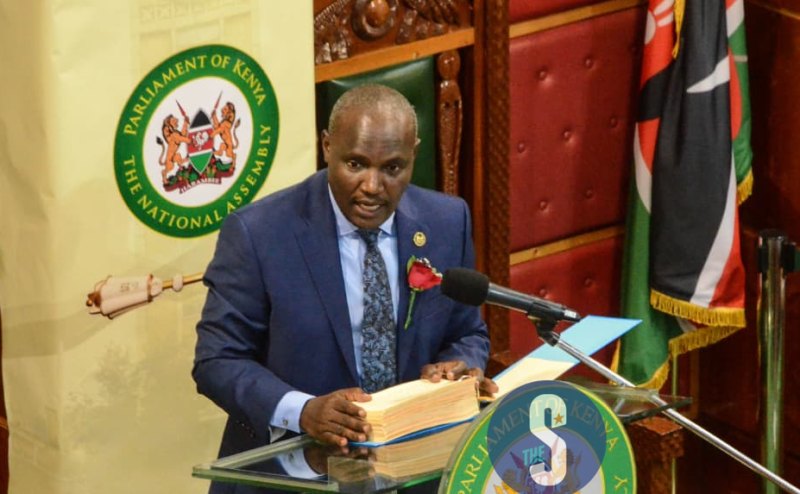
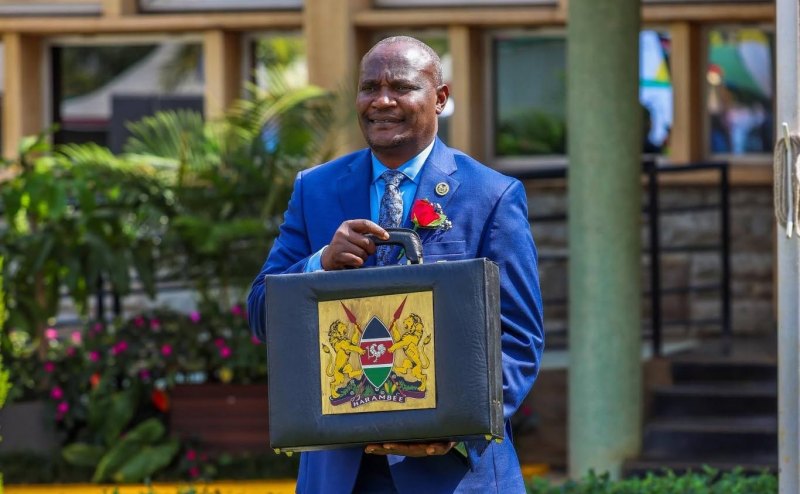
 Treasury CS John Mbadi presents the 2026-27 budget estimates in Parliament on June 11, 2026. /DOUGLAS OKIDDY
Thousands of intern teachers who have spent years demanding better pay and job security received a major boost on Thursday after the government committed funds to convert all 44,000 teachers currently serving under internship terms into permanent and pensionable employees.
Treasury Cabinet Secretary John Mbadi announced the allocations while presenting the 2026-27 Budget Statement in the National Assembly, describing the move as part of deliberate efforts to address teacher shortages and end the long-running uncertainty surrounding the internship programme.
The decision marks a significant breakthrough for thousands of teachers who have for months staged demonstrations and petitioned the government to be absorbed into permanent employment, arguing that they were performing the same duties as their permanently employed colleagues while earning a fraction of the pay.
Under the current arrangement, intern teachers earn a monthly stipend of Sh20,000, translating to a take-home pay of about Sh17,000 after statutory deductions, an amount many have described as inadequate given the rising cost of living.
Mbadi said the government had set aside Sh4.9 billion to convert 20,000 intern teachers into permanent and pensionable terms beginning January 2027.
The Treasury has allocated a further Sh8.2 billion to facilitate the absorption of the 24,000 teachers recruited earlier this year.
“I’m proposing Sh4.9 billion to be provided for conversion of 20,000 intern teachers into permanent and pensionable terms from January 2027. Further, the newly recruited 24,000 intern teachers will be converted into permanent and pensionable terms in July 2027,” Mbadi said.
The commitment means all 44,000 teachers currently serving under internship contracts are expected to transition to permanent and pensionable employment within the next financial year.
The announcement comes against the backdrop of an ongoing legal battle over the constitutionality of the internship programme.
On February 27, 2026, the Court of Appeal ruled that the Teachers Service Commission's internship programme was discriminatory and unlawful, finding that employing fully trained and registered teachers as interns on lower pay while assigning them the same responsibilities as permanently employed teachers violated fair labour practices and Article 27 of the Constitution.
The ruling was widely celebrated by intern teachers and labour rights advocates who viewed it as validation of long-standing concerns about unequal treatment within the teaching service.
However, the Teachers Service Commission appealed the decision, and on April 30, 2026, the Supreme Court issued stay orders suspending implementation of the Court of Appeal judgment and allowing the programme to continue pending determination of the appeal.
The internship programme was officially rolled out by the TSC in 2021 as a pathway for fresh graduates entering the profession.
That year, approximately 28,300 newly qualified teachers were recruited and deployed to schools across the country.
The programme expanded significantly in 2023 as the government accelerated implementation of the Competency-Based Education curriculum and the rollout of junior secondary schools, creating demand for additional teaching staff.
Today, the internship workforce consists of 44,000 teachers drawn from several recruitment cohorts, including 20,000 teachers deployed to junior secondary schools in 2024 and 2025 and a further 24,000 recruited in January this year.
The latest budget allocation signals a policy shift toward permanent employment and is likely to ease tensions that have fuelled repeated demonstrations by intern teachers over the past year.
Mbadi said the recruitment drive forms part of a broader strategy to strengthen the teaching workforce and improve learning outcomes across the country.
“By the time we reach next year, we would have employed 116,000 teachers. If you put it in terms of averages, over 20,000 teachers per year,” he said.
The teacher absorption programme is being supported by a record education allocation of Sh784.5 billion, making the sector the largest beneficiary of public spending.
The amount accounts for about 26.5 per cent of the national budget and reflects sustained government investment in education over the last four years.
Education funding has grown from Sh544 billion in the 2022-23 financial year to Sh628 billion in 2023-24, Sh657 billion in 2024-25, Sh702 billion in 2025-26 and now Sh784.5 billion in the 2026-27 fiscal year.
In just four years, funding to the sector has increased by roughly Sh240 billion, representing growth of more than 44 per cent and underscoring the government's efforts to expand access to education, strengthen institutions, support teachers and prepare learners for a rapidly changing labour market.
“Kenya's future depends on promoting strong human capital and, to this end, we will continue to strengthen quality learning, training and research, promote equity and inclusivity, scale up investment in education," Mbadi said.
Thursday's budget announcement may finally signal the beginning of the end of a contentious programme that has seen thousands of intern teachers wait for years to secure gainful employment.







![[PHOTOS] The Star, Chinese Embassy host Kenya-China media dialogue](https://cdn.radioafrica.digital/image/2026/06/215e29cd-5ca2-4faf-bb4e-d1686b2c3dad.jfif)