![[PHOTOS] Ruto holds talks with EU tech chief](https://cdn.radioafrica.digital/image/2026/06/a8cabd82-4f0b-49d2-bdd0-28e7cb2b3f5f.jpeg)
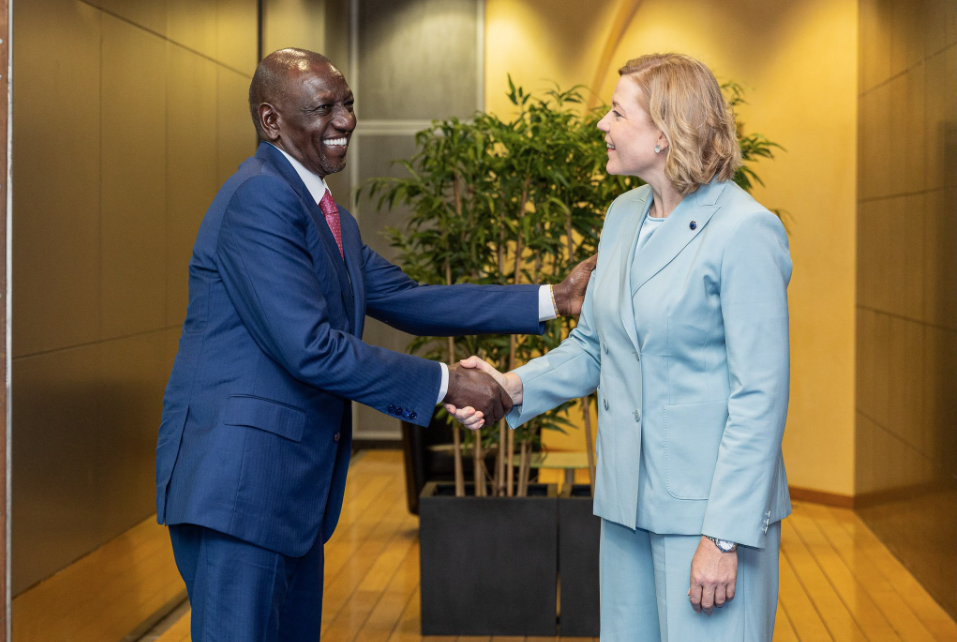
President William Ruto has called for a new era of mutually beneficial partnership with Belgium, urging European manufacturers to stop extracting raw materials and instead invest in local value addition.
Speaking at the Kenya-Belgium Business Roundtable in Brussels, Ruto emphasised that the relationship must evolve beyond historical paradigms of dependency.
"So let us be clear about the partnership we propose today," President Ruto stated.
"It is not built on dependency but on sovereign equality, not built on aid but on partnership that is mutually beneficial; and not built on extraction but on investment that generates value for all."
Reflecting on the historical ties between the two nations, Ruto noted that Belgium was among the first European countries to recognise Kenya's sovereignty back in 1963.
Six decades later, he argued, the conversation must expand to reimagine the broader partnership between Africa and Europe.
The President strongly challenged the global narrative that
views Africa through the lens of crisis, asserting that the continent holds the
keys to resolving major global challenges such as food security, energy
transitions, and shifting demographics.
"Africa is not part of the problem the world is trying to solve," Ruto declared. "On the defining challenges of our time - food, energy, climate, demography- Africa is in fact the larger part of the solution."
He highlighted Africa's formidable economic and natural assets, including abundant natural resources, vast clean-energy potential, two-thirds of the world’s remaining arable land, and the youngest population on earth.
"The world cannot feed itself – now and going into the future- without Africa’s land, nor can it power its future without Africa’s energy, or grow without Africa’s people," he added.
Despite this immense potential, President Ruto pointed out that Africa remains constrained by an outdated international financial architecture.
He identified three primary obstacles impeding continental development: severely limited access to concessional resources, unfairly high interest rates, and biased credit ratings that price African risk far above reality.
"Yet Africa cannot deliver this promise while shackled to a financial system designed for another century," Ruto argued.
Positioning Kenya as the ultimate entry point to the continent, the President explained that setting up operations in Kenya grants investors access to the African Continental Free Trade Area (AfCFTA), a market encompassing 1.4 billion people valued at $3.4 trillion.
When combined with regional and international trade agreements like the EAC, COMESA, the EU, and the UK, Kenya's preferential market access surges past $70 trillion.
Ruto issued a direct challenge to Belgian manufacturers to pivot their supply chain strategies: "So, I say to Belgian manufacturers: do not buy Africa’s raw materials to add value elsewhere. Come and build with us. Process Kenya’s minerals in Kenya and Africa, on clean power, and help Europe secure the supply chains it needs. Make it in Kenya. Make it in Africa. Make it clean. Sell it in Europe and to the world."
A major selling point for European investors is the landmark EU-Kenya Economic Partnership Agreement, which has been in force since July 2024.
As the only East African Community member to have ratified the deal, Kenya offers businesses permanent, duty-free, and quota-free access to the European Union market.
Ruto reminded the roundtable that the most credible endorsement of Kenya's business environment comes from the actions of major international corporations already on the ground.
He cited the Belgian Investment Company for Developing Countries (BIO), which has invested in Kenya for over 25 years, alongside major companies like Odoo, which chose Nairobi for its African headquarters, and Puratos, which services East Africa from a Kenyan plant.
Furthermore, environmental innovators like Sirona have built their first commercial-scale direct air capture site at Lake Elementaita, while Close the Gap has established a circular IT hub in Nairobi.
Following the roundtable, Ruto officiated the launch of the Kenya-Benelux Chamber of Commerce.
The new chamber is designed to act as a permanent bridge linking Kenyan enterprises directly with innovators, investors, and markets across Belgium, the Netherlands, and Luxembourg.

![[PHOTOS] Linda Mwananchi takes Trans Nzoia by storm](https://cdn.radioafrica.digital/image/2026/07/0d132395-ad4b-4671-867e-880c9f8144f5.webp)