


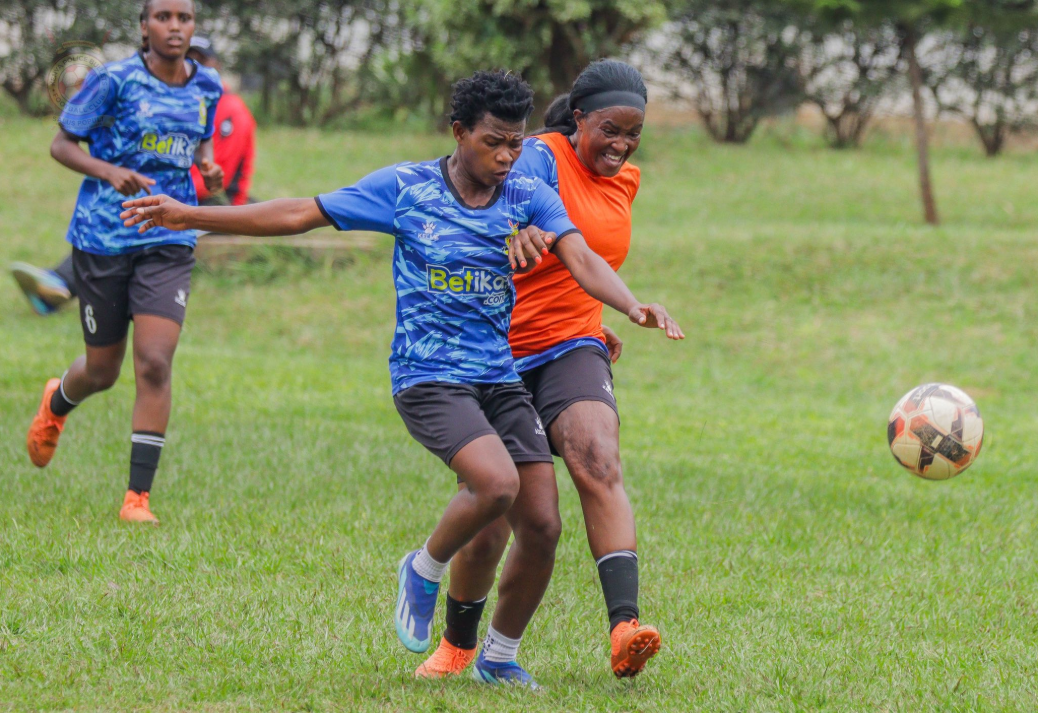
 Exploring the growing conversation around women’s football and why greater attention and investment are being called for. / FILE.
A Kenyan mother known as Ivy Winfrey on Instagram, whose 13-year-old daughter recently played against Mexico's Under-14 girls' national team in Mexico City, is raising a question she believes Kenyan football can no longer afford to ignore: Is the country doing enough to identify and develop talented girls of Kenyan descent growing up abroad?
The concern, shared in a social media appeal that has resonated with football enthusiasts, comes as federations across Africa increasingly turn to diaspora talent to strengthen their national teams.
Winfrey said watching her daughter take on Mexico was a surreal moment. The youngster, who holds dual citizenship and is eligible to represent Kenya, was facing the same nation that Kenya's Junior Starlets defeated 2-1 at the FIFA U-17 Women's World Cup in 2024 to secure the country's first-ever victory at a FIFA World Cup tournament.
But beyond the pride of seeing her daughter compete at a high level, she was left wondering whether Kenya has systems in place to identify young players like her.
“What does it mean to be eligible to play for a country that is not actively looking for you?” Winfrey posed.
Determined to play her part, the mother has launched an informal effort to connect young female footballers of Kenyan descent around the world.
“I’m not pretending to build a pipeline by myself. I’m doing the groundwork so if nothing else, my daughter knows her peers,” she said.
Winfrey has appealed to parents, coaches, relatives and community members to help identify girls aged between 14 and 17 who are eligible to represent Kenya and are growing up in different parts of the world.
The appeal comes against the backdrop of a growing trend in international football, where countries increasingly scout talent beyond their borders.
According to the mother, nearly one in three players at the 2025 Africa Cup of Nations grew up outside Africa. Countries such as Ghana have intensified efforts to recruit UK-born players of Ghanaian heritage, while DR Congo has become increasingly successful in attracting dual-national talent.
Nigeria's recent success in women's football has also been aided by the integration of players with dual nationality, reflecting a broader shift among African federations seeking to tap into talent developed abroad.
“Federations across the continent are paying attention. Can we?” Winfrey asked.
Her concerns come at a time when Kenyan women's football is enjoying some of its most successful years.
The Junior Starlets made history by qualifying for the FIFA U-17 Women's World Cup and recording Kenya's first-ever victory at a FIFA tournament. The Harambee Starlets have also secured qualification for the 2026 Women's Africa Cup of Nations after a decade-long absence.
Those achievements have demonstrated that Kenya possesses the talent needed to compete internationally.
However, the mother's appeal has reignited debate over whether sufficient investment is being made in scouting networks, talent identification programmes and pathways that connect eligible players abroad with Kenya's national teams.
Thousands of children of Kenyan descent are growing up in football systems across the United States, Canada, the United Kingdom, France and Spain, among other countries. Many are eligible to represent Kenya, yet questions remain about how many are known to football authorities and whether mechanisms exist to identify them early enough.
Supporters of diaspora recruitment argue that the conversation should not be framed as a choice between local and foreign-based players.
Instead, they say, the objective should be to widen the talent pool available to Kenya while continuing to invest in local player development.
The success of the Junior Starlets under coach Mildred Cheche demonstrated that locally developed players can compete on the world stage. For many observers, diaspora talent would complement rather than replace that foundation.
As global interest and investment in women's football continue to grow, the mother's appeal has added fresh urgency to a conversation about the future of the game in Kenya.
The question she poses is simple but significant: if talented Kenyan girls are emerging around the world, does Kenya have the structures in place to find them before someone else does?








![[PHOTOS] Red carpet in Pretoria as Ruto begins South Africa visit](https://cdn.radioafrica.digital/image/2026/06/abe3e750-6e5a-4394-a45c-899768be6240.jpeg)