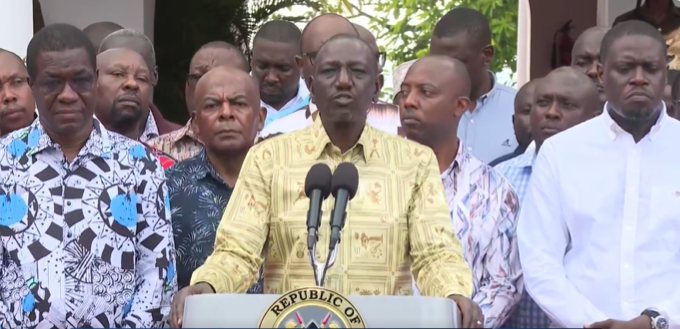
 President William Ruto addrssing the nation at State House Mombasa on May 22, 2026. /SCRERENGRAB
Diesel prices will drop by a further Sh10 per litre in the June-July fuel price review, President William Ruto has announced, signalling fresh government intervention to cushion consumers from the effects of rising global oil prices.
Addressing the nation from State House, Mombasa, on Friday, Ruto said the reduction forms part of a broader strategy to stabilise fuel prices and ease pressure on households, transport operators and businesses grappling with rising production and transport costs.
If implemented by the Energy and Petroleum Regulatory Authority (EPRA) in the next review cycle, diesel prices in Nairobi will fall to Sh222.86 per litre.
The President said the government had already spent Sh15.72 billion in fuel stabilisation measures in the May-June cycle after the Iran crisis triggered turbulence in global oil markets, pushing up the cost of crude oil, freight, insurance and logistics worldwide.
“These interventions have protected millions of Kenyans from even more severe economic hardships. I have further directed that in the next pricing cycle, we are going to reduce the price of diesel by a further Sh10 to help stabilise pump prices and provide additional relief to consumers,” Ruto said.
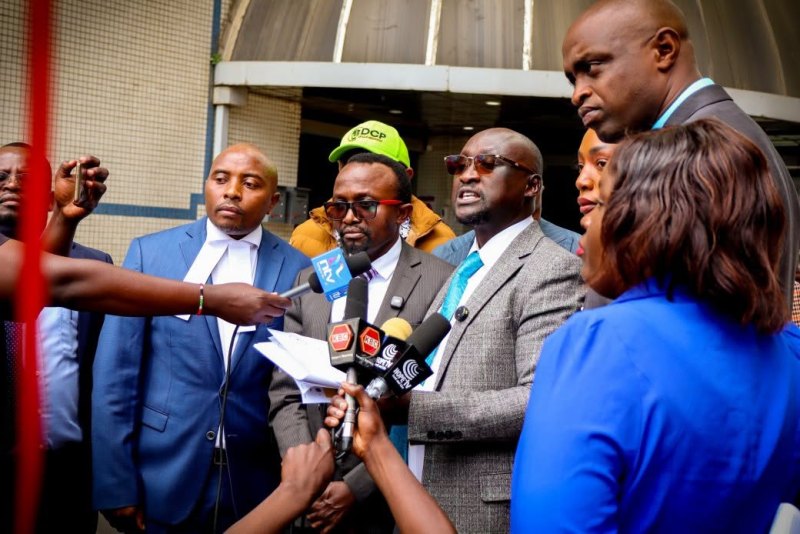
The President said the decision was arrived at following lengthy consultations with leaders from the transport sector on Thursday.
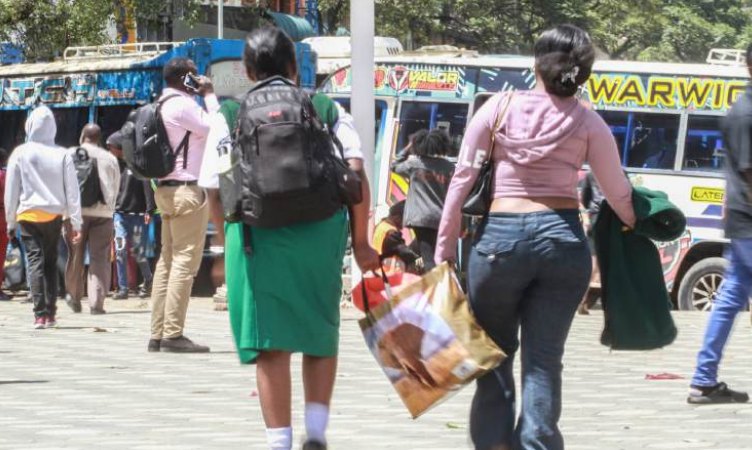
The latest commitment comes barely days after a nationwide transport strike paralysed movement across major towns and cities, forcing thousands of Kenyans to walk long distances to work after matatus, online taxi operators, cargo transporters and motorcycle riders withdrew services in protest over soaring fuel prices.
The strike, organised by the Transport Sector Alliance, followed EPRA's May 14 fuel review which increased the price of Super Petrol by Sh16.65 per litre and Diesel by Sh46.29.
The adjustments pushed pump prices in Nairobi to Sh214.25 for Super Petrol and Sh242.92 for Diesel, sparking outrage among motorists, transport operators and consumers already struggling with a high cost of living.
The shutdown disrupted businesses, schools and supply chains, piling pressure on the government to intervene.
In response, the government convened talks with transport stakeholders and announced a Sh10.06 reduction in diesel prices while increasing kerosene prices to narrow the gap between the two products and minimise the risk of fuel adulteration.
Although operators initially rejected the concession, insisting it fell below their demand for a reduction of between Sh30 and Sh35 per litre, a subsequent meeting resulted in the suspension of the strike for seven days to allow negotiations to continue.
The government has consistently maintained that the current fuel crisis is largely a result of global geopolitical tensions rather than domestic policy failures.
Speaking during the address flanked by Energy CS Opiyo Wandayi, transport sector leaders and Nairobi Governor Johnson Sakaja, Ruto defended the government's approach and pushed back against calls by some leaders and stakeholders for the complete removal of taxes on fuel.
“We must stop and ask ourselves honestly, if we stop collecting these revenues entirely, what public services shall we stop funding?” he posed.
The President warned that eliminating fuel taxes would create major funding gaps across critical sectors of the economy.
He said road construction and maintenance projects would stall, fertiliser subsidy programmes that support food production would be jeopardised, security operations along Kenya's borders would face budget constraints, while schools and hospitals would suffer severe funding shortfalls.
“These are not easy decisions. Leadership requires us to make responsible decisions not only for today but also for the long-term stability of our economy and our country,” Ruto said.
His remarks mirror arguments previously advanced by Deputy President Kithure Kindiki and Treasury CS John Mbadi, who have both opposed calls to abolish fuel levies, arguing that the revenues finance essential public services and infrastructure projects.
The President further emphasised that Kenya was not alone in grappling with rising fuel costs.
“Because we do not know how long this crisis will continue or whether prices may even rise further in the months ahead, we must act with care, responsibility and sustainability in our mind,” he said.
“Every nation facing this crisis is being forced to make sacrifices. Kenya too is making sacrifices.”
Even so, Ruto acknowledged that the burden of the crisis should not fall disproportionately on ordinary citizens.
“The sacrifices must, however, be fair and sustainable,” he added.
The anticipated diesel reduction is expected to provide relief to public transport operators, manufacturers, farmers and logistics companies, sectors that rely heavily on diesel and have warned that prolonged high fuel prices could further push up the cost of living through higher transport and production expenses.
![[PHOTOS] The new Ngong –Naivasha Road viaduct](https://cdn.radioafrica.digital/image/2026/06/64d4f771-4432-4aee-ba3c-2f304c4436ec.jpg)