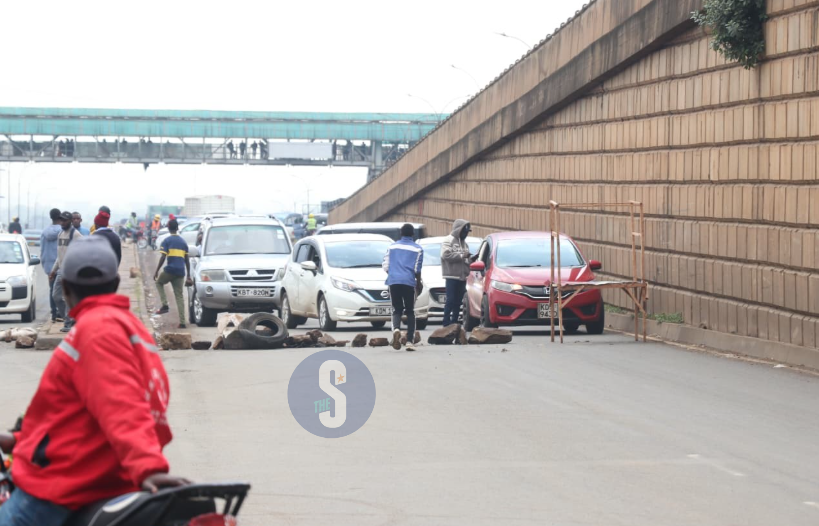
 Matatu operators barricade a section of the Roysambu roundabout as their nationwide protest over high fuel prices got underway, May 18, 2026. /LEAH MUKANGAI
Thousands of Kenyans were Monday morning forced to walk to work after a nationwide matatu strike paralysed public transport across major towns and cities, with operators protesting the sharp rise in fuel prices announced last week.
The disruption, which began at midnight on Sunday, saw most matatus remain parked in depots and residential areas as transport operators, private motorists and ride-hailing drivers joined what organisers described as the mother of all strikes in the transport sector in Kenya’s history.
As the shutdown took effect, the National Police Service moved to assure the public of safety and order, warning against disruption and unlawful conduct during the demonstrations.
In a statement issued by National Police Service spokesperson Muchiri Nyaga, the police said security measures had been enhanced across the country following reports of the planned strike.
“The NPS wishes to assure Kenyans of their security as they go about their duties. Security measures have been enhanced, and any disruptive conduct will be dealt with firmly and in accordance with the law,” the statement said.
Police urged members of the public to remain calm and continue with their daily activities, while encouraging cooperation with law enforcement officers.
The NPS also noted that the planned action had been organised by “a minority of matatu operators and a section of public service transport actors,” adding that the majority of transport stakeholders remained committed to operating normally.
Despite the assurances, Monday morning witnessed severe transport disruptions, particularly in Nairobi, Mombasa, Kisumu, Nakuru and Eldoret, where thousands of commuters trekked long distances to workplaces, schools and business premises after failing to secure public transport.
Several matatu saccos had earlier issued notices suspending operations ahead of the strike.
Forward Travellers SACCO announced that operations would remain suspended on Monday in solidarity with motorists protesting the fuel price hike.
“We apologise to our commuters for the inconvenience caused and pray for a quick solution that will lead to reduced fuel prices,” the SACCO said.
Super Metro also suspended services, informing passengers that operations would resume once the situation stabilised.
In several estates in Nairobi, stranded commuters were seen forming long queues from as early as dawn while others opted to walk for kilometres into the city centre.
On routes where a few matatus were still operating, commuters had to contend with paying nearly double the normal fare.
Even then, some passengers were forced to complete their journeys on foot after drivers and conductors declined to enter certain areas for fear of confrontation from striking operators.
“Hii ubaro anythime kunaweza thoka. After hii squad narudisha gari mtaani,” a conductor in a matatu plying Jogoo Road said.
The conductor explained that tensions remained high among operators who viewed colleagues continuing to operate as betraying the strike.
The nationwide shutdown was organised by the Transport Sector Alliance, bringing together passenger transport operators, cargo and logistics firms, ride-hailing services, motorcycle transport operators, tourism transport providers, driving schools, school buses and private motorists.
In a joint statement issued Sunday after a consultative meeting, the alliance said all transport subsectors had unanimously resolved that “no vehicle will move starting midnight today.”
“The Alliance confirms that all transport subsectors, covering passenger transport, cargo and logistics, ride-hailing, motorcycle transport, tourism transport, driving schools, school buses and private motorists have resolved to stand together in one of the largest coordinated industrial actions in Kenya’s history,” the statement said.
The alliance argued that the rising cost of fuel was hurting not only transport operators but ordinary Kenyans through higher food prices, transport costs and electricity expenses.
“This action is not only for transport operators, but for every Kenyan citizen. The ordinary mwananchi is the ultimate victim of high fuel prices, paying more for transport, food, electricity, and essential commodities,” the statement added.
The strike follows the latest fuel price review announced by the Energy and Petroleum Regulatory Authority on May 14.
Under the new review, the price of Super Petrol increased by Sh16.65 per litre while Diesel rose by Sh46.29 per litre. Kerosene prices remained unchanged.
Following the adjustments, Super Petrol in Nairobi now retails at Sh214.25 per litre, Diesel at Sh242.92 and Kerosene at Sh152.78 until June 14.
Motorists and transport operators have termed the increases excessive and unreasonable, arguing that Kenya’s fuel prices remain significantly higher than those in some neighbouring and landlocked countries despite fuel imports entering the region through the Port of Mombasa.
The Transport Sector Alliance cited Ethiopia as an example, arguing that comparisons with other East African states were misleading because some neighbouring countries had adjusted their prices upward by benchmarking against Kenya.
“Kenya should not continue paying some of the highest fuel prices in the region while countries such as Ethiopia, despite being landlocked, maintain significantly lower pump prices,” the alliance said.
The group claimed the nationwide solidarity across transport subsectors had given the strike a “99 per cent success rate.”
Private motorists also joined calls for Kenyans to keep vehicles off the roads in solidarity with public transport operators.
The Online Taxi Association announced a boycott of digital taxi services nationwide on Monday, saying the action was aimed at supporting the matatu sector demonstrations and pressuring the government to lower fuel prices.
“Solidarity Boycott Action: No online taxi operations nationwide. Reason: Supporting the matatu industry demonstration. Urging the government to lower fuel prices,” the association said.
The online taxi body also announced a second phase of protests planned for Tuesday, May 19, involving a full drivers’ strike and street demonstrations against ride-hailing applications.
“Reason: Protesting unfair pricing by digital taxi apps and demands adjustment of ride fares to match the high cost of living. Lower app commissions to cover rising driver expenses,” the statement added.
The transport paralysis extended beyond commuting, with some schools cancelling physical classes and advising teachers to conduct lessons online while non-essential staff worked remotely.
Some businesses also delayed opening operations as workers struggled to access transport.
The strike revived memories of previous transport demonstrations that have in the past resulted in confusion, injuries and clashes in some urban centres, prompting heightened police deployment in key transport corridors and business districts.
By Monday morning, uncertainty remained over how long the shutdown would last, with operators insisting they would maintain pressure until the government addressed concerns over fuel prices and the rising cost of living.
Even as police maintained that the majority of transport stakeholders had not joined the strike, the widespread disruption witnessed across the country underscored the central role public transport plays in Kenya’s economy and the ripple effect fuel costs continue to have on businesses and ordinary households.