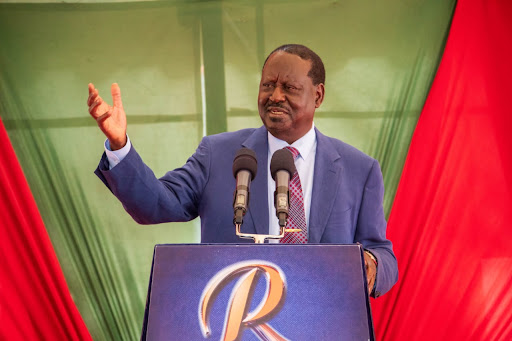
The documents show zero allocation to the former Prime Minister, a budget usually funded under the State House votehead.
However, Raila’s widow, Ida Odinga, will for her
lifetime continue to receive half of what the former Prime Minister earned as a pension, in line with the law.
The statute provides that upon the death of an entitled
person who was receiving a pension, the surviving spouse “shall be entitled to 50
per cent of the pension.”
In cases where there is more than one spouse, the
benefits are shared equally among them.
Even so, budget documents indicate that the state will
no longer cater for salaries and personal allowances of staff who worked for
Raila starting July 1, effectively closing a chapter on the publicly funded
support structure that had been maintained since his retirement from active
government service.
In the current financial year, which is drawing to a
close, taxpayers met some of the former Prime Minister’s expenses to the tune
of Sh58 million.
The allocations included Sh12 million for employees’ salaries,
Sh1.2 million for utilities such as water and electricity, Sh1.8 million for
domestic travel, Sh14.8 million for rent, Sh1.5 million for hospitality, and
Sh15 million for insurance costs.
The state also facilitated the former premier with Sh5.1
million for fuel and Sh3.8 million for routine maintenance of vehicles and
other transport equipment.
Under the Retirement Benefits (Deputy President and
Designated State Officers) Act, the former Prime Minister was entitled to a
full complement of support staff.
These included three drivers, a personal
assistant, an accountant, two secretaries, two housekeepers and two senior
support staff.
A retired premier is also entitled to two gardeners, two
cooks, two cleaners and armed security guards upon request.
Other benefits
outlined in the law include diplomatic passports for the entitled person and
their spouse, provision of an office and office equipment, and maintenance
expenses for official vehicles.
In addition, entitled persons enjoy access to VIP
lounges at all airports within the country, a privilege extended as part of the state’s recognition of their former office.
Earlier in March, about 90 workers who had been attached
to Raila were laid off, although sources indicated that
most were not part of the official retirement benefits package.
The dismissals
nonetheless stirred debate in political circles, given that many of those
affected were long-serving aides with close ties to the former premier.
The developments now signal a broader winding down of state-backed facilitation with only the legally
protected spousal pension remaining in force.
Meanwhile, the budget estimates tabled in Parliament on
Thursday show that the National Treasury has allocated Sh49
million to retired Vice President Moody Awori.
The allocation for Awori includes Sh20 million for
insurance costs, Sh12 million for rent and Sh9 million for employees’ salaries,
reflecting continued State support for former holders of the vice-presidential
office.
Former Vice President Kalonzo Musyoka has been allocated Sh47.8 million to cater for
his expenses.
The breakdown includes Sh4 million for fuel and vehicle
maintenance, Sh15 million for insurance costs and Sh1.7 million for
hospitality.
He will also receive Sh2 million for domestic travel and
subsistence, Sh1.7 million for utilities such as water and electricity, and Sh9
million for staff salaries.
Among retired leaders, former President Uhuru Kenyatta
has the highest allocation at Sh260 million for the period starting July 1.
Of this amount, Sh87 million is earmarked for employee
salaries, Sh56 million for travel — comprising Sh20 million for domestic and
Sh36 million for foreign trips — and Sh13 million for hospitality services.
Uhuru’s office has also been allocated Sh18 million for
insurance, Sh22 million for fuel and Sh16 million for routine maintenance of
vehicles and other transport equipment, underscoring the scale of facilitation
accorded to former heads of state compared to other retired senior officials.



![[PHOTOS] The new Ngong –Naivasha Road viaduct](https://cdn.radioafrica.digital/image/2026/06/64d4f771-4432-4aee-ba3c-2f304c4436ec.jpg)