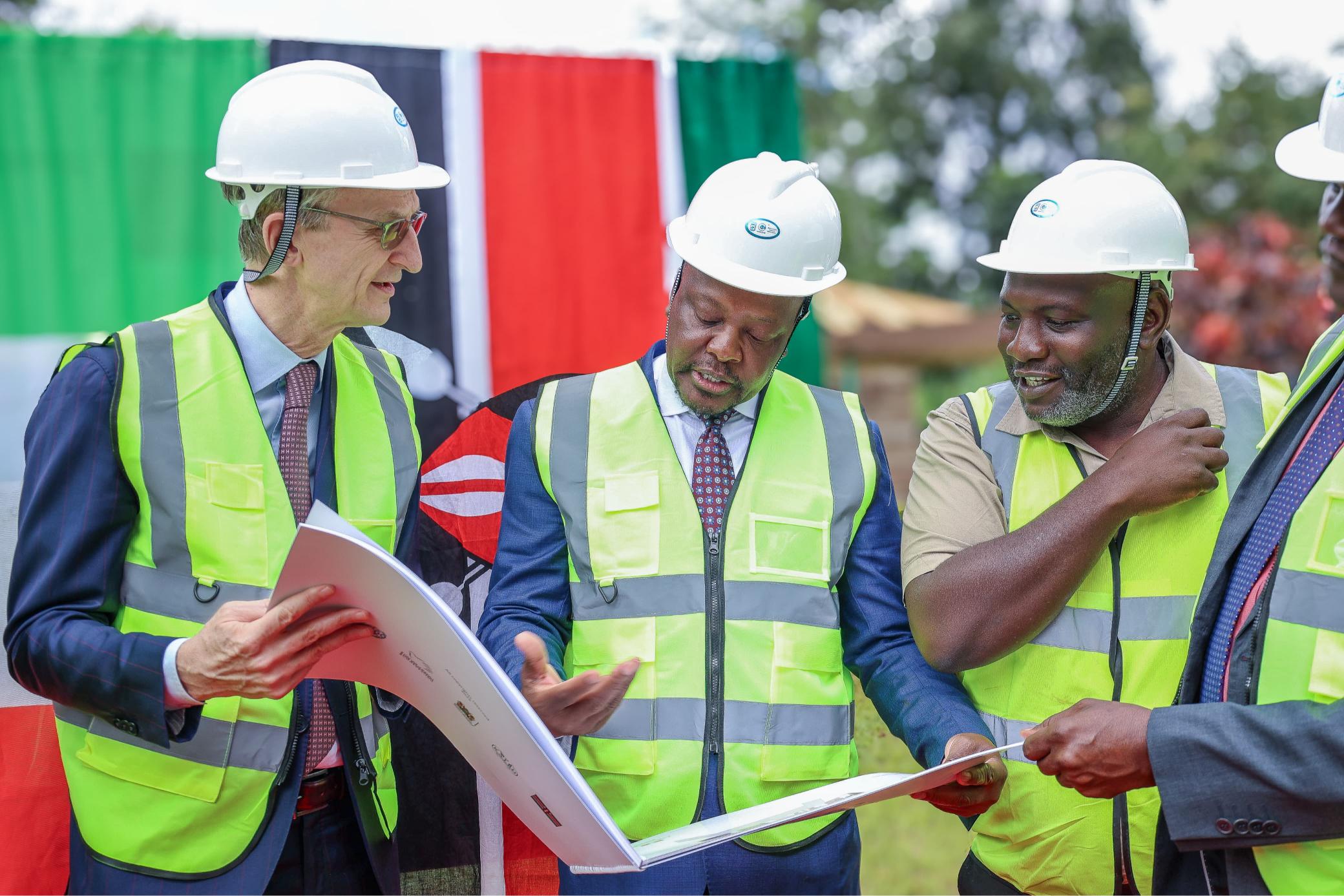
 Agriculture Cabinet Secretary Mutahi Kagwe and Stefano
Gatti, Director General for Italian Development Cooperation, during the
groundbreaking of the Coffee Training and Research Centre at KALRO’s Coffee
Research Institute, a Kenya–Italy partnership aimed at boosting farmer skills,
quality and production. /AGATHA NGOTHO.
Agriculture Cabinet Secretary Mutahi Kagwe and Stefano
Gatti, Director General for Italian Development Cooperation, during the
groundbreaking of the Coffee Training and Research Centre at KALRO’s Coffee
Research Institute, a Kenya–Italy partnership aimed at boosting farmer skills,
quality and production. /AGATHA NGOTHO.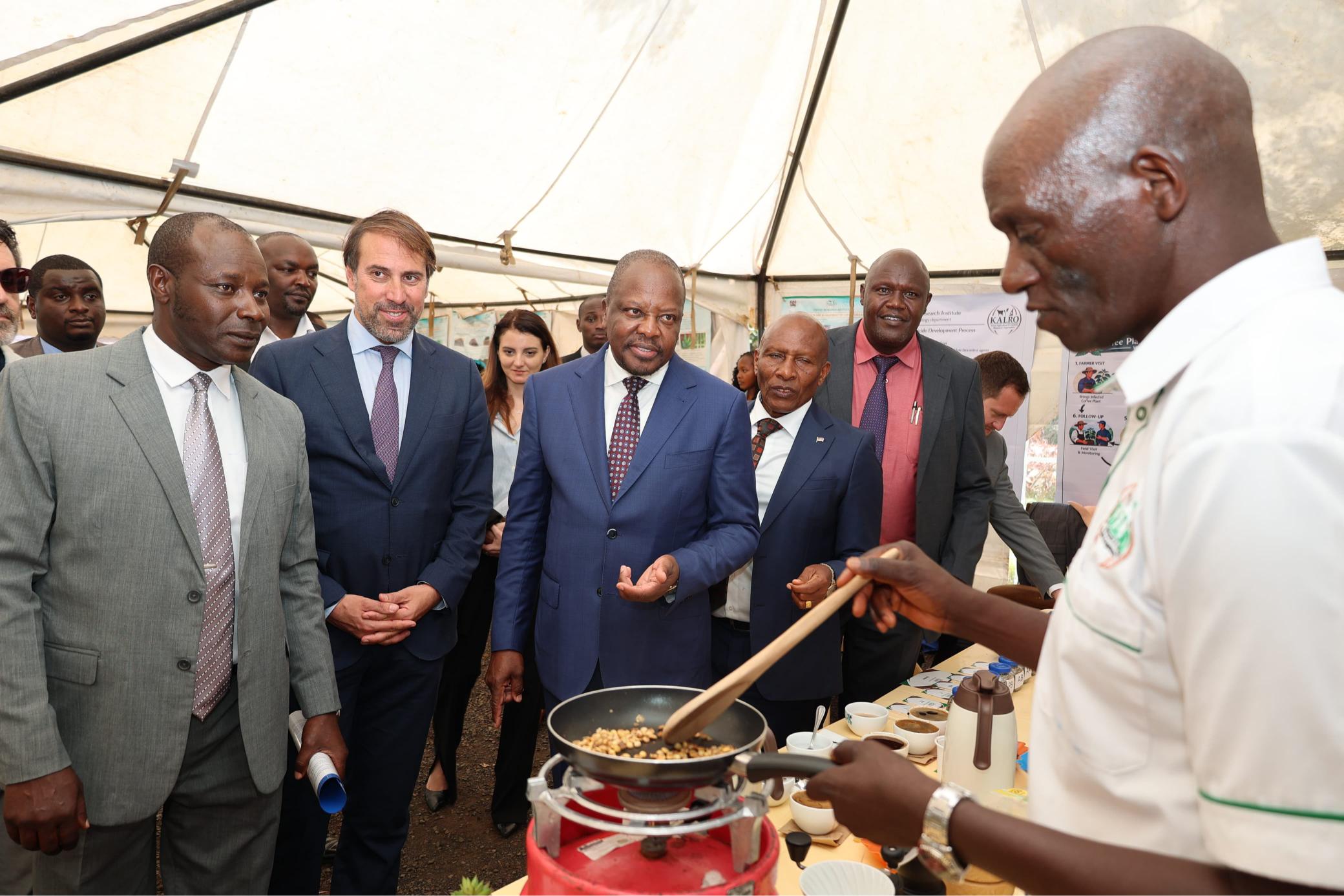 Agriculture Cabinet Secretary Mutahi Kagwe, KALRO Chairman Dr Thuo Mathenge, KALRO Director General Dr Patrick Ketiem and other officials listen as a Coffee Research Institute researcher explains coffee roasting and quality control processes./AGATHA NGOTHO.
 Kenya is pushing to revive its once-thriving coffee sector through a renewed focus on farmer training and research to reverse decades of decline.
The plan involves a new law and international partnerships.
Central to the push is the planned Coffee Training and Research Centre to be established at the Kenya Agricultural and Livestock Research Organisation (KALRO).
The centre is being developed with support from the Italian government.
The facility is expected to rebuild
farmer knowledge, improve coffee quality and ultimately boost production.
Speaking at the groundbreaking ceremony,
Agriculture CS Mutahi Kagwe said the government aims to double
production from the current 49,000 metric tonnes to levels last seen in the
1990s.
Data from the Agriculture and Food
Authority shows that production has fallen sharply from about 150,000 metric
tonnes in the late 1980s and early 1990s, largely due to high costs, ageing
trees, low returns, and land fragmentation.
“The newly signed Coffee Act will
anchor the revival strategy,” Kagwe said. “It establishes a Coffee Board and a
Coffee Research and Training Institute, expanding the current mandate of CRI.
Farmer education and research will be critical in reversing the decline.”
Kagwe noted that while increasing
volumes is a priority, Kenya will maintain its reputation for high-quality
speciality coffee.
“We must invest in farmer training,
research and climate-smart practices. Productivity per tree matters more than
acreage expansion.”
KALRO director general Dr Patrick Ketiem said coffee remains a lifeline for smallholder farmers, contributing
to rural development, foreign exchange and employment.
The CRI, established in 1944 and integrated
into KALRO in 2014, continues to drive research and innovation across the
sector.
“The training centre will empower
farmers, youth and agripreneurs to improve productivity, enhance quality, and
access better markets,” Ketiem said.
The centre will also strengthen
links between research, extension services, and industry players, ensuring
scientific innovations reach farms.
Research technologist Ezekiel
Njoroge said quality begins at the farm.
“Soil fertility, proper nutrition,
and harvesting only ripe cherries determine final quality. From sorting and
fermentation to drying and grading, every step matters.” Premium grades, such
as AA and AB, fetch higher prices, highlighting the importance of proper
handling.
The partnership with Italy is built on shared values.
“This is not just business; it is about supporting farmers while strengthening global supply chains. Italy is investing millions, including €80 million (Sh13 billion) in climate financing aligned to agricultural transformation,” Italian Development Cooperation director General Stefano Gatti said.
The government is also targeting new regions in the Rift Valley and parts of the north with climate-resilient varieties.
CRI produces about 200,000 seedlings
annually, but demand is in the millions, prompting plans to scale up production
with private sector nurseries.
Kagwe said access to
finance remains critical.
“Coffee farming requires long-term
investment with delayed returns. Financial institutions must develop products
aligned to the agricultural cycle to make coffee profitable again.”
Njoroge urged the promotion of local
consumption.
“Farmers often sell their best
coffee and keep the rejects. We want Kenyans to roast and enjoy quality coffee
at home, creating a more stable domestic market.”
Global coffee consumption continues
to rise, offering Kenyan producers a ready market.
With targeted training, improved seedlings, and international support, the government hopes to restore both production and quality, ensuring the sector benefits farmers, the economy, and Kenya’s global reputation.



![[PHOTOS] The new Ngong –Naivasha Road viaduct](https://cdn.radioafrica.digital/image/2026/06/64d4f771-4432-4aee-ba3c-2f304c4436ec.jpg)