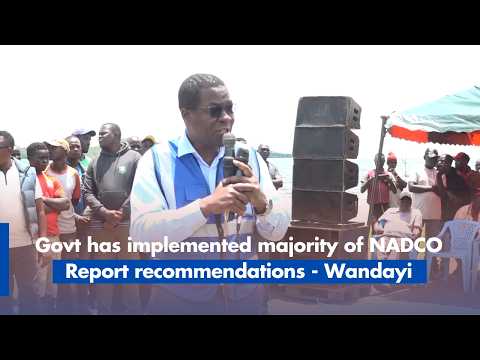
Govt has implemented majority of NADCO Report recommendations - Wandayi
5mon agoadminvideo
The demands focused on economic relief, anti-corruption measures, government accountability, job creation and social services reforms.


Audio By Vocalize

Now 2 years down the line, from the
Anti-Finance Bill GenZ Demonstrations. Were the 49 Demands or so as we saw
then, by the Gen Z being met by the Broad-Based Government under the 10-Point
Agenda?
Article 37 of the Constitution of Kenya, 2010,
envisages the Right to assembly. During the 2024
#RejectFinanceBill protests in Kenya, Gen Z circulated a memorandum of about 49 demands directed
to the government. The
demands focused on economic relief, anti-corruption measures, government
accountability, job
creation
and social services reforms.
In a nutshell. The Gen Z demonstrations
evolved from rejecting the Finance Bill into a broader push for lower taxes,
anti-corruption, reduced government spending, better public services, and youth
employment opportunities.
These demands were segmented into 7 thematic areas:
1. Economic and Tax Reforms.
2. Government Accountability and Political Reforms.
3. Governance and Institutional Reforms.
4. Education Reforms.
5. Health and Social Programs.
6. Employment and Youth Opportunities.
7. Youth and Economic Empowerment.
These demands necessitated the push to have an MOU
signed between the Late Rt Hon Raila Odinga as the Party Leader of the Orange
Democratic Movement and the Principal of the Azimio coalition, then and H.E.
President William Ruto as the Party Leader of the United Democratic Alliance and
the Principal of the Kenya Kwanza Coalition.
The tenets of the MOU encompassed the 10-Point Agenda,
which actually enshrined the demands of not only Gen Z but also the concerns of
Kenyans that had arisen before the establishment of the National Dialogue
Committee (NADCO), and the Committee had given its report. The Report, which
was submitted in November 2023 and later adopted by Parliament in February 2024,
had a raft of recommendations.
The 10-Point Agenda included;
1. Full Implementation of the NADCO Report.
2. Inclusivity in all spheres of public life.
3. Protecting and Strengthening Devolution.
4. Promoting and strengthening the livelihood of the
youth.
5. Leadership and Integrity.
6. The
right to peaceful assembly as enshrined under Article 37 of the Constitution of
Kenya, and compensation for victims of protests and riots.
7. The
national debt.
8. Fight
against corruption.
9. Stopping
wastage of public resources and promoting Government efficiency.
10. Protecting
and promoting the sovereignty of the people, the rule of law, and
constitutionalism.
The Broad-based Government has achieved the following for
each of the 10 agenda items.
1. Full Implementation of the NADCO Report.
The
National Dialogue Committee (NADCO) Report, adopted by Parliament in February
2024, proposed constitutional, legal, policy, and administrative reforms to
strengthen electoral justice, constitutional governance, multi-party democracy,
the entrenchment of key development funds, and the establishment of key State
offices.
Status on
Implementation.
I.
Parliament
received 9 Bills, of which:
a) 3 Bills have been enacted into law, including the
Independent Electoral and Boundaries Commission (Amendment) Bill, 2023, the
Statutory Instruments (Amendment) Bill, 2023 and the Ethics and Anti-Corruption
Commission (Amendment) Bill, 2023;
b) 2 under mediation, including the Elections (Amendment)
Bill, 2023 and the Election Offences (Amendment) Bill, 2023; and
c) 4 under consideration by Parliament. These include the
Constitution of Kenya (Amendment) Bill, 2023, the Political Parties (Amendment)
Bill, 2023, the National Government Coordination (Amendment) Bill, 2023, and the
Leader of Opposition Bill, 2023.
II.
The
IEBC (Amendment) Act, 2024, was enacted on 9th July, 2024, enabling
reconstitution of the electoral commission.
III.
A
selection panel completed recruitment of commissioners, and new IEBC
commissioners were sworn in on 11th July, 2025.
IV.
The
Commission has since conducted by-elections and commenced mass voter
registration.
V.
The
Elections (Amendment) Bill, 2024, and the Election Offences (Amendment) Bill,
2024 remain under mediation by Parliament.
VI.
The
IEBC has commenced the process that will lead to the delimitation of electoral
boundaries.
Fidelity to
Political Parties and Multi-Party Democracy.
Constitutional amendments to strengthen multi-party
democracy, fidelity to political parties, and protection against interference
with parties and coalitions are under consideration by Parliament.
Entrenchment of
Funds into the Constitution
I.
The
Constitution Amendment Bill on the entrenchment National Government
Constituency Development Fund, National Government Affirmative Action Fund,
Senate Oversight Fund and County Ward Fund, is under consideration by
Parliament.
II.
The
Court of Appeal has already determined that NG-CDF does not violate the
Constitution.
III.
The
County Wards (Equitable Development) Bill, 2024, is under consideration by the
Senate.
Establishment and
Entrenchment of State Offices.
The Constitution of Kenya (Amendment) Bill, 2024,
contains provisions for the entrenchment of the offices of the Leader of the
Official Opposition and the Prime Cabinet Secretary.
2. Inclusivity in all spheres of public life.
Promoting inclusivity ensures that all Kenyans,
regardless of gender, ethnicity, disability, or socio-economic status, can
participate in and benefit from national development.
Status on
Implementation.
I.
Launch
of the National Policy on Ethnic Minorities and Marginalised Communities
(2025-2035).
II.
KSh500
million scholarship programme for children from marginalised communities.
III.
KSh200
million annually allocated for education infrastructure in marginalised areas.
IV.
Creation
of a Directorate for Minorities and Marginalised Communities in the Executive
Office of the President.
V.
Measures
to reduce the cost of living include the fertiliser subsidy, which lowered
prices from KSh7,000 to KSh2,500 a bag.
VI.
Youth
empowerment initiatives, including the NYOTA programme and the Hustler Fund,
are expanding access to entrepreneurship support, skills development and
affordable credit for young people and small businesses.
VII.
Financial
support through the Youth Enterprise Development Fund has been enhanced to
include asset finance for the youth.
VIII.
Timely
payment of social protection stipends alongside government salaries has
improved disbursement and circulation of money. Payments have shifted to mobile
money platforms to enhance efficiency and reduce fraud, while 550,000
beneficiaries have been integrated into the Social Health Authority (SHA).
IX.
The
Equalisation Fund allocation to support development and service delivery in
marginalised areas has increased from KSh5 billion to KSh9.6 billion with a
projection of its increase to 15 billion in the FY 2026/2027.
X.
The
rollout of the universal health coverage (UHC) by transitioning to the Social
Health Authority (SHA) has increased healthcare insurance cover from 7 million
to 29.8 million beneficiaries under SHA to date.
XI.
107,831
Community Health Promoters deployed nationwide, enhancing access to primary
healthcare.
XII.
SHA
premiums for 1.5 million indigents under the social protection programme are
being paid for by the Government.
XIII.
100,000
teachers recruited since 2022. With 24,000 of them having been hired in January
2026.
XIV.
Teacher-to-student
ratio improved from 1:45 to 1:29.
XV.
23,000
classrooms and 1,600 laboratories are under construction.
XVI.
A
student-centred university funding model providing up to 95% scholarships and
loans for needy students.
XVII.
Streamlined
Competency-Based Curriculum (CBC) by reviewing and transitioning it to Competency-Based
Education and Training (CBET).
XVIII.
University
allocation increased from KSh45 billion to KSh82 billion.
XIX.
HELB
and scholarship funding increased to KSh41 billion.
XX.
260,000
affordable housing units under construction across the country, with 4,888
completed homes advertised for sale and student hostels with 177,686 bed
capacity under construction.
XXI.
450
modern markets are being constructed nationwide.
XXII.
6,000
km of roads under construction nationwide, improving connectivity, and
promoting inclusivity by linking underserved regions to economic opportunities
and markets.
XXIII.
Expansion
of the Last Mile electricity connectivity programme, improving livelihoods in
rural communities.
3. Protecting and Strengthening Devolution.
The Broad-Based Government continues to strengthen
devolution through increased county funding, timely disbursement of resources
and enhanced financial autonomy.
Status on Implementation.
The equitable share of revenue to counties increased
from KSh385 billion in FY 2024/2025 to KSh415 billion in FY 2025/2026, and is
projected to rise to KSh450 billion in FY 2026/2027.
County Assemblies granted financial autonomy through
the County Public Finance Laws (Amendment) Act, 2025, assented to on 13th
August, 2025, guaranteeing their financial independence.
The County Wards (Equitable Development) Bill, 2024,
is under consideration by the Senate.
4. Promoting and Protecting the Livelihood of the Youth.
Status on
Implementation.
I.
The
National Youth Opportunities Towards Advancement (NYOTA) programme has created
opportunities for over 820,000 young entrepreneurs aged 18-29 years (up to 35
years for persons with disabilities) across all 1,450 wards, with 50:50 gender
parity, 5% participation from refugee and host communities, and 5%
representation of persons with disabilities.
II.
NYOTA
supports youth through skills development, recognition of prior learning,
on-the-job experience, entrepreneurship training, start-up capital and
mentorship.
III.
More
than 600,000 youth entrepreneurs are being trained under AGPO to enhance access
to government procurement opportunities and financing through the Youth
Enterprise Development Fund, Uwezo Fund, Hustler Fund and Women Enterprise
Fund.
IV.
The
Youth Enterprise Development Fund has been strengthened to include asset
financing for young entrepreneurs.
V.
The
Broad-Based Government has established Jitume Digital Labs in TVET institutions
across 290 constituencies to support youth participation in the digital
economy.
VI.
Additional
employment initiatives have created large-scale opportunities for youth:
5. Leadership and Integrity.
The Broad-Based Government continues to strengthen
transparency, accountability and ethical leadership in public service.
Status on
Implementation.
The Conflict-of-Interest Act, 2025, assented to on
30th July, 2025, is now operational. The Act strengthens integrity and
transparency by regulating and preventing conflicts between public officials’
private interests and their official duties.
6. The
Right
to Peaceful
Assembly
as enshrined under Article 37 of the Constitution of Kenya, and Compensation for victims
of protests and riots.
Status on
Implementation.
I.
The
Broad-Based Government has allocated KSh2 billion in the first Supplementary
Budget of FY 2025/2026 for compensation of victims of protests.
II.
Identification
of victims has been completed by relevant institutions, including IPOA and the
Kenya National Commission on Human Rights (KNCHR).
III.
From
2023 to 2025, IPOA handled 820 cases of alleged police misconduct during public
order management, securing convictions in 35 cases involving 49 officers, and
recommending disciplinary action against 30 officers.
IV.
The
Demonstration Bill, which proposed restrictions on the right to assembly and
protest, was withdrawn.
V.
The
Ministry of Interior and National Administration has issued policy directives
limiting excessive use of force and strengthening training and re-tooling of
police officers for lawful crowd management.
7. The National Debt.
The Broad-Based Government has prioritised responsible
debt management, reduced borrowing, and strengthened fiscal sustainability
through liability management, alternative financing mechanisms and improved
domestic revenue mobilisation.
Status on
Implementation.
I.
The
Broad-Based Government has reduced reliance on external borrowing by exploring
innovative financing mechanisms for public infrastructure and development
projects.
II.
Successfully
undertaken a series of Eurobond buyback transactions in February 2024, February
2025, October 2025 and February 2026, smoothing the repayment profile of
sovereign obligations and eliminating near-term default risks.
III.
Commissioned
a comprehensive forensic audit of public debt by the Office of the Auditor
General to strengthen transparency, verify the utilisation of borrowed funds
since independence, and reinforce public confidence in debt management.
IV.
The
Broad-Based Government has established the National Infrastructure Fund (NIF)
to mobilise blended financing from public and private sources, including
capital markets, pension funds and other institutional investors, to reduce
reliance on public debt in the execution of major national infrastructure
development projects.
V.
Kenya
is leveraging and monetising mature public assets to finance future
infrastructure investments.
VI.
The
Public Private Partnership (PPP) framework has been re-designed to attract
private investment in major infrastructure projects such as the Rironi-Mau
Summit Highway.
VII.
The
Central Bank Rate has been reduced to 8.75%, signaling improved macro-economic
stability, increased access to affordable credit and strengthened investor
confidence.
VIII.
Securitisation
of the Road Maintenance Levy Fund (RMLF) has enabled payment of pending
contractor bills dating back to 2021 and facilitated the revival of stalled
road projects.
IX.
Through
a Liability Management Framework, the Broad-Based Government has re-organised
the national debt portfolio to reduce refinancing risks and minimise the
likelihood of default.
X.
Kenya
has successfully negotiated debt re-arrangements with bilateral lenders,
freeing fiscal space for social and development programmes.
XI.
Moody’s
upgraded Kenya’s sovereign credit rating from CAA1 to B3, with a stable outlook
on 27th January, 2026, reflecting improved external liquidity,
stronger foreign exchange reserves and successful liability management measures
such as Eurobond buybacks.
XII.
Greater
emphasis has been placed on mobilising domestic revenue to finance development
and reduce dependence on debt.
8. The Fight against Corruption.
Kenya continues to combat corruption through a
constitutional and institutional framework anchored in the Constitution (2010),
the Anti-Corruption and Economic Crimes Act, the Ethics and Anti-Corruption
Commission Act, and coordinated action by administration of justice
institutions, including the EACC, DCI and the Office of the Director of Public
Prosecutions (ODPP).
Status on
Implementation.
I.
The
Conflict-of-Interest Act, 2025, assented to on 30th July 2025, is
now operational and strengthens transparency by regulating and preventing
conflicts between public officials’ private interests and their official
duties.
II.
Adoption
of an e-Government procurement system has digitised the entire procurement
cycle from planning to payment, enhancing transparency, reducing operational
costs, increasing supplier participation and strengthening audit trails that
deter corruption.
III.
Over
23,000 government services digitised on the e-Citizen platform (up from 353 in
2022), eliminating cash payments and middlemen, reducing corruption risks, and
increasing revenue collection.
IV.
The
Anti-Money Laundering and Combating of Terrorism Financing Laws (Amendment)
Act, 2025, assented to on 17th June, 2025, strengthens the legal
framework for combating illicit financial flows and supports Kenya’s exit from
the Financial Action Task Force (FATF) Grey List.
V.
The
Broad-Based Government continues to prioritise asset recovery and successful
prosecution of corruption cases, strengthening accountability across public
institutions.
VI.
From
the 2023/24 financial year to the second quarter of the current financial year,
the EACC has filed 143 asset recovery cases valued at KSh22.9 billion,
disrupted corruption schemes worth KSh27.4 billion, recovered assets valued at
KSh9.8 billion, completed 627 investigations, and secured 86 convictions.
VII.
Implementation
of Zero-Based Budgeting has enhanced fiscal discipline and accountability by
requiring justification of all public expenditures.
VIII.
The
Single Treasury Account system has consolidated government cash management,
improved transparency, reduced transaction costs and minimised idle public
funds in commercial banks.
9. Stopping wastage of public
resources and promoting Government efficiency.
The Government has implemented austerity measures,
strengthened financial management systems and digitised public services to
reduce wastage, improve efficiency and enhance transparency in public
expenditure.
Status on
Implementation.
I.
Austerity
measures were introduced, including the removal of budgets for the offices of
the First Lady, the Spouse of the Deputy President and the Spouse of the Prime
Cabinet Secretary.
II.
Non-essential
foreign travels suspended.
III.
A
12-month freeze on the purchase of new government vehicles, except for security
services.
IV.
The
Government-Owned Enterprises Act, 2025, assented to on 21st
November, 2025, will strengthen professional management of State assets,
eliminate non-performing corporations and improve efficiency.
V.
Over
23,000 government services digitised on the e-Citizen platform, improving
transparency and access to services and revenue collection.
VI.
Implementation
of a Single Treasury Account has consolidated government funds, improved
oversight and minimised idle balances in commercial banks.
VII.
Zero-Based
Budgeting was adopted from FY 2025/26, requiring all public expenditures to be
justified annually.
VIII.
Passports
and National Identification cards processing time has been reduced from one
month to one week, improving service delivery and eliminating brokerage and
corruption.
10. Protecting
and Promoting
the Sovereignty
of the People,
the Rule
of Law,
and Constitutionalism.
The Broad-Based Government continues to strengthen the
justice system and uphold constitutionalism by improving access to justice,
expanding judicial capacity and promoting transparency in court processes.
Status on
Implementation.
I.
The
Judiciary has recruited additional judicial officers, including 11 Court of
Appeal judges, 20 High Court judges and additional magistrates, to improve case
handling capacity and reduce backlogs.
II.
Judicial
mobility strengthened through procurement of vehicles for judicial officers.
III.
Supported
the Judiciary to establish new appellate court benches in Nakuru, Mombasa and
Eldoret to reduce case backlogs and bring justice closer to the people.
IV.
Provided
funding to the Judiciary for the operationalisation of mobile courts in remote
and under-served areas to bring justice closer to the people.
V.
Nationwide
e-filing system has been implemented, enabling paperless court processes,
remote case filing and virtual hearings.
VI.
The
Judiciary has achieved near compliance with the two-thirds gender rule, with
332 women judges and magistrates representing 47% of the bench.
VII.
Adherence
to court orders and decisions of the courts.
CONCLUSION.
It is evident, as the sky is blue, that out of the 49
demands of the Gen Z demonstration. Quite a sizable number of their demands
were met with the withdrawal of the Finance Bill 2024. Similarly, H.E.
President William Ruto reconstituted his cabinet, including firing part of his
cabinet and reorganising the state departments.
Additionally, through the broad-based arrangement, the
President in adhering to service delivery of Kenyans, the full implementation
of the 10-Point agenda and the BETA Plan as was in the manifesto, has met the
remaining 30 demands totalling to 45 of the 49 total demands of the GenZ having
been met by the broad-based government.
It is time for the youth and the Gen Z to fully
support and come out in big numbers to rally behind H.E. President William Ruto
and the broad-based government come 2027 for the remaining 4 or 5 demands to be
fully met in the 5 year remaining term and much more progress on the promotion and
protection of the livelihood for the youth to be fully enhanced and realized