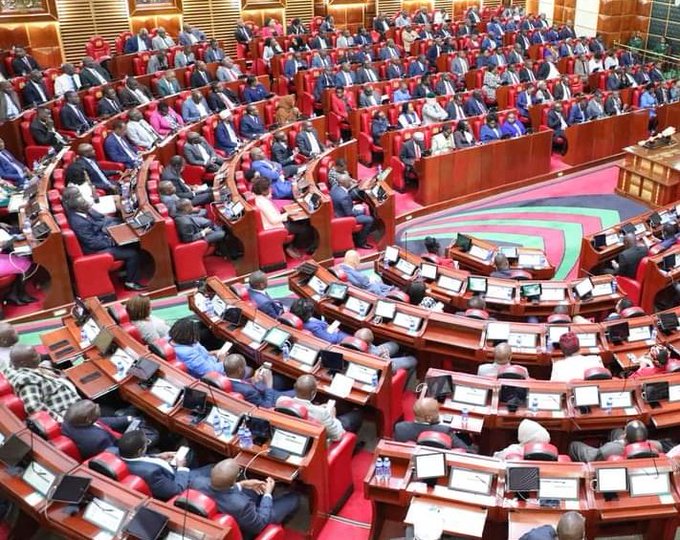
The National Assembly processed thousands of documents
and passed nearly two dozen major laws in the fourth session, which ran from
February to December 4.
The House capped off the busy legislative year with the
passage of significant laws and the approval of key government appointments.
The session focused on economic reform, social
protection, governance and compliance with international standards.
The 2025 parliamentary session was characterised by responding
to global pressures (money laundering, digital assets), as well as domestic
demands (housing, social welfare), and governance reforms (privatisation,
conflict of interest).
A total of 49 bills were introduced during the session,
with 23 successfully passed and assented into law.
Among the most notable included the Finance Bill, 2025, which
overhauled tax laws to offer employee relief, boost manufacturing, agriculture,
and incentives for telecoms, while widening the tax net.
The Excise Duty Bill removed 25 per cent duty on
imported electric transformers to lower electricity connection costs.
MPs also considered the Capital Markets Bill, giving
regulators flexibility to set shareholding limits for brokers, fund managers
and align with regional tariffs.
A Social Protection Bill passed in the period establishes
a framework for non-contributory social assistance.
It also created a National Board for Social Protection
to cushion vulnerable citizens against poverty and shocks.
MPs also amended 10 laws affecting money laundering, addressing
deficiencies identified by international watchdogs, and strengthened the
country’s financial integrity regime.
The Virtual Asset Service Providers Bill, which created the
first regulatory framework for cryptocurrency and virtual asset services, was
also passed.
It was viewed as a direct response to the country being
placed on the Financial Action Task Force’s (FATF) ‘grey list’.
The Privatisation Bill paved the way for efficiency and
broader ownership of public entities, and imposed parliamentary oversight in
the sale process.
Other significant laws passed include the Gambling
Control Bill, the Government Owned Enterprises Bill, the Conflict of Interest
Bill, and the Division of Revenue Bill.
The Conflict of Interest Bill consolidated laws on
personal interest and empowered the EACC to manage integrity in public office.
The Enterprises Bill paved the way for state
corporations to operate as commercial companies under the Companies Act for
better governance.
Computer Misuse and Cybercrimes Bill, which expanded
offences to include cyberbullying, promotion of extremism, cultism and phishing
via calls or emails, was also approved but not taken off following a court challenge.
The House approved 56 nominees to critical state offices
through 25 special motions.
These included Cabinet and principal secretaries,
ambassadors, and members of independent commissions such as the Central Bank of
Kenya, the Independent Electoral and Boundaries Commission (IEBC), and the
National Police Service Commission.
Additionally, the House approved 2,030 nominees to the
National Government Constituencies Development Fund (NG-CDF) committees across
all 290 constituencies.
During the period under review, MPs posed 130 questions to
Cabinet secretaries and independent offices.
Key issues addressed included the disbursement of NG-CDF
and school capitation funds, the status of the Road Maintenance Levy Fund, and
the criteria for classifying hardship areas for civil servants.
In international engagements, the assembly approved the
ratification of nine treaties and agreements.
These included a Comprehensive Economic Partnership with
the United Arab Emirates, an agreement to eliminate double taxation with
Singapore, and treaties related to marine biodiversity conservation and
fisheries subsidies.
The session also saw intense scrutiny of delegated
legislation, with 82 statutory instruments processed.
The House annulled a suite of 10 petroleum regulations
due to procedural failures, including a lack of timely tabling and inadequate
public participation.
Conversely, it approved impactful regulations on
affordable housing (reducing purchase deposits from 10 per cent to five per cent),
social health insurance tariffs, and revised national park fees.
On public engagement, 276 petitions were received.
A notable outcome was when the House adopted a report
calling for a review of regulations to legally recognise and protect digital
boda boda (e-hailing motorcycle) riders.
The session’s overall performance pointed to a high
level of activity with 210 motions, 591 statements, 3,130 papers laid before
the House, and four Sessional Papers considered.
INSTANT ANALYSIS
The summary illustrates a Parliament engaged in shaping the
country’s policy direction across economic, social and governance spheres
while fulfilling its constitutional duties of representation, oversight and
approval of national appointments. The huge volume of papers, at least 3,130, reflects
a year of intense legislative activity, with nearly two dozen laws setting the
tone for the country’s policy direction in the years ahead.

 National Assembly/FILE