
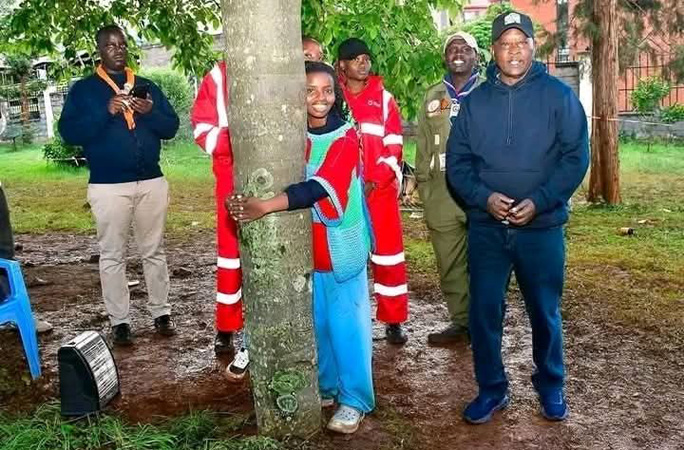
 Tree-planting ambassador and environmental activist Truphena Muthoni during her 72 hour tree-hugging challenge / Guinness World Records
 Nigerian celebrity chef Hilda Baci holding two GWR certificates. She earned her second in September 2025 by cooking the world's largest serving of Nigerian-style jollof rice, weighing a staggering 8,780kg/COURTESY
 On January 26 2026, environmentalist Truphena Muthoni 72-hours tree hugging fete was conformed as a world lead by the Guinness World Records.
In a statement, Guinness World Records described Muthoni's feat as an act by a "passionate environmental activist from Kenya sending a strong message about protecting the Earth after hugging a tree for three whole days."
"Truphena Muthoni has set the record for longest marathon hugging a tree with an unbelievable total of 72 hours," Guinness World Records said
The confirmation coming month after Guinness also confirmed Truphena's 48 hours, tree-hugging a feat she accomplished between January 31 and February 2, 2025.
The 22-year-old Truphena didn't just inspire environmentalists; she unlocked a competitive spirit in Kenyans that has led to some of the most unusual record-breaking attempts we’ve ever seen.
In the 254, if someone does it, someone else will try to do it longer, louder, or with more aura.
Her feat has triggered a "Copycat Culture" that is sweeping across the country, turning a symbol of conservation into a series of extreme, and sometimes perilous, public stunts.
As Kenyans celebrate with Muthoni, here is an explainer looking inside the GWR.
What is Guinness World Records?
Founded in 1955, Guinness World Records is globally recognised as the
authority on record-breaking achievements.
It was formerly named the Guinness Book of Records.
The organisation documents feats ranging from athletic excellence and human
endurance to creative arts, innovation and unusual accomplishments.
GWR verifies and publishes records achieved by individuals, groups,
institutions and companies, aiming to measure human limits and highlight
accomplishments that are measurable, repeatable and verifiable.
Records fall into categories such as sports and athletics, endurance, arts
and media, science and technology, food and drink, and environmental or
community challenges.
As of 2024, GWR approved 3,324 records, with 68,523 active record titles.
How GWR are verified
Verification is the backbone of GWR’s credibility. Every record attempt must
meet strict criteria before it is recognised.
This includes the application and pre-approval stage where applicants
submit online applications, either for an existing record or a proposed new
one. Guinness issues specific guidelines after review.
Before attempting any record, participants must apply on the Guinness World
Records website and receive approval of the category, guidelines and rules.
If Muthoni did not submit a pre-attempt application or receive the formal
guidelines beforehand, she may be required to submit a post-attempt
application, which takes longer and faces stricter scrutiny.
GWR categories often have precise definitions, in Muthoni’s case, such as
what constitutes “continuous hugging,” whether rest breaks are allowed, and how
timing must be measured.
Strict evidence requirements
Guinness requires a mountain of documentation before it considers ratifying
a record.
For time-bound endurance feats like tree-hugging, these are typically required:
a) Continuous 24/7 video recording
The entire attempt must be captured on uninterrupted video, without any
cuts.
The footage must clearly show the participant, the tree, the attempt area,
time-stamped proof and visibility of any breaks (if permitted).
b) Independent witness statements
Guinness requires two independent witnesses per shift.
These individuals must not be friends, relatives or organisers involved in
the attempt.
Each witness signs a detailed logbook.
c) Timekeeper logs
Evidence must include official timing records and a certified timekeeper or
established timing system.
d) Medical assessment
Because endurance records risk physical harm, Guinness typically requires
pre-attempt health clearance and post-attempt medical report confirming wellbeing.
e) Photographic evidence
High-resolution photos showing the start, middle, end, surroundings and
participant’s position relative to the tree.
f) Stewards’ logs
Designated stewards must keep detailed minute-by-minute logs noting
activity, rest breaks and rule compliance.
Without these, the attempt is considered unverifiable.
Post-submission review
Submitting evidence is only half the journey. Once Guinness receives the
materials, its review team begins a forensic evaluation, sometimes taking up to
12 weeks or longer.
Fees and applications
Attempting a Guinness World Record does not automatically cost money.
For an existing record, the standard application process is free, though if
the attempt involves proposing a totally new category there is a small
administration fee of about £5/$5.
Guinness also offers optional paid services, like priority application and
priority evidence review, which can accelerate processing but are not required
to secure a title.
"If you're an individual, simply register or sign in and explore our
database of over 47,000 current record titles to find the one you would like to
apply for. If you wish to suggest a new record title, don't forget to read our
record criteria and policies," GWR says.
Once you have chosen a record title, you are required to fill out the online
application form.
"We strongly advise you to read all of the information on our website
before making your application, to save time and disappointment," it adds.
During this phase, they may request additional footage, ask for
clarifications, reject parts of the evidence, ask for witness credentials and
also seek further proof of rule compliance.
Attempts fail at this stage more often than many realise, not because they
are fake, but because documentation is incomplete or doesn’t follow guidelines
to the letter.
Official confirmation or rejection
Guinness only declares a record after its verification team is satisfied.
Until then no certificate is issued, no media announcement is made, the
attempt remains unofficial and this is where Muthoni stands today.
What Kenyans witnessed was undoubtedly extraordinary.
Videos of the challenge show supporters cheering, medics nearby, and Muthoni
leaning on the tree with unshakeable resolve.
But viral success does not equal world record status.
She, or her organisers, must now compile all required evidence, submit it
through the Guinness portal and await review.
Only then will it be known whether her 72-hour embrace becomes Kenya’s next global record.
Kenya and Africa in GWR
Africa’s presence in Guinness World Records has grown steadily, with social
media, youth engagement and community-driven challenges driving visibility.
Kenya has made its mark in categories such as endurance, athletics, dance
marathons, environmental initiatives and mass participation events.
Some notable Kenyan Guinness World
Record holders include Muthoni and
Eliud Kipchoge, celebrated for
his historic sub-two-hour marathon during the 2019 INEOS 1:59 Challenge.
Olympian David Rudisha set a remarkable record in the 800 meters at the
London 2012 Olympics, clocking 1:40.91, while Faith Kipyegon became the first woman to complete a race in
3:48.68.
Retired athlete Tegla Loroupe holds three records for
the fastest female times over 20,000m, 25,000m and 30,000m.
Meanwhile, the late Kimani Maruge earned the title of the
oldest person to begin primary school. Enrolling at age 84, the Mau Mau veteran
became a global symbol of the universal right to education and even addressed
the United Nations. His inspiring story was immortalized in the film The
First Grader.
Joseph
Love, known as “The Dairy Virtuoso,”
showcased Kenya’s agricultural endurance by hand-milking an astonishing 531
litres from 30 cows in 24 hours in 1992 - a very different kind of record,
highlighting stamina and precision.
Alikhan
Kazia, “The Trick Shot Maestro,” demonstrates
Kenya’s range of skill through table tennis. He holds three GWRs for precision
trick shots, including bouncing 17 ping pong balls into a cup in one minute.
All of his records, set in Nairobi,
showcase remarkable hand-eye coordination and creativity.
Maliha
Mohammed, the “Culinary Marathoner” from
Mombasa, excels in endurance cuisine.
She holds the Guinness World Record
for the longest home kitchen cooking marathon (individual), having cooked
continuously for 90 hours and 15 minutes.
Her attempts illustrate the intense
discipline required, especially after a previous effort of 150 hours was
disqualified for a minor rest-break infraction.
Across Africa, countries like Nigeria, South Africa, Egypt and Ghana have
also produced record holders in cooking marathons, arts and cultural
performances, sports skills and mass participation events.
Some holders include Sharon Dede Padi (Ghana) – largest leaf-print paainting,
Roselyn Akosua Mantey (Ghana) – longest makeup application marathon, Ace-Liam
Nana Sam Ankrah (Ghana) – youngest male artist (Professional), Hilda Baci
(Nigeria) – largest serving of Nigerian-style jollof rice.
Symply Tacha (Nigeria) – most makeover in 24 hours, Kanyeyachukwu
Tagbo-Okeke (Nigeria) – largest art canvas and Joshua Olusanya (Nigeria) – longest
trumpet playing marathon.
These achievements often double as moments of national pride and youth mobilisation.
Categories Africans have excelled in
African record holders are particularly visible in endurance
challenges: marathons of physical or mental stamina, food and
hospitality records: long-duration cooking or baking and, arts
and performance: dance, music, and creative output.
Other categories are mass participation records: large
group or community-driven challenges, and sports-related feats:
speed, agility and repetition-based achievements
These categories are accessible, visually engaging and globally appealing.
Most attempted Guinness World Records
Certain records are attempted more frequently than others.
GWR lists these as longest marathon performing a task, like dancing, singing
or cooking, most repetitions of a simple action within a set time, largest
gatherings or coordinated group activities, and endurance-based challenges
requiring minimal equipment.
These records are popular because they are relatively easy to organise, require stamina over specialised equipment and attract public attention.
Why people chase GWR
Individuals pursue Guinness World Records for personal achievement, national
recognition, career visibility or brand building.
In recent years, record attempts have also raised awareness for social
causes, attracted tourism and inspired youth engagement.
In Muthoni’s case, she said her mission was to draw attention to the urgent
need to protect Kenya’s forests and inspire youth to take up environmental
stewardship.
“This record is not just for me; it is for our trees, our climate, and our
future. If hugging a tree for 72 hours gets even one more person to plant or
protect a tree, then it is worth every second,” she said.
Social media has amplified these efforts, turning record attempts into global spectacles.
A growing global platform
As Guinness World Records evolves, Africa’s participation is expected to
grow in both quantity and diversity of categories.
While feats may be extraordinary, the organisation maintains rigorous verification processes, clear rules, and fairness, ensuring that every achievement is genuine and globally recognised.