UN offices whose headquarters are set to relocate to Nairobi
The three agencies are currently based in New York
a y agoRosa MumanyiInfographics
Ki-moon said the global environment has significantly deteriorated since he left office in 2016


Audio By Vocalize
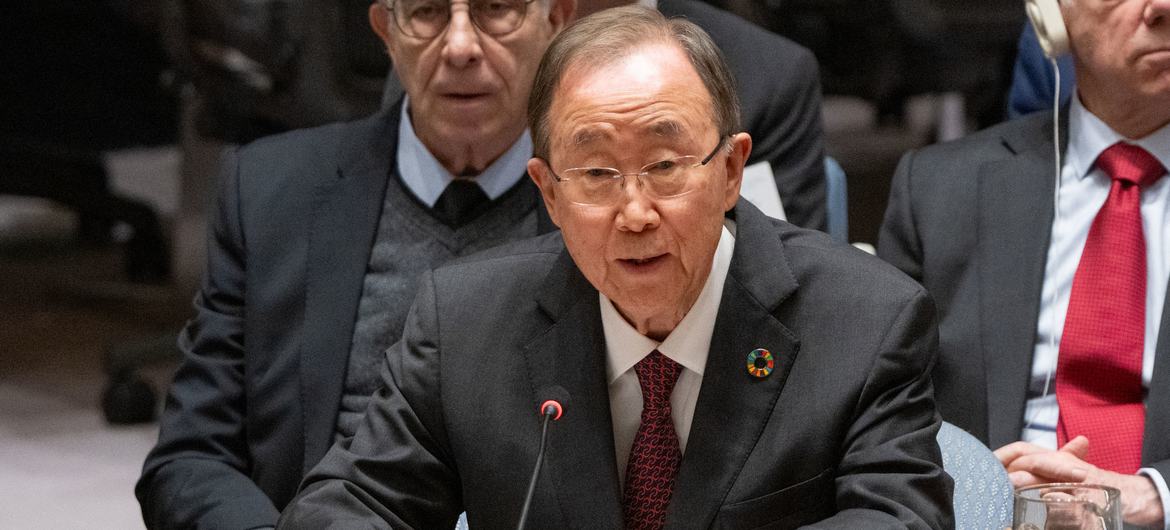 Former Secretary-General Ban Ki-moon, addresses the Security Council/UN
Former United Nations Secretary-General Ban Ki-moon has urged member states to overhaul the leadership structure of the world body.
Ki-moon said this should be done by adopting a single,
non-renewable seven-year term for future UN chiefs, warning that the current
system weakens the independence and effectiveness of the office.
Addressing ambassadors during an open Security Council debate on “Leadership
for Peace,” Ban challenged diplomats to reflect on moments in history when,
despite deep rivalry, the Council was able to select leaders capable of
steering the international community away from catastrophe and towards cooperation.
He said those lessons are urgently needed as global divisions deepen and
multilateralism continues to erode.
Ban, now an emeritus member of The Elders group, said the global environment
has significantly deteriorated since he left office in 2016.
He cited rising confrontation among major powers, persistent conflicts and
mounting civilian suffering as evidence of a system under strain.
Referring to the war in Ukraine, mass civilian casualties in Gaza and the
accelerating climate crisis, Ban told the Council that cooperation has been
replaced by rivalry at a time when collective action is most needed.
“This deeply disappointing situation is characterized by confrontation
rather than cooperation among major powers,” he told the Council.
He argued that the UN’s broader crisis cannot be separated from the failures
of the Security Council itself, singling out the repeated use of the veto by
permanent members.
Ban said veto power has too often been deployed to shield permanent members,
their allies and proxies from accountability, undermining the Council’s
credibility and ability to protect civilians.
“The Security Council’s ongoing failure to properly function constitutes the
most egregious cause,” Ban said, adding that vetoes have been used “to shield
themselves, their allies and their proxies from accountability.”
Without meaningful reform, he warned, impunity would persist and the UN
would risk sliding towards collapse or irrelevance.
Turning to the issue of UN leadership, Ban said the current convention of
allowing secretaries-general to serve two five-year terms leaves them overly
dependent on the goodwill of permanent members for reappointment.
He stressed that this arrangement is not mandated by the UN Charter and said
the General Assembly has the authority to determine the terms of appointment.
A single seven-year term, he argued, would reduce political pressure and
allow future secretaries-general to exercise their mandate more independently.
The intervention comes as the selection process for the next UN
Secretary-General gathers pace.
Secretary-General António Guterres’ second term is due to end next year, and
the formal process was launched in November by the Presidents of the General
Assembly and the Security Council, in line with a resolution calling for
transparency and inclusivity.
Candidates are required to submit vision statements, curricula vitae and
campaign financing disclosures, and to participate in publicly broadcast
dialogues with member states.
As of mid-December, Argentina has nominated Rafael Mariano Grossi, the
Director-General of the International Atomic Energy Agency.
The debate also heard from Anjali Dayal, an associate professor of
international politics at Fordham University, who warned that the next UN
leader will assume office amid unprecedented strain.
She pointed to a deepening funding crisis that is already reducing the organisation’s
capacity to deliver essential services, including vaccinations, humanitarian
assistance and mine clearance.
Dayal said history shows that even during periods of intense division, the
Security Council has been able to choose leaders who advanced peace through
diplomacy rather than force.
That will result not just in shrinking this Organization, but also in less
of the work that only the UN can do at scale,” she said, pointing to reduced
vaccinations, humanitarian assistance and mine-clearance efforts.
For Ban, however, the responsibility lies squarely with the Council to
reform its practices and renew its support for UN leadership.
Without that commitment, he warned, the world risks embracing a path of
mutual destruction rather than collective survival.
The three agencies are currently based in New York