

![[PHOTOS] Family, friends gather for Albert Ojwang requiem mass](/_next/image?url=https%3A%2F%2Fcdn.radioafrica.digital%2Fimage%2F2025%2F07%2Fbf36690c-e55a-44da-ac7b-2e4571a41dec.jpeg&w=3840&q=100)
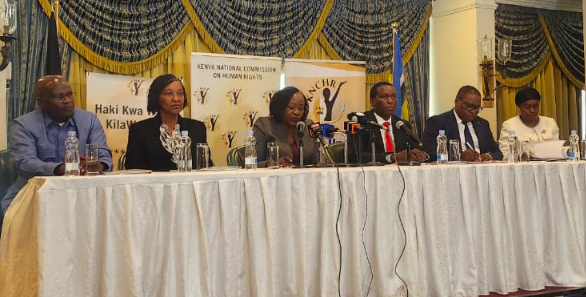
The Kenya National Commission on Human Rights (KNCHR) has documented 57 deaths linked to violations of the right to life between December 2024 and December 2025, describing the past year as “an affront to Article 26 of the Constitution.”
According to the Commission, most of the violations occurred between June and July during civic unrest across the country.
The cases include the killing of human rights defender Richard Otieno in Molo, the fatal shooting of a minor in Kiambu County, land clashes in Angata Baragoi that left five people dead, and the death ofAlbert Ojwang, a civilian who allegedly died in police custody.
“These deaths represent a grave breach of the Constitution, which guarantees every person’s right to life,” the Commission chairperson Claris Ogangah said.
“The pattern of killings—be they from crowd control failures, custodial deaths, or community conflicts—shows a worrying disregard for the sanctity of life.”
KNCHR also raised concern over the killing of security officers in the line of duty, warning that such attacks undermine public safety and weaken the enforcement of law and order.
“We regret the loss of all lives—civilians and security agents alike,” the Commission stated. “Every death demands accountability," she said.
The Commission called for the full operationalisation of the National Coroners Service Act, including the appointment of a Chief Coroner and establishment of the Service, along with the adoption of the Minnesota Protocol on the Investigation of Potentially Unlawful Death.
It further urged the Inspector-General of Police to expedite investigations into the killings and ensure perpetrators are brought to justice.
KNCHR also pressed IPOA to fast-track investigations into enforced disappearances, torture and deaths in police custody, and to recommend charges against officers implicated in extra-judicial killings.
“The time for half-measures is over,” the Commission added. “Kenyans deserve truth, justice, and institutions that protect life—not those that enable impunity.
Ogangah further reported a surge in violations of the right to freedom and security of the person, protected under Article 29 of the Constitution, which prohibits violence, cruel or degrading treatment, and torture by public or private actors.
Between December 2024 and December 2025, the Commission documented 661 complaints related to these violations, including arbitrary detentions, torture, abductions and enforced disappearances many allegedly linked to security officials.
“Fifteen cases of abductions were reported during the review period, signalling a worrying resurgence of tactics that have no place in a constitutional democracy,” she noted.
While acknowledging “relative calm and improved security” in the North Rift counties of West Pokot, Elgeyo Marakwet, Baringo, Turkana and Samburu areas earlier gazetted as disturbed and dangerous, the Commission expressed alarm over fresh reports of extra-judicial killings linked to officers deployed under Operation Maliza Uhalifu.
“We are in receipt of at least twelve complaints of abductions, torture and extra-judicial killings in parts of Marakwet East, Pokot Central and Tiaty,” she stated, warning that such violations undermine trust and derail peace efforts in the region.
The Commission also flagged the re-emergence of criminal gangs reportedly hired by politicians and business people for private security, intimidation and violence.
“These groups pose a direct threat to national security and must be dealt with strictly within the law,” the Commission said.