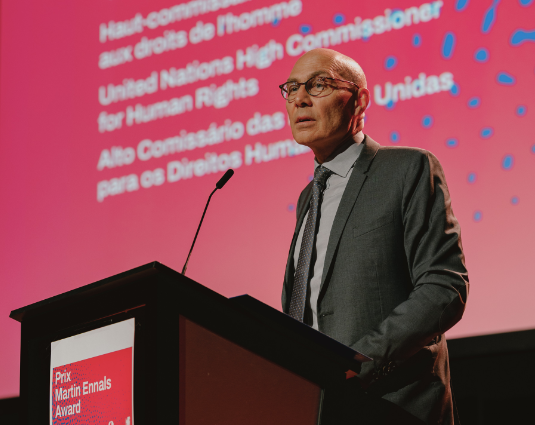
The United Nations High Commissioner for Human Rights, Volker Türk, has expressed deep concern over the escalating crackdown on opposition groups and the media in Uganda ahead of next month’s general election.
Türk urged Ugandan authorities to respect and protect human rights before, during, and after election day, highlighting what he described as a disturbing pattern of repression.
“It is deeply regrettable that election campaigns have once again been marked by widespread arbitrary arrests, detentions and the use of unnecessary or disproportionate force against the opposition, as well as undue restriction of press freedom,” he said.
“I urge Ugandan authorities to cease the use of such repressive tactics to enable Ugandans to fully and peacefully exercise their right to participate in their country’s public affairs on election day, and in its aftermath.”
Reports indicate that at least 550 individuals, including members and supporters of the National Unity Platform (NUP), have been arrested and detained since the start of the year. More than 300 of these arrests occurred after campaigning began in September.
Those detained face charges ranging from public nuisance and disobedience of lawful orders to assault, obstruction, and incitement of violence, with many still in custody.
Security forces, heavily armed, have been deployed at locations where NUP rallies are scheduled.
Last week, live ammunition was reportedly used in the eastern town of Iganga, resulting in at least one death and three injuries.
Security operatives have also employed tear gas, whips, batons, water cannons, and chemical irritants to disperse opposition supporters, injuring many in the process.
Türk highlighted a growing trend of arbitrary arrests, enforced disappearances, torture, and other forms of ill treatment. Security forces have reportedly used unmarked minibuses, referred to as “drones,” to transport detainees to unofficial “safe houses” where they are held incommunicado—violating international law, which requires detention only in officially acknowledged facilities to prevent torture.
In one notable case in May, the head of Uganda’s military posted on social media that he was holding the bodyguard of the NUP leader in his “basement.” The individual was later presented in court showing visible signs of torture.
Similarly, two Kenyan activists detained after attending an opposition rally in October were held incommunicado for over a month before being returned to Kenyan authorities.
Dozens of other opposition supporters remain detained from prior elections over four years ago.
Türk called on Ugandan authorities to investigate all allegations of arbitrary detention, enforced disappearance, and ill treatment, punish those responsible, and provide reparations to the victims.
He stressed that all individuals arbitrarily deprived of liberty should be released.
The UN official also condemned ongoing restrictions on press freedom. In October, journalists from NTV Uganda and The Daily Monitor had their parliamentary accreditations withdrawn, apparently due to critical reporting.
In March, at least 32 journalists and media workers were assaulted or had equipment confiscated during a parliamentary by-election in Kawempe North.
“The Ugandan authorities must halt all violence against the
media and the opposition and act fully in accordance with their obligations
under international human rights law,” Türk said.