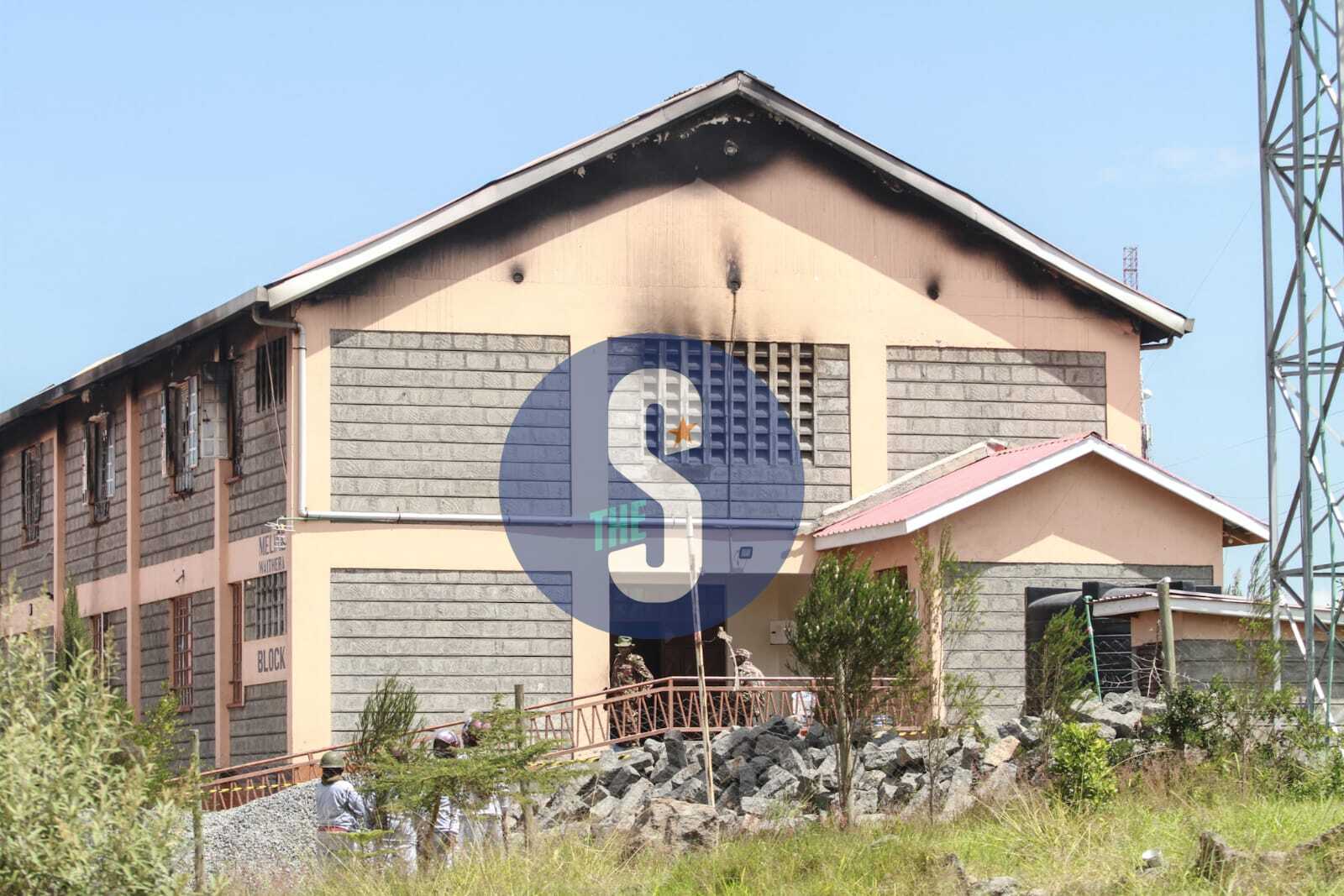
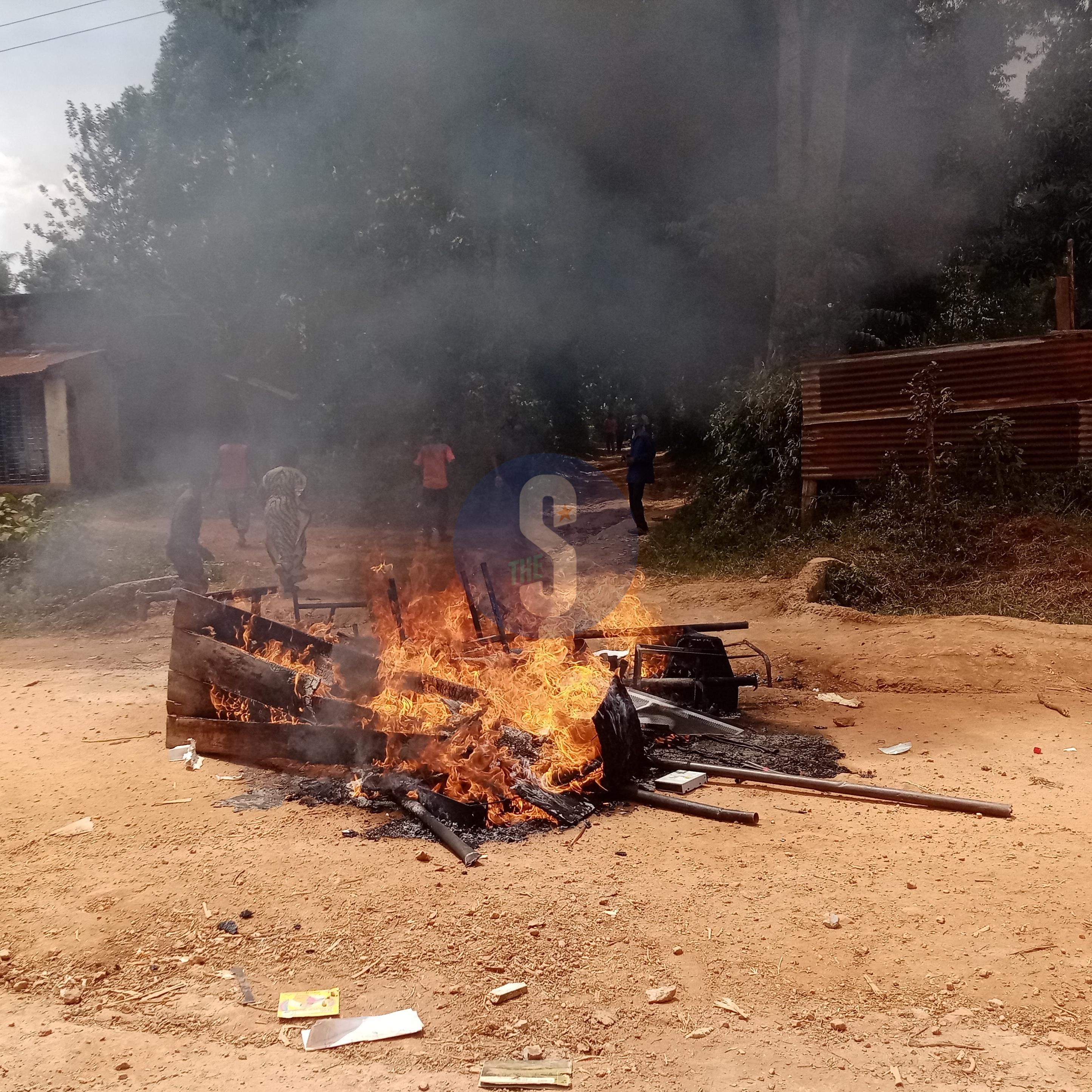
 School property, including a public address system, was set on fire by protesters on Thursday, December 4, 2025 /IMAGE /HILTON OTENYO
Four people died, and six others, including two police officers, were admitted to hospital with serious injuries on Thursday following violent protests in Ikolomani over plans to mine gold worth Sh680 billion in the area.
Western regional police commander Issa Mohamoud confirmed the deaths, adding the injured were admitted at the Kakamega County General Hospital.
The protests erupted during a meeting convened by the Director-General of the National Environmental Management Authority (NEMA) to gather local community and stakeholder views on the proposed mining project, which includes relocating over 800 households.
The four fatalities occurred after police opened fire during confrontations with residents who were pelting them with stones.
Two police officers—a male and a female—were critically injured after rioters attacked them with metal bars and clubs.
Protesters blocked the Sigalagala-Butere road, lit bonfires, and harassed travelers for several hours. They stormed Imusali Primary School, where the NEMA meeting was scheduled, clashed with police, and eventually overpowered the officers.
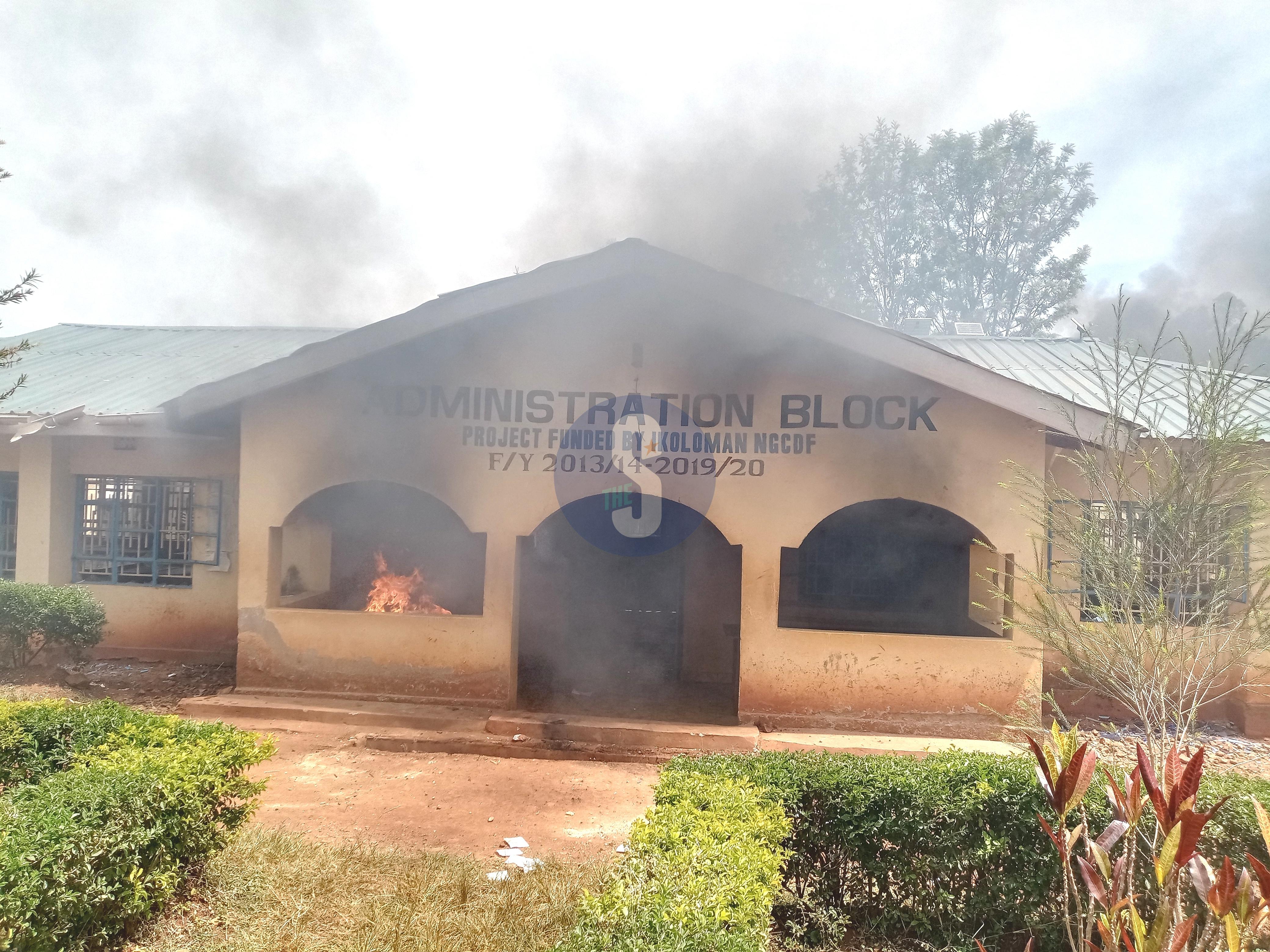 The Imusali Secondary School administration block that was set ablaze during protests against gold mining on Thursday, December 4, 2025 /IMAGE /HILTON OTENYO.
The rioters tore down tents, destroyed hundreds of plastic chairs, burned the public address system, and stole metal bars. They also broke into the administration block of the neighbouring Imusali Secondary School, vandalising property and setting parts of it on fire.
Four journalists covering the event were also attacked, sustaining injuries while their cameras and mobile phones were stolen.
A journalist's camera was vandalised while another lost a laptop, mobile phone and a camera. One scribe suffered head and hand injuries after he was hit by a metal bar. He was treated at Sheywe hospital in Khayega and discharged.
A similar meeting convened at Bushangala Technical Training Institute (TTI) was called off at the last minute on November 12 after the community turned hostile.
A resident, Alfred Shitiavai, said the community was opposed to the proposal to be relocated from their ancestral land.
“When Shanta came here, we agreed that they would agree with us before sinking shafts on our land upon paying us. All of a sudden, we’re now being told we should leave our land for mining. This is unacceptable,” he said.
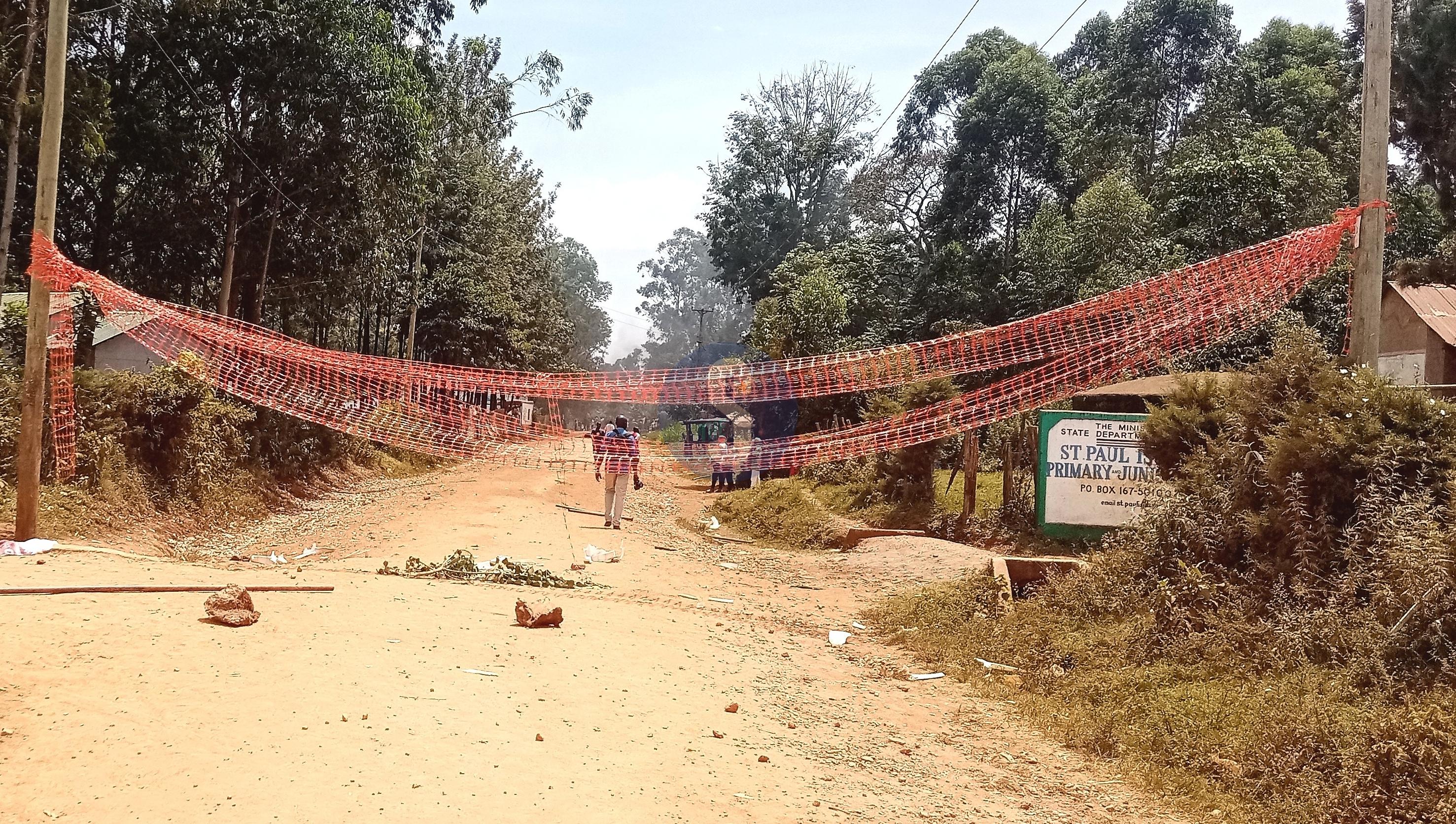 A barricaded road that passes by Imusali secondary school in Ikolomani /IMAGE /HILTON OTENYO
The major gold mining proposal in Kakamega South recently met resistance from local communities, who said that they are concerned about possible environmental, cultural, and social impacts if the project proceeds.
Shanta Gold Limited, a British-based mining firm, recently announced the discovery of what it describes as one of Kenya’s largest gold deposits, valued at an estimated Sh683 billion.
The company’s feasibility study indicates that about 337 acres of predominantly privately owned land would be required, potentially affecting approximately 800 households.
According to an Environmental Impact Assessment (EIA) report submitted to the National Environment Management Authority (Nema), the company’s Kenyan subsidiary has confirmed 1.27 million ounces of gold at the Isulu-Bushiangala underground mining site in Kakamega South Sub-county.
The study, prepared by Kurrent Technologies Limited together with South Africa’s Digby Wells Environmental, proposes a large-scale underground mine covering Musoli and Isulu locations, roughly 55 kilometres from Kisumu.
However, residents of Isulu, Bushiangala, and Musoli formally expressed opposition to the project. In a memorandum submitted to Nema, community members say they have concerns about how consultations were carried out, as well as potential effects on the environment and local livelihoods.
“We object to the approval of this project because it is a private commercial venture, not a public purpose project, and therefore cannot lawfully acquire ancestral land without consent,” the memo states.
The document also argues that the project could impact cultural heritage, household incomes, and community welfare if safeguards are not clearly outlined.
Residents say issues raised in an earlier petition submitted in July 2025 have not been fully addressed. They cite what they describe as gaps in public participation, including the absence of translated materials and limited engagement with women, elders, and people with disabilities.
Community members say a survey they conducted across 18 villages showed that many households had not reviewed the EIA report, and they are requesting that all documents be made available in Kiswahili, Luhya, and accessible formats.
Residents have also raised concerns about potential environmental impacts, saying more clarity is needed on how the mine would manage waste, protect water sources such as the Yala, Luyeku, Mukongolo, and Itechedi rivers, and address dust, fumes, and other emissions associated with mining.
Cultural preservation and social well-being are additional issues highlighted by the community. They say sacred sites and graves exist within the project area and want a Cultural Heritage Management Plan developed in consultation with local custodians.