

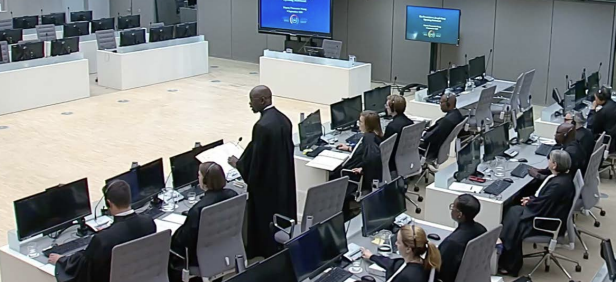
 International Criminal Court / Screengrab
The International Criminal Court (ICC) has formally closed its investigation into the situation in Kenya.
However, the Court continues to pursue two fugitives accused of interfering with witnesses, highlighting the unresolved legacy of a case that once placed the country at the centre of international justice.
According to the report, the Office of the Prosecutor announced on November 27, 2023, that it had concluded investigations relating to the Kenya situation.
The decision effectively brought an end to the Court’s active inquiry into events that had shaped years of legal and political debate both in Kenya and globally.
Despite closing the investigation, the Court has maintained activities focused on monitoring developments in Kenya and tracking two individuals who remain at large.
The ICC report notes that the outstanding warrants relate to alleged offences against the administration of justice under Article 70 of the Rome Statute.
The two individuals are wanted for allegedly corrupting or attempting to corruptly influence ICC witnesses—actions that fall under crimes meant to protect the integrity of the Court’s proceedings.
“On 27 November 2023, the Office announced its decision to conclude the investigation in this situation. Following this decision, the Office’s activities have been limited to monitoring developments and tracking two suspects at large,” the report read.
“They are the subject of warrants of arrest for alleged offences against the administration of justice pursuant to Article 70 of the Rome Statute, consisting of corrupting or attempting to corruptly influence ICC witnesses.”
Such offences include efforts to interfere with testimony or tamper with witnesses—conduct that the Rome Statute classifies as serious violations of international judicial processes.
The report underscores that the ICC’s remaining engagement in the Kenya situation is now limited strictly to following developments and pursuing the execution of these warrants.
No further investigative activities are being undertaken following the decision to conclude the case.
The Kenya situation, which once involved high-profile cases and intense international attention, continues to cast a shadow years after its formal closure.
In 2025, civil society organisations (CSOs) across the globe have actively engaged with the Guidelines for Documenting International Crimes and Human Rights Violations for Accountability Purposes, launched in 2022 by the Office of the Prosecutor in partnership with Eurojust.
The guidelines aim to support CSOs in collecting and preserving information that can feed into national investigations and prosecutions, as well as proceedings before the ICC.
The development of the Guidelines drew on years of experience from CSOs, consolidating best practices and identifying areas where further guidance could improve practical application.
The Office and Eurojust have emphasised two-way dialogue, ensuring that civil society input shapes the implementation of these standards.
Throughout 2025, the Office conducted a series of regional briefings, bringing together over 200 CSO representatives to discuss how the Guidelines can be tailored to different contexts.
Sessions were held in Asia (4 June), Southern and Eastern Africa (16 September), Central Africa and the Sahel (18 September), and the Middle East and North Africa (8 October). Additional briefings targeting Latin America, the Caribbean, Eastern Europe, and the Caucasus are expected before the end of January 2026.
Each session offered unique regional perspectives, generating practical discussions on applying the Guidelines in challenging environments.
The briefings also aimed to broaden engagement with organisations in non-state parties, further extending the reach and impact of the initiative.
Earlier in the year, on 27 February and 3 July, the Office and Eurojust held sessions with international CSOs working across multiple situations and non-situation countries.
These gatherings provided a platform for constructive dialogue, enabling civil society to offer feedback on the Guidelines’ usability while strengthening collaborative approaches to documenting human rights violations and international crimes.