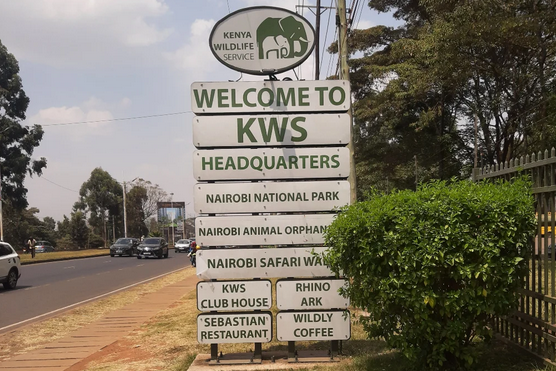
 A signboard at the entrance to the KWS headquarters along Langata road in Nairobi/COURTESY
The Kenya Wildlife Service (KWS) has moved to firmly dispel widespread social media claims alleging that the newly established Ritz-Carlton Safari Camp is obstructing the world-famous wildebeest migration within the Maasai Mara National Reserve.
In a detailed statement issued Thursday, KWS described the allegations as misleading, outdated, and largely fueled by competing commercial interests within the tourism sector.
The camp, according to KWS, is situated within a designated “low-use tourism investment zone” set out in the Maasai Mara National Reserve Management Plan for 2023-2032.
The zoning system, it is said, was jointly developed by national and county authorities and is rooted in ecological sensitivity assessments and long-term spatial planning to ensure tourism facilities do not interfere with wildlife behavior.
“The zonation in the reserve were established based on comprehensive scientific assessments, ecological sensitivity analyses, and spatial planning frameworks jointly developed by National and County government,” reads the statement.
Beyond zoning, KWS anchored its response on decades of scientific evidence.
According to the agency, wildebeest movements in the Mara have been tracked since 1999 using GPS collar data collected from more than 60 migratory wildebeest.
Each GPS data point represents herds ranging from 2,000 to 100,000 animals, offering one of the most comprehensive datasets on wildlife movement in Africa.
The findings are conclusive.
“Long-term collar data clearly shows that the entire Maasai Mara National Reserve is a general dispersal area for migrating wildebeest,” KWS noted.
The agency added that the animals use the entire 68-kilometre stretch along the Kenya-Tanzania border, with no single preferred migration corridor or bottleneck route that could be blocked by any camp.
The statement further pointed out that the Sand River, along which the Ritz-Carlton Safari Camp is located, has for years hosted five permanent safari camps and more than two seasonal facilities. None of these establishments has historically been associated with migration obstruction.
Wildlife, including wildebeest and zebra, have continued to move freely across the Sand, Talek, and Mara rivers, routes that have defined the Great Migration for decades.
KWS also took issue with images and videos circulating online, noting that several of them originate from unrelated historical incidents dating back to 2018 and 2020.
Others, the agency warned, may be deliberately amplified by rival commercial interests seeking to influence public perception of tourism investments in the Mara.
The public was urged to rely on verified information to avoid misrepresentation of Kenya’s conservation record.
To address concerns raised in the online debate, KWS assured the country that all ecological, regulatory, and environmental impact assessment requirements were rigorously met before the Ritz-Carlton Safari Camp was approved.
Kenya’s protected areas, the agency stressed, operate under some of the most robust and globally recognized conservation standards.
The alert comes amid a wave of online posts claiming that construction of the luxury camp has affected natural migration paths and blocked access to key river crossing points used by hundreds of thousands of wildebeest during their annual migration from Tanzania’s Serengeti.
The migration, recently celebrated by the World Book of Records UK as the world’s greatest annual terrestrial wildlife phenomenon, attracts global attention and is one of Kenya’s most valuable natural heritage assets.
KWS emphasised that the government of Kenya places the protection of wildlife corridors at the highest level of national priority.
This commitment, the agency said, is demonstrated through ongoing policy actions such as the recent Cabinet approval to secure the Nairobi National Park-Athi-Kapiti wildlife corridor.
The same conservation safeguards apply across the Maasai Mara ecosystem, where wildlife movements and tourism development are guided by strict scientific and environmental frameworks.
The agency further reaffirmed its commitment to balancing responsible tourism development with wildlife conservation and community livelihoods.
“We remain dedicated to safeguarding the wildebeest migration for current and future generations,” KWS said as it appealed to Kenyans to be remain patriotic and uphold facts.