WANJAWA: When lecture halls fell silent and dons stood tall
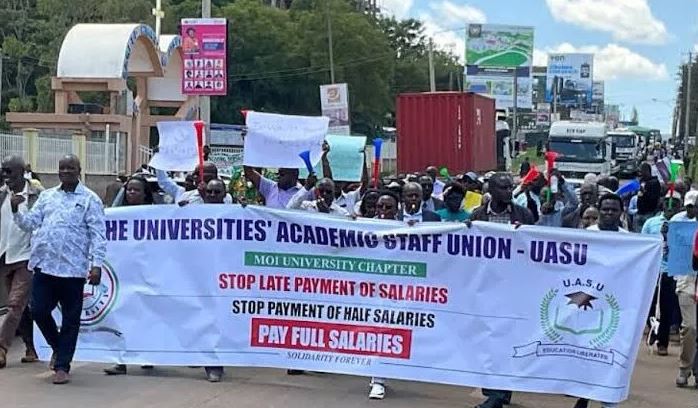
For 49 days, the corridors of Kenya’s public universities echoed with silence.
by EDWIN WANJAWA
Audio By Vocalize
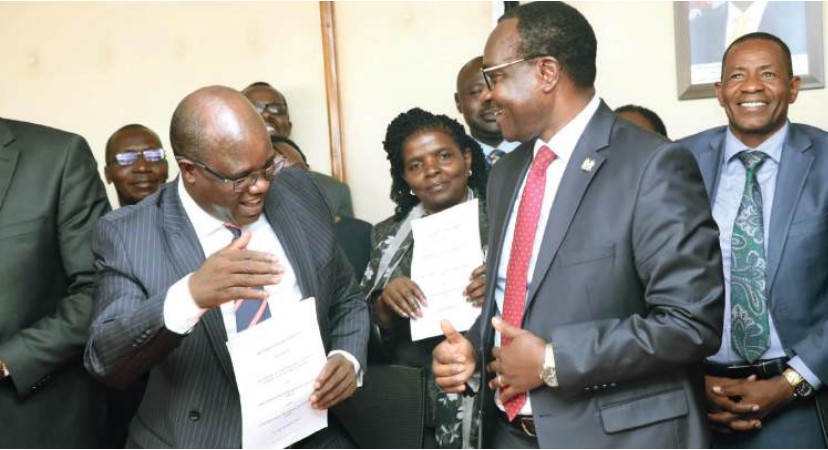
UASU secretary general Constantine Wesonga and Education Cabinet Secretary Julius Ogamba after signing the return-to-work formula following the lecturers’ strike that lasted 49 days at Jogoo House, Nairobi, on November 5 /LEAH MUKANGAI
For 49 days, the
corridors of Kenya’s public universities echoed with silence. The strike by
lecturers under the University Academic Staff Union and the Kenya University
Staff Union dragged on for seven long weeks — a silence heavy with frustration
and unspoken questions about how we value knowledge in this country. It was not
just an industrial dispute; it was a national mirror reflecting our collective
neglect of higher education.
The unions, led by their
indefatigable secretaries general Dr Constantine Opiyo Wasonga (Uasu) and Dr
Charles Mukhwaya (Kusu), chose dialogue over brinkmanship, accepting a phased
settlement instead of their lawful one-off demand, Christened “Kumalizana”.
That climbdown was not weakness — it was leadership: the rare kind that places
national interest above ego and short-termism.
Yet, the truce must not
lull us into complacency. This strike should jolt us into confronting a broken
system — one that turns every CBA into a contest of endurance between state
bureaucrats and workers. It is a system that has normalised crisis management,
where agreements are signed with flourish and forgotten with ease, and
universities are left to operate on fumes of goodwill and deferred hope.
For nearly two months,
the Inter-Public Universities Councils Consultative Forum (IPUCCF), the
Salaries and Remuneration Commission (SRC), the Ministry of Education, and the
National Treasury took turns twiddling their fingers and fumbling a crisis that
everyone saw coming. Numbers kept shifting, statements contradicted each other,
and decisions were deferred endlessly.
The Treasury hid behind
the familiar refrain of “budget constraints,” yet offered no credible payment
plan. The SRC issued figures that unions immediately disputed, widening
mistrust. IPUCCF and university councils oscillated between sympathy and
surrender, unsure whether to stand with their staff or appease the government.
The Ministry of
Education, which should have been the honest broker, watched from the fence,
issuing perfunctory statements of concern. Parliament, which ought to have
enforced accountability, found its voice too late. The result was paralysis at
the top and desperation below.
Amid the confusion, the
unions stood firm. Their discipline and unity were not mere acts of defiance;
they were statements of principle. They reminded the country that CBAs are
contracts, not tokens of goodwill — promises made and signed, not suggestions
to be implemented at convenience. For once, the public saw that intellectual
labour too demands dignity.
Their solidarity was an
act of pedagogy — teaching the nation that justice, once deferred, must
eventually be pursued. The unity between Uasu and Kusu symbolised a larger
truth: that dignity in labour is indivisible. Whether one stands at the lectern
or guards the lecture hall, the principle is the same — fair work deserves fair
pay.
But let’s not romanticise
struggle. The human cost of those 49 days was heavy. Students lost time and
morale; parents lost patience and money. Academic calendars will have to be
squeezed, milestones delayed, and research disrupted.
The silence in the
lecture halls was not peaceful — it was painful. It carried the weight of
missed opportunities, broken academic momentum, and creeping cynicism that
comes when learning is treated as negotiable.
That pain must not be wasted; it
must compel reform.
Kenya needs a new way of
handling CBAs — one anchored on transparency, timeliness, and respect. First,
establish a CBA Reconciliation Protocol
— a legally mandated 30-day window for SRC, Treasury, university management,
and unions to reconcile figures before emotions escalate. Numbers should be
verified by data, not picked from a hat at will and debated on talk shows.
Second, every CBA must
carry enforceable timelines and
penalties with individual liabilities for delay. Once an agreement is
signed and verified, it should be implemented as automatically as a salary
deduction.
More importantly, the
Ministry of Education must lead with honesty and coordination — one voice, one
set of facts, one commitment to truth. It should not merely react to strikes
but anticipate them by fostering regular engagement with staff unions and
university councils.
This strike was a storm —
fierce but necessary. It exposed how fragile our public universities have
become and how indifferent our bureaucracy can be. Yet storms, if we learn from
them, cleanse the air. They strip away illusion and leave behind the
possibility of renewal.
Let this be our moment of
institutional maturity: to replace improvisation with structure, opacity with
transparency, and confrontation with consistency. The lecturers and their
leadership have done their part. They have taught, not just in lecture halls,
but also in the public square — that justice, once sought with discipline and
reason, ennobles even those who resist it.
Now the government must
do its homework. It must reimagine higher education as a pillar of national
development, not an annual line item for austerity. When lecture halls fall
silent, a nation’s future whispers in regret. Let us never again allow that
silence to linger. Let us build a system where knowledge is not just taught —
but honoured, in word, in deed, and in pay.
This is premium content
Subscribe to Continue Reading
Help us continue bringing you unbiased news, in-depth investigations, and diverse perspectives. Your subscription keeps our mission alive and empowers us to provide high-quality, trustworthy journalism. Join us today to make a difference!