

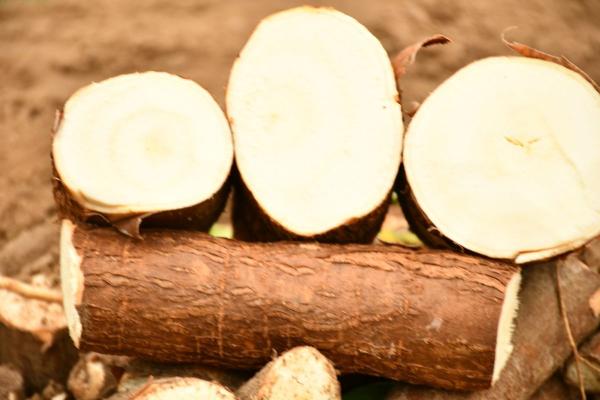
The KingaKUU cassava variety /KALRO
The National Environment Management Authority has called on Kenyans to submit feedback on an Environmental and Social Impact Assessment report for the proposed commercialisation of a genetically modified cassava variety.
The proposed variety, known as KingaKUU, has been bred to resist two major diseases that ravage cassava yields across Kenya and the wider East African region.
The diseases are cassava mosaic disease and cassava brown streak disease.
Kalro says the disease-resistant variety has demonstrated consistent performance across multiple cropping seasons and sites in Kenya and Uganda.
“KingaKUU cassava varieties are disease-resistant and will empower East African smallholder farmers and improve their socio-economic welfare,” reads Kalro’s technical factsheet.
“The varieties have shown robust and durable resistance to cassava brown streak disease, validated over several production cycles.”
The research organisation notes that the variety was developed through a collaborative effort involving Kalro and international research partners.
The commercialisation proposal seeks approval to introduce the cassava variety to farmers in 18 counties.
Kalro maintains that KingaKUU cassava poses no additional environmental or health risks compared to conventional cassava varieties.
It adds that food and feed from the new variety is considered as safe as that from traditional varieties.
“The adoption of KingaKUU cassava will help address longstanding disease-related constraints in cassava production. This is expected to boost yields and household incomes among smallholder farmers,” Kalro noted in its submission to the assessment.
The researchers further argue that commercialisation of the GM cassava would offer farmers a lasting solution to repeated crop losses linked to cassava mosaic disease and cassava brown streak disease.
In the notice, Nema said the assessment aims to evaluate potential environmental and social effects of a proposed project, and to guide decision-making to ensure sustainability.
“It identifies likely impacts of the project on the environment and proposes mitigation measures. It also provides baseline data for future monitoring and evaluation,” the authority said in the public notice.
If approved, KingaKUU would become the first GM cassava to be commercialised in Kenya.
Members of the public are encouraged to submit their comments to Nema by November 20 before a final decision is made.
INSTANT ANALYSIS
Cassava is the second-most important food crop after maize in Kenya’s coastal and western regions. Kalro says severe infection by cassava brown streak disease can result in up to 100 per cent loss of usable roots, affecting both food supply and income. Cassava is also increasingly valued as a raw material for starch, animal feed, flour and industrial ethanol production.