Treasury is
planning to introduce a new debt monitoring and tracking system in fresh
crackdown on state corporations that have defaulted on billions of shillings in
government-backed loans.
This is after it emerged
that state corporations have been receiving loans on lent by the government for
development and either poorly implementing the projects or failing to honour
back repayments.
This, according to the Treasury Annual Monetary Report, has seen the on-lent loans hit over Sh1 trillion, comprising Sh874.91 donor donor-funded financing and
Sh322billion issued by the National government.
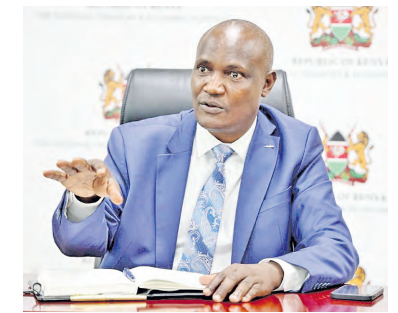
Treasury Cabinet
Secretary John Mbadi said through the new Government Investment Management
System (GIMS), the state will be able to see real-time tracking of all loans
advanced to corporations, including disbursements, repayments and project implementation.
“The system will
enhance accessibility to real-time information on loan disbursements and
repayments, ensuring transparency and accountability in the management of
public funds,” Mbadi told the Parliamentary committee on Public Debt and Privatisation.
The plan comes
amid growing concern over rising loan defaults among state corporations,
especially in the water, transport and energy sectors.
An audit by the
Office of the Auditor-General recently revealed that dozens of parastatals have
either stalled in project implementation or failed to remit repayments for
on-lent loans from the National Treasury.
According to
Mbadi, the new monitoring system will also feed into a broader fiscal risk framework
under the Fiscal Risk Committee, which has been tasked with vetting all future
loans to ensure that only financially viable projects are approved.
This is aimed at
curbing reckless borrowing and preventing the recurrence of stalled or
incomplete projects financed through external loans.
Government data shows that some of the worst-hit agencies include water sector
parastatals such as the National Water Harvesting and Storage Authority (NWHSA)
and regional Water Works Development Agencies, which have struggled to generate
revenue after devolution stripped them of direct billing powers.
In a bid to clean
up the debt portfolio, Mbadi disclosed that the Treasury has submitted a Cabinet
memo seeking approval to write off billions owed by water sector agencies
that have no independent revenue streams.
“To resolve the issue, the outstanding loans are being considered for
write-off through a Cabinet Memorandum that has been submitted to Cabinet for
approval. Lack of last-mile connectivity under the Victoria South Water Works
Development Agency.”
The
Auditor-General’s report had flagged several stalled or disputed projects tied
to billions in concessional loans, including the Mandera Water Supply Project
and the Changamwe Seawater Project, both bogged down in protracted arbitration
cases.
The Treasury
confirmed that some of these projects, financed through international loans,
remain frozen as agencies battle contractors in court, delaying service
delivery and loan repayment schedules.
"A
contractual dispute has stalled the Changamwe seawater project. After delays,
the agency moved to terminate the contract, but a court order and ongoing
arbitration have frozen progress, locking the site and funds until a resolution
is reached," added the CS.
Other than the
water sector utility companies, the treasury also came under sharp scrutiny from
Members of parliament over the lack of clear regulations governing on-lending
to state-owned enterprises.
Lamu West member
of parliament Stanley Muthama, sought to know why the treasury approved a loan
that has seen Kenya Electricity Transmission Company (Ketraco), struggle pay
and are now facing penalties of about Sh180 billion.
“A utility transmission company in Ketraco,
has an accumulation of penalties amounting to about Sh180 billion. My question
is, what are the contractual terms of repayment of this loan that was extended
to Ketraco? And in addition to paying the loan, how are they going to pay about
Sh180 billion in penalties?” asked Muthama.
Mbadi admitted
that there had been “an oversight” in monitoring Kentraco’s loan obligations,
adding that the ministry would issue a comprehensive statement on the matter.
“They are not
servicing their on-lent loan. It is quite significant and we will address it
comprehensively,” Mbadi told MPs.
The committee
questioned why the Treasury has continued issuing on-lent loans where the
government borrows externally and relends to parastatals, despite widespread
defaults and missing accountability records.
Lawmakers cited
major discrepancies between Treasury’s and Auditor General’s figures on
outstanding loans, with Treasury reporting Sh1.19 trillion while the Auditor’s
report shows Sh875 billion, a difference of Sh322 billion.
Mbadi explained
that the higher figure includes direct government obligations (GOP), not just
on-lent loans, but acknowledged that poor data coordination between departments
had worsened oversight challenges.
Nyaribari Masaba
MP Daniel Manduku, pressed the CS over the lack of regulations governing the on-lending
framework under Section 57 of the Public Finance Management Act, 2012, a legal
gap that has persisted for 13 years.
“We still don’t
have regulations for on-lent loans, but I agree that the delay is inordinate.
We’ll ensure this does not drag to 15 or 20 years,” Mbadi conceded.



![[PHOTOS] The new Ngong –Naivasha Road viaduct](https://cdn.radioafrica.digital/image/2026/06/64d4f771-4432-4aee-ba3c-2f304c4436ec.jpg)