The
Mau Forest Complex stands as one of Kenya’s greatest natural endowments.
It is
the country’s largest water tower and one of the most critical
ecosystems in East Africa. Its rivers feed Lake Victoria, the
Mara, Sondu, Njoro and Ewaso Ng’iro basins, sustaining agriculture, tourism
and hydropower.
The Mau is not simply a forest. It is the beating heart of
Kenya’s ecological and economic stability.
For
years, the forest has faced destruction through illegal logging, encroachment
and poor land use. Each fallen tree has
carried a hidden cost in soil erosion, reduced rainfall and silted rivers. Science
explains this clearly.
Forests moderate rainfall distribution, recharge
groundwater, filter water and prevent flooding.
The Mau’s canopy regulates evaporation, keeps the soil moist and controls
river flow throughout the year.
When this canopy is destroyed, floods become
severe, dry seasons become longer and rivers shrink. These are not
abstract effects.
They translate directly into lower crop
yields, unreliable electricity generation and economic loss for millions of Kenyans.
This
is why the government’s renewed push to restore the Mau is a moment of great
national importance. Reforestation here is not just an environmental
exercise.
It is a matter of climate justice and
intergenerational responsibility. It is also a strategic investment in Kenya’s
long-term stability.
The forest’s health directly affects rainfall
patterns from the Rift Valley to the Lake Victoria Basin and
influences the livelihoods of communities that depend on agriculture, livestock
and tourism.
The
government’s programme of restoration in the Mau and other catchment areas
demonstrates an understanding that
environmental protection must go hand in hand with economic planning.
Under
the national tree-growing initiative, the government aims to plant 15 billion
trees by 2032. This is not a ceremonial campaign.
It is a carefully
designed policy linking forest restoration with
livelihoods, water security and energy production. Counties such as Narok, Kericho
and Nakuru have already integrated these goals into their development plans.
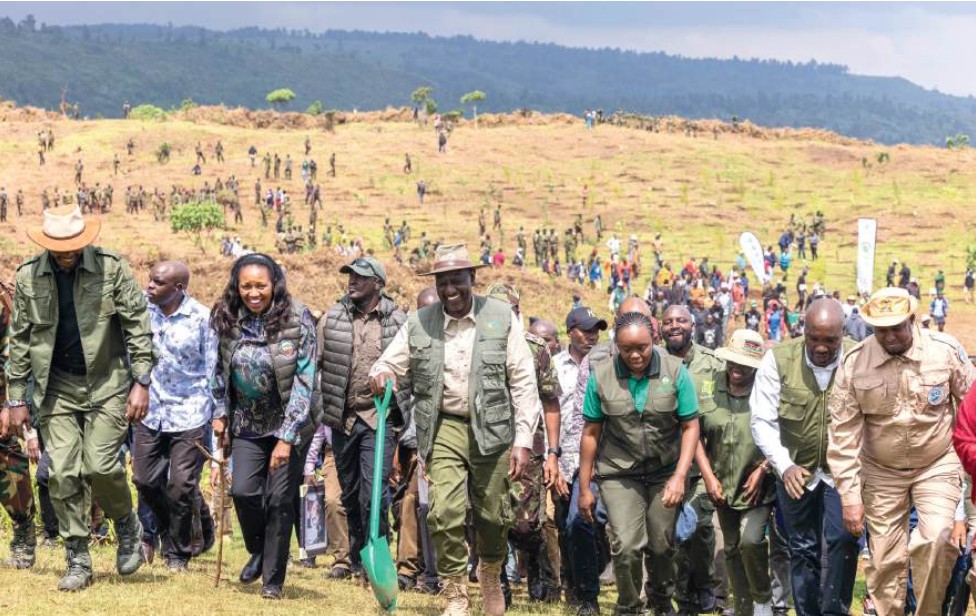
Chief
of Staff and Head of Public Service Felix Koskei recently led a tree-growing
event at the Mau and adopted 50 hectares
(123.5 acres) for restoration.
His sent a powerful message to public servants
and communities. He reminded Kenyans that the cost of failing to preserve the
Mau would be far greater than the effort of restoring it. He urged
citizens to view tree growing not as a symbolic act but as a
patriotic duty.
“Our
collective commitment to planting and growing trees will
gradually transform Kenya into a beacon of ecological responsibility,” he said.
His
appeal for shared responsibility placed environmental care within the
framework of national service.
The
Mau’s history reminds us that this is not a simple task. In the late 2000s, the
government under President Mwai Kibaki and Prime Minister Raila Odinga
attempted to remove illegal settlements from the
forest. The exercise was scientifically justified but politically charged.
Thousands
of people had settled within excised areas, some with genuine titles and others through
irregular allocation. The government’s decision to clear encroachments led to
protests and intense political debate.
Raila, who pushed for decisive
action to save the forest, faced strong resistance, especially from
leaders who framed the evictions as ethnic or political persecution.
The
process revealed the deep tension between environmental justice and social
equity. It also taught the nation that
restoration must be accompanied by humane resettlement, legal clarity and alternative
livelihoods for affected families.
The
current approach builds on those lessons. It combines ecological science with
social responsibility. Restoration efforts now involve communities
directly through nursery management, beekeeping,
tree seedling enterprises and sustainable farming.
These activities provide
income while protecting the ecosystem. This model recognises that conservation
cannot thrive where poverty persists. When local people benefit from
restoration, they become protectors of the forest
rather than its adversaries.
From
a scientific perspective, the success of the Mau restoration will be measured
through observable changes. These include increased forest cover, better
soil health and more consistent river flow during dry
months.
The government and partners plan to monitor soil carbon, water quality
and sediment levels in major rivers. Such data will help evaluate progress and
guide adjustments in policy.
Restoring the forest also contributes to
carbon sequestration, helping Kenya to meet its
international climate commitments while improving local environmental conditions.
The
government’s investment in the Mau is also an economic decision. Healthy
catchments reduce sedimentation in dams, which extends their lifespan and
ensures steady hydropower generation. This reduces
energy costs and supports industries that depend on electricity.
Similarly,
sustained river flows guarantee reliable irrigation for agriculture, leading to
higher food production and lower market prices. Restoration therefore
supports both economic growth and climate resilience.
One
of the striking features of the current initiative is its scale and
coordination. It brings together the Kenya Forest
Service, the National Environment Management Authority, county governments
and communities under a unified plan.
This interagency approach ensures that restoration
is not left to chance. It links environmental action with planning, water
management and social protection.
It also aligns with the global understanding
that landscape restoration requires integration of
science, governance and community participation.
Still,
the task ahead remains demanding. Seedling survival rates must improve, grazing
must be managed and illegal logging must be deterred. Restoration will
only succeed if it is followed by consistent protection and
monitoring.
The public must also remain engaged through awareness and
community patrols. Government alone cannot save the Mau. It requires collective vigilance.
Kenya’s
reforestation effort, particularly in the Mau, symbolises a broader awakening
to the reality of climate change. As extreme weather events become more
frequent, water scarcity and food insecurity threaten
economic gains.
Restoring the Mau is therefore a national insurance policy.
It ensures that rivers keep flowing, farms remain productive and communities
continue to thrive.
The
government’s step to reclaim and restore this forest is bold and timely. It
demonstrates foresight and
responsibility. The Mau’s health affects not only Kenya but also neighbouring countries
that share its rivers.
This effort is a contribution to regional stability and
global climate goals.
When Koskei and his
team lead from the front, they send a powerful message that public
service extends beyond offices and policies. It reaches the soil, the streams
and the trees that sustain life itself.
The
Mau restoration is more than an environmental programme. It is a moral
statement about the kind of nation Kenya wants
to be. A country that restores its forests restores its future.
The government’s
action, backed by science and guided by compassion, stands as a monumental step toward
ecological renewal and climate justice.
The success of this work will define
not only the fate of the Mau but also
the legacy of a generation that chose to heal the land that feeds it.




![[PHOTOS] The new Ngong –Naivasha Road viaduct](https://cdn.radioafrica.digital/image/2026/06/64d4f771-4432-4aee-ba3c-2f304c4436ec.jpg)









![[PHOTOS] 'Mr Speaker Sir' Gen Z protester in court](https://cdn.radioafrica.digital/image/2026/06/b3e62d8e-25c3-4780-90f9-4eb48b1ce8a7.jpg)