
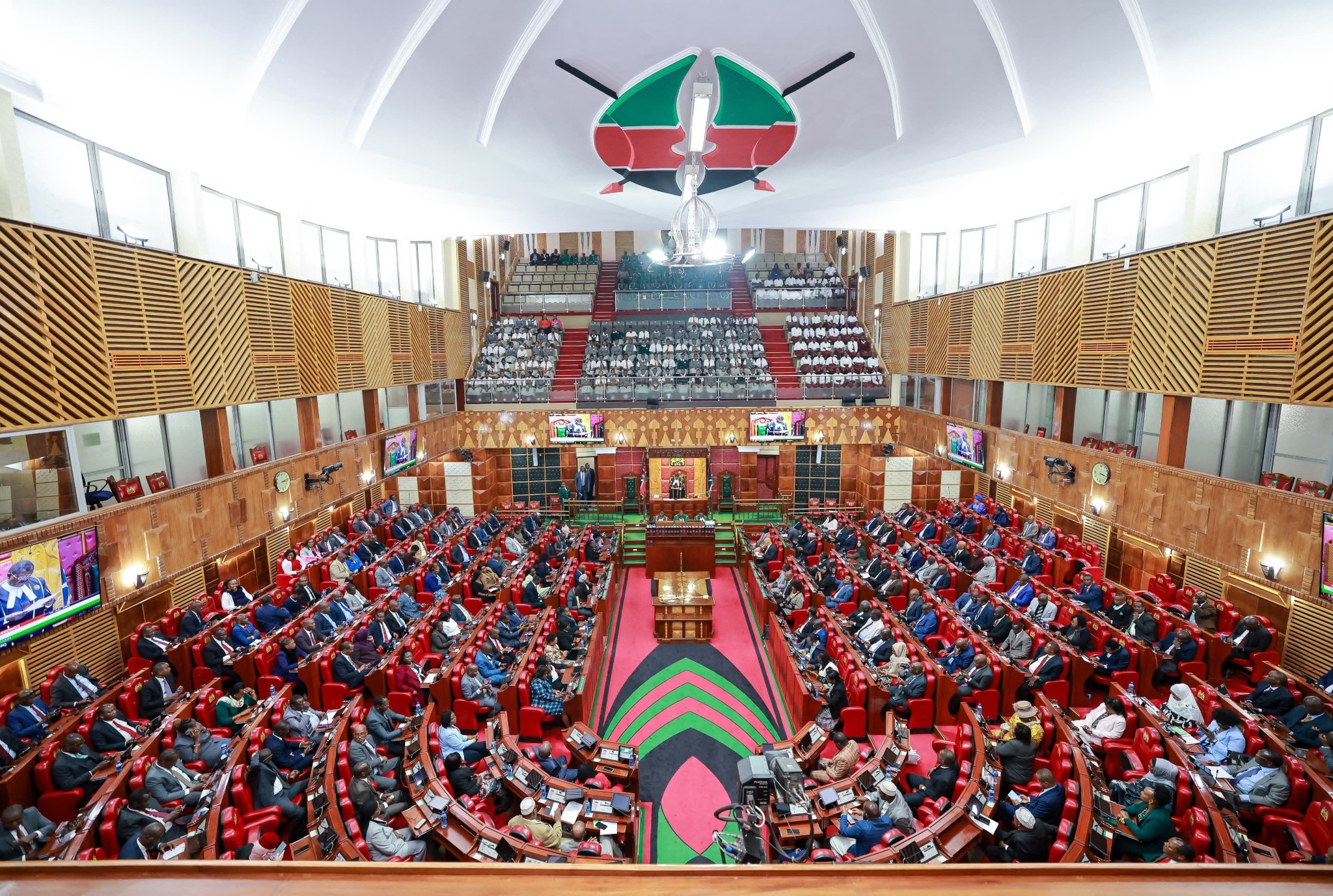
 National Assembly. /PARLIAMENT
The National Assembly has received a petition from the Computer Science Teachers Association of Kenya calling for urgent policy and legislative action to revive interest in Science, Technology, Engineering, and Mathematics subjects.
The teachers also want stronger support for Computer Science education across the country.
Presenting the petition to the House, Deputy Speaker Gladys Boss described the matter as central to Kenya’s future competitiveness.
“Honourable Members, my office has received a petition from the Computer Science Teachers Association of Kenya, a national professional body representing computing educators. The association is dedicated to ensuring that educators are fully equipped to train the next generation of technology innovators, in alignment with the country’s national digital master plan and strategic objectives,” she said.
The boss underscored the petitioners’ concern over declining interest in STEM disciplines, warning that Kenya risks losing ground in an increasingly technology-driven global economy.
“Without timely intervention, the nation risks falling behind in global competitiveness, innovation, and its ability to thrive in the Fourth Industrial Revolution,” she added.
In the petition, CSTAK commended the Teachers Service Commission (TSC) for prioritising STEM subject teachers in the ongoing recruitment of 24,000 intern teachers for junior secondary schools.
It also welcomed the inclusion of coding in the Competency-Based Education (CBE) through platforms such as Scratch and Python.
However, the association warned that relying on a single introductory tool limits learners’ preparedness for advanced areas such as Artificial Intelligence (AI), Cybersecurity, and Data Science.
It also pointed out that the robotics component in the Grade 7–9 curriculum lacks meaningful hands-on training due to inadequate infrastructure, a shortage of trained teachers, and high implementation costs.
“The lack of formal financial and policy support for STEM activities, unlike music, drama, and sports, creates inequality in access, particularly for marginalised communities,” CSTAK said in the petition.
“The Kenya Science and Engineering Fair policy mandating the use of proprietary LEGO robotics kits further excludes affordable, open-source alternatives such as Arduino and Raspberry Pi Pico.”
The teachers’ body urged Parliament to engage the Ministry of Education in developing a National Policy and Funding Framework for STEM and Robotics, and to direct the Kenya Institute of Curriculum Development (KICD) to incorporate practical, hands-on learning modules in AI, Robotics, Data Science, and Cybersecurity within the curriculum.
Supporting the petition, Gilgil MP Martha Wangari said it was timely and called for equitable funding between STEM and arts-related subjects.
She cited the case of John Tongoi, a Chuka University student who placed third out of 80,000 participants from 11,000 universities at the 2025 International Quant Championship in Singapore, after receiving support from the Gilgil NGCDF.
“This is a live example of the kind of support we can give young men and women to enjoy STEM,” said Wangari.
“It shows how much potential we have as a country if we fully support STEM.”
Marakwet East MP Kangogo Bowen cautioned that while integrating ICT and artificial intelligence in schools was a noble idea, many parts of the country still lack basic infrastructure.
“There is a need for us to first focus on developing infrastructure across the country,” he said.
The petition was committed to the Public Petitions Committee for consideration.
The Committee will examine the issues raised and table a report in the House in accordance with Standing Order 227(2).