President Ruto, through a memo by the Head of Public Service in June 2023, gave conditions for travel, capping
delegation sizes and timelines.
Cabinet secretaries, principal secretaries, chairpersons and CEOs of state corporations
were directed to get travel approval from the President.
It was ruled
that delegations by Cabinet secretaries shall not exceed four persons,
including the CS as head of delegation.
PSs' delegations
were restricted to three, while personal assistants and security personnel were
barred.
Governors
were allowed a maximum of three people, including themselves, while state
corporation CEOs and board chairs are only allowed to travel alone.
Commission
CEOs and chairpersons were allowed one extra person while staff travel was suspended – save for leave-based travel and representation.
Only the
Deputy President and the Prime Cabinet Secretary were allowed to travel with
personal assistants.
The circular
also provided that government officials would only be granted a maximum of
seven days per travel, 15 days per quarter and 45 days in a year.
In October
2023, the government in another memo suspended benchmarking and study visits,
trainings, and conferences.
Meetings of
general participation, symposia, exhibitions, and association meetings were
also banned.
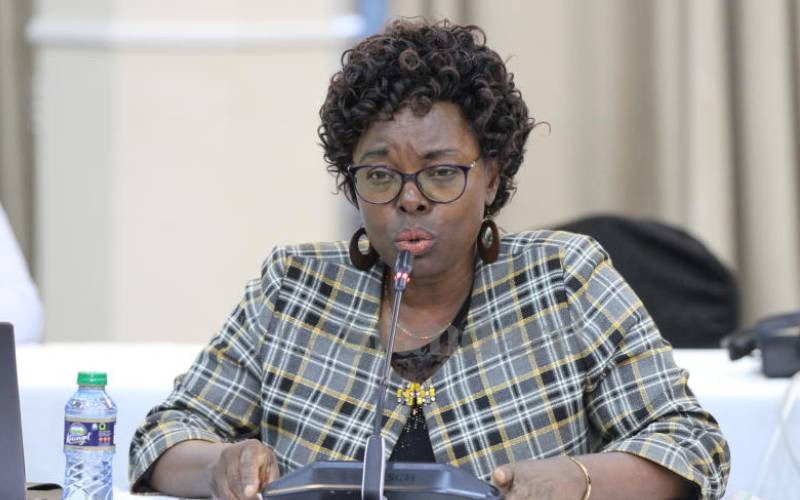
The dossier by CoB Margaret Nyakang’o reveals that some of the flagged
trips included those to luxury destinations and conferences of questionable
value.
The State Department of MSMES had the highest delegation of 80 to Juba,
South Sudan, for EAC Trade Fair, and took 10 days, burning Sh40 million.
The department sent another 15 personnel to the USA for negotiations. It
stands out as having sent some of the biggest delegations of five to nine
people.
The Trade Department spent Sh16 million on 13 officers to attend a
training in Arusha in breach of the presidential directive.
Another 11 from the Trade Department went to Tanzania for the 46th meeting
of the Sectoral Council on Trade, Industry, Finance and Investment.
Labour Department was also found to be notorious for sending huge
delegations. A team of 40 gobbled Sh109 million in a trip to Geneva,
Switzerland. Reports show the team was there for the International Labour
Conference.
This was besides another team of 15 who went to Geneva on what was
reported as “audit verification on consular offices”.
Another 10 went to Riyadh, Saudi Arabia, for an ILO meeting, with 10 others
to Addis Ababa for a labour skills conference.
Some 10 officers from the department travelled to New York, USA, for the 69th
Session of the Commission on the Status of Women for 11 days.
The National Gender and Equality Commission sent 10 officers to the same
event, bringing the total of Kenyan attendees to 21.
The Judiciary is also on the spot, with the report flagging the huge
delegations it dispatched to various countries in the year under review.
The Judiciary sent 18 personnel to Kigali, Rwanda, for the annual
conference of the Commonwealth Magistrate and Judges' Association.
Another group of 11 travelled to Tanzania on a benchmarking tour of
Arusha, while the number sent to the US for a global conference was not stated, yet they splurged Sh11 million.
The Judicial Service Commission sent 11 officers to Mozambique for a
training of trainers and another 22 to Arusha for the East African Magistrates
and Judges Association conference.
The commission further sponsored 27 officers for an exchange visit of the
United States, costing taxpayers Sh33 million.
The Ministry of Defence’s trip of 10 officers to attend the 40th meeting of
the Sectoral Council in Defence Affairs has also been flagged.
The Housing Department has also been called out after sending 20 officers to
Cairo for the World Urban Forum 12, spending Sh8 million at the end
of it all.
Lands dispatched 13 to Arusha for a training on strategic public sector financial management and human capital optimisation.
The report also flagged five officers of the EACC who were allocated
Sh300,000 in winter clothing allowances during an undercover training in Tampa,
Florida.
The Health ministry had the lowest spend of Sh1 million from three officers
who were sent to Tanzania and Azerbaijan for a strategic meeting and climate change summit, respectively.
Many officers – 12 on different dates - from the Livestock Department went for training in Dubai, another six to Singapore.
Foreign Affairs recorded the highest spend at Sh2.5 billion, which is
attributed to their nature of activities, followed by the National Assembly at
Sh2 billion and the Senate at Sh633.49 million.
Geneva, Switzerland, emerged as a recurring destination, with multiple
delegations attending WTO meetings. One trip for two officers to a WTO
committee meeting cost Sh2.14 million.
Washington DC is also a
much-sought destination. It came out as a hub for numerous engagements,
including a Kenya-US trade negotiation where a principal secretary’s air ticket
alone cost Sh1.4 million.
Government officers also have a
huge preference for Dubai, UAE, the destination standing out as a favourite for
training and forums.
A Gulf food meeting cost
taxpayers Sh4.9 million, and a training on retirement and pension
planning for eight officers cost Sh7.6 million.
Dozens of other trips were undertaken to global capitals, notably London,
Paris, Beijing, Rome, Singapore, Barcelona and Vienna.
Besides the huge delegations, the report highlights expenditures that raise
questions about how the trips are prioritised.
A delegation of 15 officials from the Supreme Court spent Sh29 million on
a trip to the United Kingdom for a meeting on alternative dispute resolution and judicial leadership.
The Judiciary allocated Sh265,932 to send two officers to a business football tournament in Gaborone, Botswana.
The Directorate of Information Communications and Technology spent Sh17
million to send an undisclosed number of officers for training in Dubai.
In several cases, the audit found that government entities paid for trips
even when external sponsors had offered to cover the costs.
An officer’s travel and accommodation to a conference in Belgium were fully
covered by Ghent University, yet the budget still recorded a cost.
Similarly, trips to China, Ghana, and Germany were noted as being paid
for by external universities and foundations, yet still appeared on the
government's ledger.
INSTANT ANALYSIS
The National Government Budget Implementation Review Report for 2025
paints a picture of a government struggling to enforce its own rules. The
detailed breakdown of travel costs serves as a powerful testament to the challenges
of curbing wasteful expenditure in the public sector. The report presents a
critical test of accountability. It remains to be seen whether those who
authorised the defiance of a presidential directive and use of public funds
will face any consequences, or if the cycle of extravagant spending will
continue unabated.