In 1991, when Kenyans won the hard-fought battle to repeal Section 2A of the constitution and restore multiparty democracy, there was a palpable sense of hope.
It felt like a new dawn. The formation of the Forum for the Restoration of Democracy (Ford) galvanised dreams of millions who believed that political pluralism would finally slay the ogre of repression, corruption and state capture.
More than three decades later, however, what remains of that dream is a mangled corpse of what democracy ought to be.
Democracy in Kenya is broken, let’s not sugarcoat it. What we practice today is a far cry from a government of the people, by the people, and for the people.
Instead, it has devolved into a ritual of manipulation, a periodic auction of public power in which the highest bidder takes all, while ordinary citizens are reduced to voting fodder, political pawns and background noise in a rigged tragicomedy.
And yet, the constitution recognises the aspirations of all Kenyans for a government grounded in the essential values of human rights, equality, freedom, democracy, social justice, and the rule of law—an aspiration that remains painfully out of reach in our current reality.
Every electoral cycle in Kenya plunges the country into a frenzy, as recycled politicians armed with fresh slogans, handouts, and tribal appeals woo the masses.
Elections here are rarely about ideas or policy—they hinge on ethnic arithmetic, financial muscle, and the illusion of choice.
The poor vote while the rich count, and nothing fundamentally changes after the ballot, save for the faces of those eating.
Political parties, devoid of ideology or public commitment, operate as shell companies for elites, activated to capture power and plunder resources.
Coalitions shift with convenience, and manifestos are abandoned without consequence in this theatre of organised greed.
Meanwhile, the state itself has been captured by capital, by cartels and foreign donors. Economic policies are written in Washington and Brussels and then rubber-stamped by MPs who can barely fathom the bills they pass.
Budgetary priorities favour debt repayments and elite deals, not healthcare, education and food security.
The government borrows recklessly and steals relentlessly. Oversight bodies are neutered. Whistle-blowers are threatened. Investigative reports gather dust.
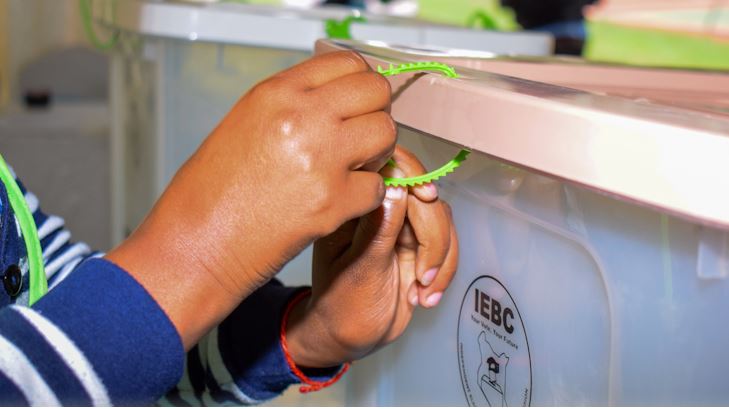
And all this happens under the rubric of “democracy.” Kenya’s electoral system is a costly farce, with the so-called Independent Electoral and Boundaries Commission consistently failing the independence test.
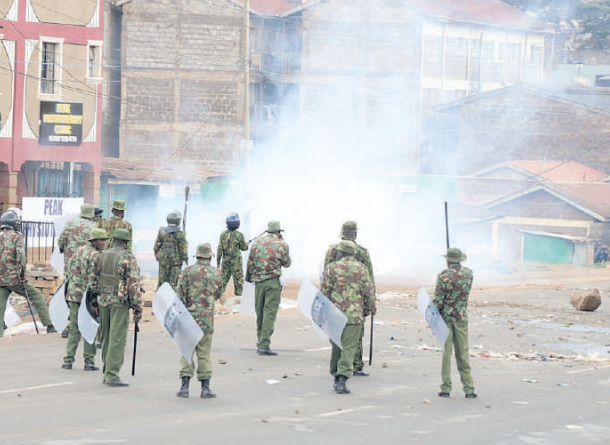
Each cycle is riddled with high school logistical blunders, tech failures, rigging claims, and courtroom battles, all at the expense of tens of billions of shillings, just to crown another emperor.
At the heart of every election lies the elephant of tribalism. When policies fail, politicians retreat into ethnic bunkers, chanting divisive mantras such as, “our people are being finished” or “our turn to eat.”
Power becomes a zero-sum game, reducing Kenya to a confederation of tribes scrambling for state patronage at the expense of true nationhood. Then there’s the economic dimension of democracy’s failure.
In a country where nearly half the population lives in poverty, democracy cannot thrive. Hungry people are easy to manipulate. Voter bribery is not just rampant, it’s normalised.
People trade votes for as little as a packet of unga or a branded t-shirt. When survival is on the line, civic duty takes a backseat. And who can blame them? The system is rigged to reward corruption, incompetence and idiocy, not character.
Political campaigns are financed through stolen public funds and proceeds of economic crimes.
To get elected, one must spend millions. Once in office, the pressure to recover that investment is intense.
The result? A Parliament full of millionaires whose primary agenda is self-preservation. And let’s not forget the external puppeteers. Our democracy is often shaped to please development partners, not citizens.
Western embassies praise our “peaceful transitions” while ignoring the structural violence of poverty, joblessness and inequality.
Foreign donors bankroll civic education, election observation, and governance reforms, while turning a blind eye to stolen elections and shrinking civic space.
As long as Kenya plays ball on security, trade and investment, democratic backsliding is accommodated.
So what do we do? We must abandon the illusion that elections alone define democracy. True democracy is not about ballot boxes or biometric kits, but about justice, accountability, equity, and dignity—values our institutions still lack.
We need a political culture that values substance over slogans, driven by issue-based politics, empowering civic education, and sustained citizen oversight beyond elections.
Power must also be redistributed—socially, economically, and politically—because a democracy that marginalises the majority from land, opportunity, and voice is a cruel contradiction. Without economic justice, democracy remains a privilege of the wealthy and a trap for the poor.
Most importantly, we must confront our failures with honesty. Finally, we must speak honestly about our failures. Patriotism demands we hold power accountable, even when it is uncomfortable. Silence is complicity.
Democracy in Kenya is dead, surviving only as a lie—until we, the people, choose to rise and demand something truly better.
Edwin Wanjawa teaches Globalisation and International Development at Pwani University and is a Programmes Associate at DTM, media CSO, [email protected]

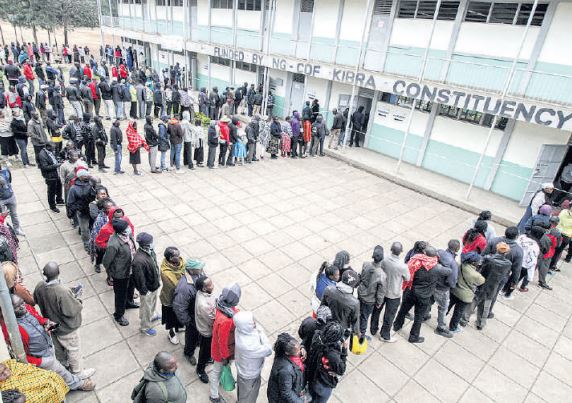 Kenyan queue at a Toi Primary school polling station to cast their vote in the August 8,2022 General election /ENOS TECHE