Beyond the turmoil in Mt Kenya, both leaders’ firm grip on
their traditional political bases is now doubtful, with former loyalists defecting
or distancing themselves from their once-influential principals.
The likely defections threaten to weaken the political dominance of the two
most powerful figures in Kenya’s current political landscape and may reflect
deeper shifts in the country’s political dynamics.
Several leaders within both Kenya Kwanza and ODM now fear the burden of
incumbency could come at a steep political cost in 2027.
The courage by some of the leaders to openly breakaway from Raila and Ruto, while
still confident of a win, could also signify changing political fortunes
for the duo, analyst say.
Interestingly, some of the realignments are
happening in Nairobi, Western Kenya, Coast and in parts of Masailand, regions
where Raila and Ruto swept clean in the 2022 polls.
Ruto’s administration is grappling with unprecedented public unrest
fueled by high taxation, allegations of corruption, and growing accusations of
impunity.
This pressure has prompted ambitious political leaders to quietly distance
themselves from the broad-based government.
Multiple MPs who rode the UDA or ODM wave in 2022 are now crafting new
political identities.
Some hint at contesting as independents or aligning with emerging
formations—seeking to avoid being directly associated with the perceived
failures of the government.
Others are drifting toward the opposition, with Raila’s influence suffering
particularly in the Gusii region.
In Central Kenya, many leaders, including some current governors and senior
government officials, are said to be planning to quit as the clock ticks
towards 2027.
Moses Kuria resigned last weeks as Ruto’s adviser, but his political plans
remain unclear.
Prominent figures once fiercely loyal to Ruto or Raila and now seemingly
changing course include Kakamega Senator Boni Khalwale and MPs Mohamed Ali
(Nyali), Babu Owino (Embakasi East), and Caleb Amisi (Saboti).
In Kisii, nearly all ODM MPs have signaled defection. They include Senator
Richard Onyonka and Kitutu Chache South MP Anthony Kibagendi.
In Maasailand, Kajiado Senator Lenku Seki, who was elected on Ruto’s UDA
ticket, has shifted his allegiance to Gachagua.
It is a similar case in Narok, where Moitalel Ole Kenta, who ran for Narok governor
on Raila’s ODM party ticket in 2022, is leaning towards Gachagua.
In Western Kenya, Senator Khalwale—long regarded as a key Ruto ally and who
doubles up as the Majority Whip— is gradually detaching himself from the ruling
UDA party.
Sources close to the outspoken legislator reveal that he is quietly laying
the groundwork for a new political outfit, the United Patriotic Movement, which
is reportedly in the process of being registered through proxies. The party is
expected to be headquartered in Nairobi.
"Yes, he has registered a party through proxies. He cannot declare
himself party leader because he is still serving as a senator," said a
close confidant who requested anonymity.
In a video clip that has since gone viral, Khalwale hinted at the formation
of a political vehicle to rescue Luhyas from what he termed as the current
political bondage.
“I have respected Wetang’ula. I have
respected Mudavadi, but because they have let us down, I have decided. Let them
go there (stay in government), but they will also find me here,” he says.
“I have been relying on them so that we walk together, either in one vehicle
or a vehicle that can give me leeway to reach up there. That is the problem
they used in 2022 to stop me. I’m the first person who brought William Ruto to
the Luhya nation.”
When contacted by The Star, Khalwale neither confirmed nor denied the
reports. Instead, he offered a cryptic analogy:
"Even Americans went to the moon, but they never said until they were
there. Let’s continue talking. We will talk.”
Known for his fiery speeches and blunt commentary, Khalwale has recently
emerged as a sharp critic of the Ruto administration—especially over alleged
police killings, abductions, and what he calls a politically motivated
anti-corruption drive.
His defiance is seen as a potential sign of shifting allegiances in the
vote-rich Western region ahead of 2027.
His latest criticism followed the dramatic arrest of Trans Nzoia Governor
George Natembeya by the Ethics and Anti-Corruption Commission.
Khalwale came to Natembeya’s defense, aligning himself with the embattled
governor, who is increasingly leaning toward Deputy President Rigathi Gachagua’s
Democracy for Citizens Party. He decried the arrest as political persecution.
"That was political intimidation of the governor," Khalwale said,
further fueling speculation of his split from the Ruto camp.
At the Coast, Nyali MP Mohamed Ali, popularly known as Jicho Pevu
from his days as an investigative journalist, has also signaled intent to ditch
UDA as he eyes the Mombasa gubernatorial seat in 2027.
In an interview with the Star, Ali lamented internal party wrangles
and accused some UDA operatives of micromanagement and exclusion.
“There is a lot of micromanagement in the party, especially in Mombasa. It’s
stifling leadership and personal agency,” he said.
His discontent has caught the attention of the opposition. Last month, Wiper
leader Kalonzo Musyoka hinted that Ali could be headed their way. At a rally in
Changamwe, Kalonzo praised Ali and suggested his defection was imminent.
"You have been greeted by a young man called Jicho Pevu. Do you know
Jicho Pevu? He has said he is on his way. He will join us like the others,”
Kalonzo told the crowd.
Ali, the only MP elected on a UDA ticket in Mombasa, appeared to confirm his
frustrations days later in a scathing social media post directed at the Kenya
Kwanza administration.
“As a leader in this country and a former investigative journalist who
sought to bring truth and justice to my fellow Kenyans, nothing is clearer to
me today than the depths of depravity we have sunk in as a country,” he wrote. “The
lies do not add up, and the story does not stick.”
He accused the regime of abandoning its promises and adopting “uncouth and
authoritarian” methods to suppress dissent.
Meanwhile, Raila’s side of the political aisle is restless with internal
rebellion. Some of his close allies are now distancing themselves from the
opposition leader’s broader alliances—some quietly, others publicly.
Both Babu Owino and Caleb Amisi have openly criticised the Ruto-Raila cooperation
and hinted they may walk away if the two join forces for 2027.
Amisi, in a clear indication of exploring new political options, remarked: “We
must not just accept to be bandwagoned into only two political formations.
Alternative voices are also critical in solving problems.
“Kenya needs a renaissance. For Kenya to change, we must never be drawn into
team Wamunyoro (Rigathi Gachagua) or team Ruto. We must preach change—change
that Kenya desperately needs.”
Babu, who has declared interest in the Nairobi gubernatorial race, has been
especially vocal in opposing the Ruto-Raila rapprochement.
Despite both leaders hinting at supporting Governor Johnson Sakaja, Babu has
insisted he will be on the ballot—triggering speculation that he may bolt out
to pursue his ambition elsewhere.
INSTANT ANALYSIS
With defections looming, disillusionment simmering, and new alliances
forming under the radar, observers believe that both Ruto and Raila now face an
uphill task to either consolidate their camps or risk being left behind in a
fast-shifting political terrain.


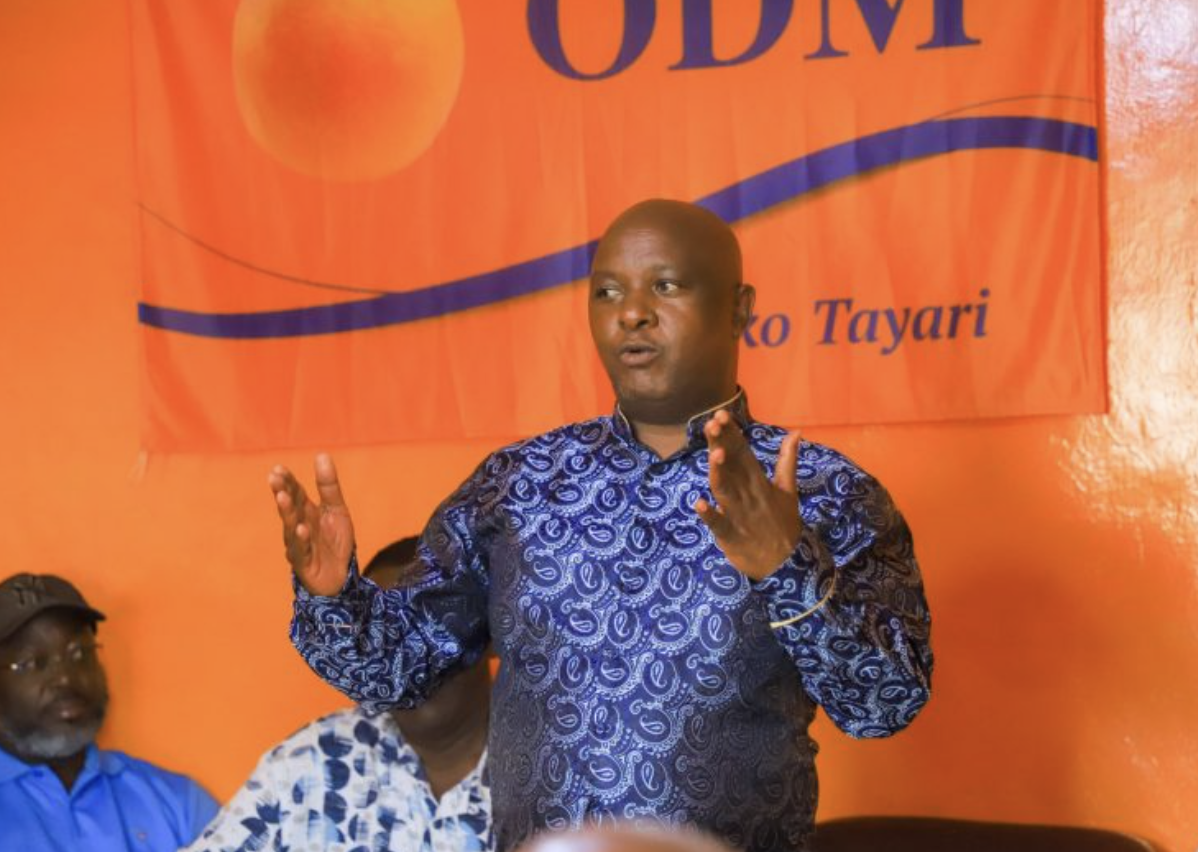
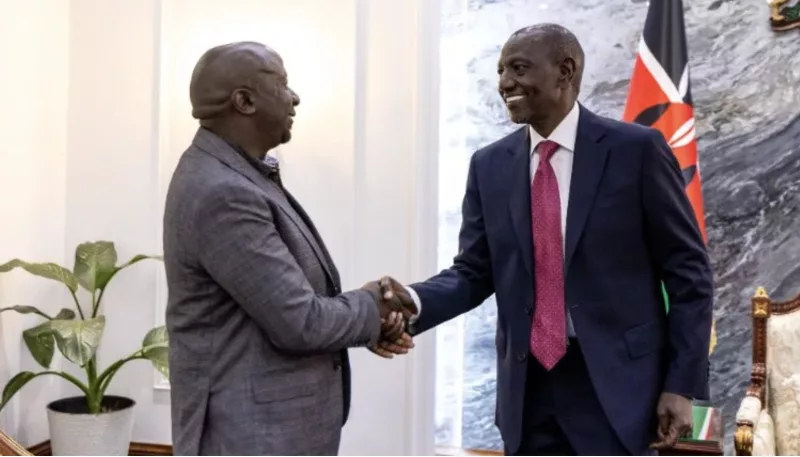
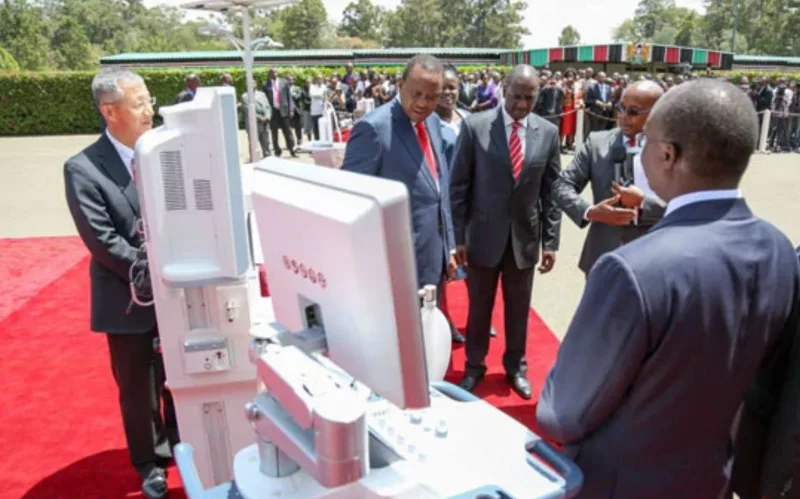
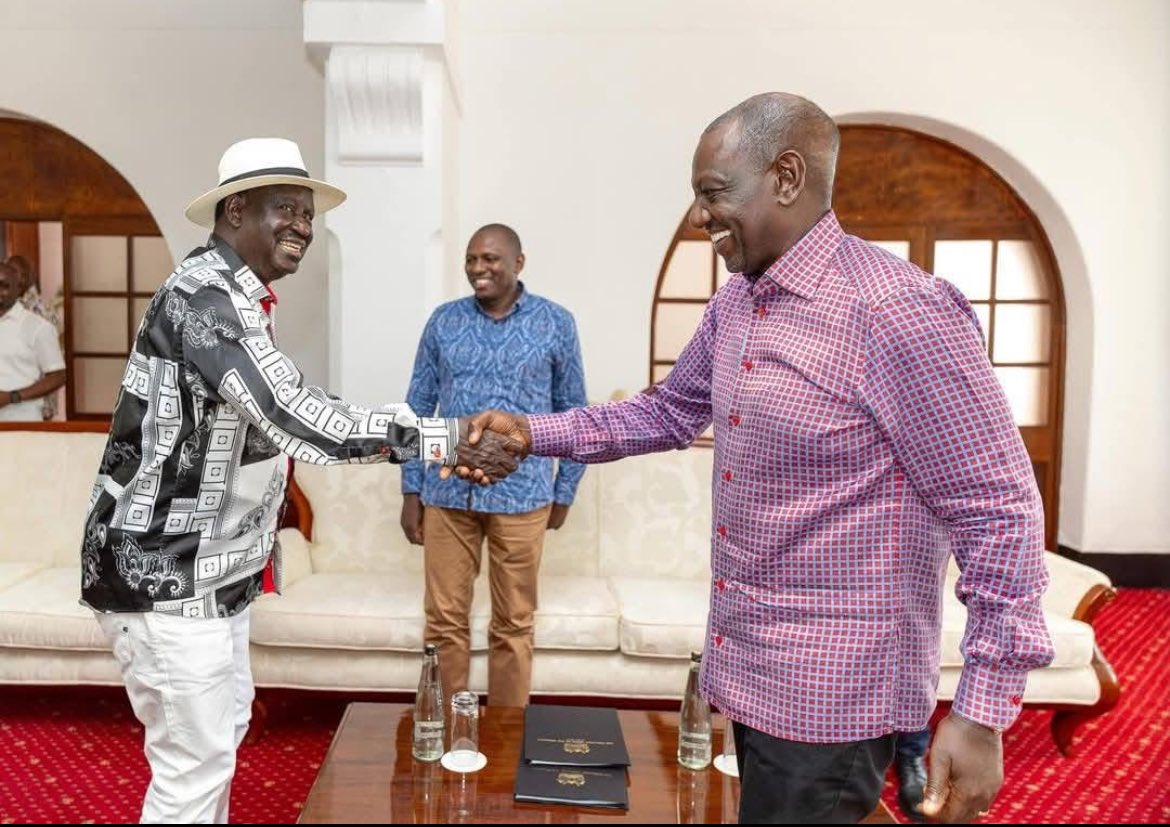 President William Ruto shakes hands with ODM leader Raila Odinga at Mombasa State House. [PHOTO: PSC]