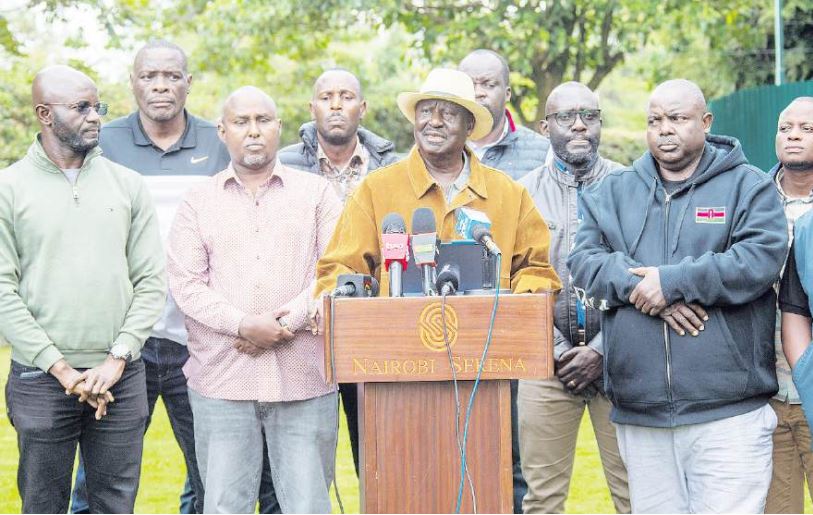
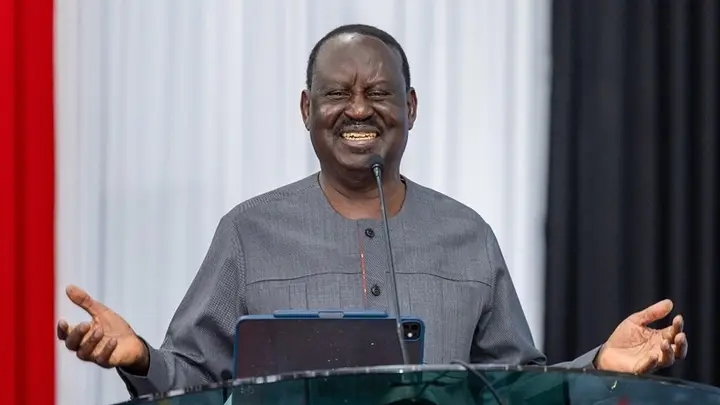
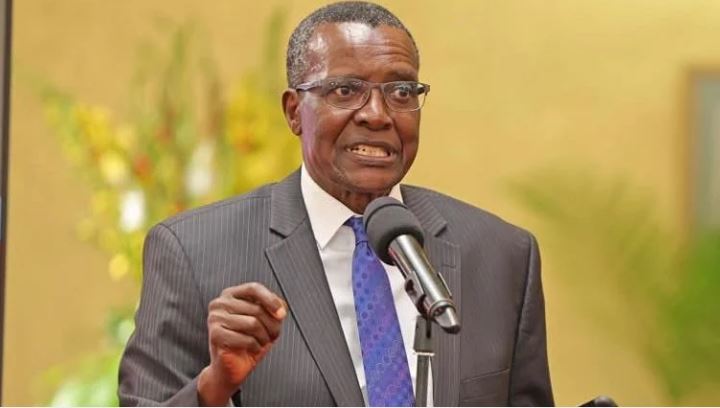
FORMER Prime Minister Raila Odinga faces numerous hurdles in his rebranding
strategy as his ODM party unveils a fresh roadmap for the 2027 elections.
Raila’s inner circle remains split, with some urging him to back President
William Ruto’s re-election while others push for a direct challenge,
especially in light of mounting public discontent with the UDA administration.
In recent days, Raila has signaled a potential sixth stab at the presidency,
lining up a flurry of activities aimed at reinvigorating his party and
reaffirming his political presence.
Last week, the Star exclusively reported on an aggressive campaign
orchestrated by influential Mt Kenya power brokers to pressure Raila into the
race to scuttle Ruto’s second term.
According to insiders, the argument advanced by the emissaries is that
aligning with Ruto would make it nearly impossible to dislodge the UDA regime.
On Tuesday, ODM rolled out a series of activities aimed at setting the stage
for the 2027 presidential campaign.
The plans, crafted by the party’s Central Management Committee during a
meeting chaired by Raila, include countywide celebrations to mark ODM’s 20th
anniversary, culminating in a major national event in October.
“The events will reflect on the party’s journey, achievements, and future
direction,” ODM secretary general Edwin Sifuna said in a statement.
The party is also planning a National Delegates Convention in October to,
among other things, “chart the path forward in readiness for the 2027 general
elections.”
However, even if Raila chooses to run, analysts warn that he faces
formidable obstacles amid shifting opposition dynamics under the Ruto
administration.
They argue that a sixth presidential attempt is fraught with complexities, ranging
from a shrinking traditional support base to the challenge of staying
politically relevant.
Since assuming office, Ruto has employed a tactical approach seen as more
effective at neutralising Raila than the 2018 handshake with former President
Uhuru Kenyatta.
Observers suggest that the burden of incumbency, which hurt Raila in the
2022 polls, may once again weigh down his chances in 2027.
Former Deputy President Rigathi Gachagua, currently on a US tour, dismissed
Raila as a political relic whose support base has eroded.
“Raila Odinga brings nothing to the table,” Gachagua said. “The Kambas who
were behind him have left. The Kisiis have left. The Luhyas have left. The
Maasais have left. The Luo nation is divided in the middle.”
He further asserted that even a Raila-Ruto alliance would not change the
political outcome, boasting that, “Even if they are together, we’ll beat them 70
plus one per cent.”
Another challenge for Raila is the slow but steady co-optation of his allies
into Ruto’s administration.
Former ODM deputy party leaders Hassan Joho and Wycliffe Oparanya,
among others, have been appointed to government roles, labelled as ‘experts’.
Speculation is also rife within ODM that Ruto may pick a running mate from
Nyanza, a move that could further blur political lines and complicate Raila’s
positioning.
Raila’s continued silence amid growing public dissatisfaction with the
government has also attracted criticism, with some perceiving him as complicit
or at least tolerant of the administration’s perceived failures.
Prof Gitile Naituli dismissed Raila’s chances in 2027, arguing that his
national appeal has significantly declined, despite maintaining influence in
traditional bases such as Nyanza and parts of Nairobi.
“Raila has caused irreparable damage. No magic can make him get even a
quarter of his former supporters,” the former NCIC commissioner said. “For the
first time, people saw a Raila pattern, which is selfish.”
Should Raila break ranks with Ruto, questions remain over whether any
potential coalition partners would trust him enough to form a formidable
alliance, given Kenya’s history of shifting political allegiances.
However, political activist Victor Marende dismissed claims that Raila’s
support bases are gone.
“He is okay, his support bases are still intact—whether you speak of
Western or elsewhere,” he said. “They
are stronger together with Ruto. As a youth, our major concentration is to
nurture the relationship between him and Ruto for development and peace.”
Political analyst Javas Bigambo acknowledged Raila’s continued relevance but
questioned the logic of another presidential run.
“As a notable politician and as a Kenyan whose political rights are not
perishable, Raila's political shelf life remains within date and
consequential,” Bigambo said.
“The tides have kept turning, and a 2027 stab at the presidency would be
expeditionary if given a microscopic look. But the critical question would be:
what would be informing the candidature?”
Bigambo argued that Ruto is unlikely to abandon the political memorandum of understanding
between the two.
In his view, Raila’s most strategic move may be to solidify his
partnership with the President rather than oppose him.
“Raila Odinga has effectively twinned himself with President Ruto and would
do better by combining forces to face off the Gachagua-led opposition,” he
said. “Their nationalistic sensibilities and welcomed sense of cohesion would
be more formidable than Gachagua's wing, which is powered by vengeance and a
separatist tribal mantra.
“The taproot of Raila's major significance, therefore, would be to
rationalise his working relationship with President Ruto.”
Government insiders aligned with Raila express confidence that he will
remain within the orbit of the administration.
Deputy President Kithure Kindiki recently described Raila as a crucial
pillar in a political alliance that could be unbeatable in 2027.
“If you look at William Ruto, me, and now that we have His Excellency Raila
Odinga in our team, do we look like people who can be defeated during
campaigns?” Kindiki posed.
While he downplayed early politicking, Kindiki’s remarks reinforced
perceptions that Ruto’s camp views Raila as an asset rather than a threat, at
least for now.
Raila loyalists supporting the broad-based government arrangement insist the
alliance is not about to unravel.
Homa Bay Town MP Peter Kaluma, while confirming ODM will field a candidate,
gave no indication of a looming fallout with Ruto.
“How do you part ways with your thing?” Kaluma asked. “ODM will have a
candidate, either as a party or in a coalition of parties.”
University of Nairobi lecturer Herman Manyora believes Raila would only
break ranks with Ruto if he intends to run.
“He will figure out where he is likely to be more respected,” Manyora said,
noting that the ODM leader may stand to gain more from working with Ruto.
“From where I sit, either he is going to run, but he is more likely to stick
by Ruto in 2027 because of the attendant benefits, some immediate.”
INSTANT ANALYSIS
The coming months will reveal whether Raila’s political calculations lean
toward continued collaboration with the Ruto administration or he will opt for
a confrontational approach. But one thing is certain: his path to a sixth
presidential bid is not smooth, especially with the Gen Z wave keen on denying demolishing
the legacy of his politics.