On a chilly Tuesday morning in June last year, Rex Masai laced
up his favourite running shoes, kissed his mum on the cheek and left home.
“Don’t worry,” he told her with a grin, “we’re just marching for
our future.”
He never came back.
By nightfall, Rex’s name was trending globally.
He had been shot dead on Moi Avenue — one of the 63 young
Kenyans fatally wounded during the nationwide protest against the government’s
2024 Finance Bill, which would have raised taxes on everyday essentials.
But the protests weren’t just about taxes. They were also about years of frustration, corruption and
hopelessness. Gen Z protesters were weary of waiting for change, demanding
jobs, reducing poverty and reforming what they called bad governance.
“They didn’t just kill my son,” said Chrispine Odawa, the father
of Masai, who didn’t return home.
“They killed a dream. He was my only child. He had never even
harmed a fly.”
Odawa held a portrait of Rex and spoke at the offices of Amnesty
International.
For Jacinter Anyango, the mother of 12-year-old Kennedy Onyango,
the pain of the loss has deepened with time.
The boy was killed at home in Ongata Rongai, Kajiado, felled
by multiple gunshots.
After the bloodletting, President William Ruto made contradictory
statements about Onyango, at one point claiming the boy was still alive.
The family also suffered when internal squabbling boiled over and disrupted burial plans for
months.
Anyango told the Star the past year has been hell and one of
struggle and bitterness, plus failed financial
support by politicians.
No security officer has been made to answer for her son’s blood, she said.
“It is sad that my son is not just no more, but also that the
powerful don’t care about it. They looked us in the eye and lied to us that we
would get justice and support. It is unforgivable,” she said.
She remembers seeing her son’s body “riddled with countless
gunshot wounds as though he was a thief or a rioter. That image won’t go away.
“They should have just shot him in the head so he would have
died at once, rather than spraying him with the bullets as they did.”
And as many families struggle with broken hearts, fresh wounds
of recent shootings by rogue police bullets increase their pain. The families
of recent victims are also suffering.
For example, the family of Boniface Kariuki, the facemask hawker
shot in the head by a police officer during protests last Tuesday, is not only overwhelmed
by his near-death, but also the ballooning hospital bill.
They want the government to finance treatment of the 22-year-old
youth.
Kariuki was accosted by riot police in Nairobi and wounded on
the left side of his head, causing extreme injury. He underwent surgery to save
his life but he’s not out of the woods.
Kariuki’s grandfather George Irungu said his grandson is in
serious condition at Kenyatta National Hospital and the government should
ensure he gets the best treatment until he recovers.
Irungu spoke when Central regional police commander Samuel
Ndanyi led security officers to Kariuki’s home in Karugia village, Kangema
subcounty, Murang’a county.
“We keep getting reports of his unstable condition. We want the
state to take responsibility because this situation was caused by its workers,”
Irungu said.
Kariuki was eking out a living and trying to support his family.
“We want the government to work with us until the young man gets
better. Our hope is that the government will not abandon us because we cannot
afford to give him the treatment and support that he requires,” he said to the
police officers on their condolence visit.
“We’re happy you have visited but we hope you won’t stop there.
Hold our hands. Walk with us until our son is healed,” he told the regional
police commander.
As planned during the demonstration on June 25 last year,
protesters stormed Parliament, vandalised and set fires to part of it.
Protesters later hunted down some of the MPs who voted in favour
of the Finance Bill, as security agents hunted down protesters.
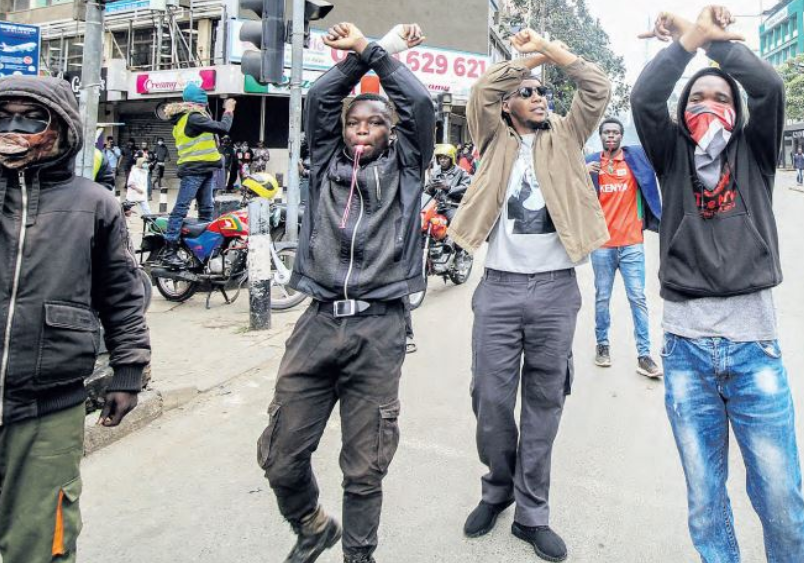
In Nairobi, Mombasa, Kisumu, Nakuru and elsewhere, thousands of
young people —many barely out of high school and some in college — poured into
the streets, fired by passion and rage.
Armed with online zeal, placards, art, chants, and hope, they
were part of a movement born online and fuelled by TikTok, X, Instagram and
other platforms.
They are Gen Z — tech-savvy, fearless and unaligned to any
political party. They say they are officially leaderless. While the movement is
led by Gen Z, they have widespread support by the general public that is
similarly disillusioned and angry.
Generation Z, also known as Zoomers, is the demographic cohort
succeeding Millennials and preceding Generation Alpha.
They did not expect to die that day.
Benson “Scott” Mbithi, 29, was a matatu tout in Korogocho who
had never attended a rally in his life. But on that day, he skipped work and
joined the protest in Nairobi’s CBD.
“He told me, ‘Mathe, this is not about me — it’s about all of
us’,” recalls his mother, Penina Mueni, who tried to discourage him from taking
to the streets.
“That was the last call I got from him. They shot him nine
times.”
Some protesters were shot in the back while running away.
Others reportedly were abducted, tortured, or disappeared.
The constitutionally mandated Kenya National Commission on Human
Rights confirmed 63 police killings linked to those protests.
The Independent Policing Oversight Authority (Ipoa) has been
investigating these deaths and chairman Issack Hassan said 20 files have been
sent to the Director of Public Prosecutions for action.
A year later, the nation remains restive and on edge as
activists from those protests still face threats, surveillance and arrests.
Amnesty International executive director Houghton Irungu told
the Star the government’s failure to deliver a measure of justice is fuelling
the passion against those in power in the country.
“It is shameful that it had to take BBC investigative reporting
to identify the police officers who pulled the killing trigger on the unarmed
protesters in Parliament, yet our authorities, including Ipoa, either sit on
their hands or feign lack of capacity,” he said.
On Tuesday, Interior CS Kipchumba Murkomen said that one year
on, he is ready to meet families of the June 25 victims “to explore how the
government can offer further support”.
He said the government had opened the door for dialogue and was
prepared to extend a supporting hand to the affected families.
"In the ministry, and from a human perspective, we are
ready to meet the families of the victims who unfortunately lost their lives as
a result of these political acts. We are open to having a conversation with
them and exploring ways we can offer further support,” the CS said.
Murkomen alleged politicians and activists are preventing the
victims’ families from engaging with the government. He urged them to step
aside and allow dialogue to proceed.
“I want to ask those political actors to keep off and allow the
families to meet us and have a conversation, so we can explore how best to
support them,” he said.
The CS also called out politicians planning violence under the
guise of peaceful demonstrations.
“It is unfortunate that some leaders who, just around this time
last year, were standing here defending law and order are today orchestrating
violence and distributing crude weapons,” the CS said.
“We will be ruthless in dealing with such characters because we
want this country to remain a nation of law and order.”
Today, June 25, is expected to be another day of massive protest
as youths have been mobilising themselves to mark the day. Disruption of normal
activities, including public transport, is part of the protest package.
Criminal elements may exploit the situation to loot, steal and generally cause
trouble.
“It is a day of honouring our compatriots who were illegally
hunted down and butchered by state agents as though they were al Shabaab
terrorists,” 21-year-old Felix Odhiambo, a university student said. He pledged
to turn up for the protests.
“We turn up to mourn our countrymen declared treasonous and
criminal by this Ruto regime,” WM said, asking that his name be withheld.
“We turn up to show him the middle finger.”
In Mathare, Edith Kamau stands by a mural (a wall painting) of
her son, Ibrahim Kamau, who was gunned down as he tried to shield another
protester.
“He wasn’t even part of the protest at first,” she says. “He saw
someone fall, ran to help, and then he was gone.”
Many youth activists urge the government not to regard all
youths as violent when they advocate for their right to protest through
peaceful demonstrations.
Some Gen Zs in Homa Bay say the government should not perceive
them as hooligans whenever they champion their rights through peaceful
demonstrations.
They urged the government to exercise democracy as enshrined in
the constitution.
They addressed a forum in Homa Bay town, convened by the
Community Action for Health and Development in collaboration with the Coalition
of Homa Bay Organisations on Governance Oversight.
Harrison Ochola and Laveen Ogaya said the government has
developed a mindset that perceives young people as lawbreakers whenever they
hold demos to oppose its action or lack of action on service delivery.
“Police have a brutal habit of viewing and approaching youths
who are championing their democratic rights. The state should listen to
demonstrators and not perceive them as hooligans,” Ochola said.