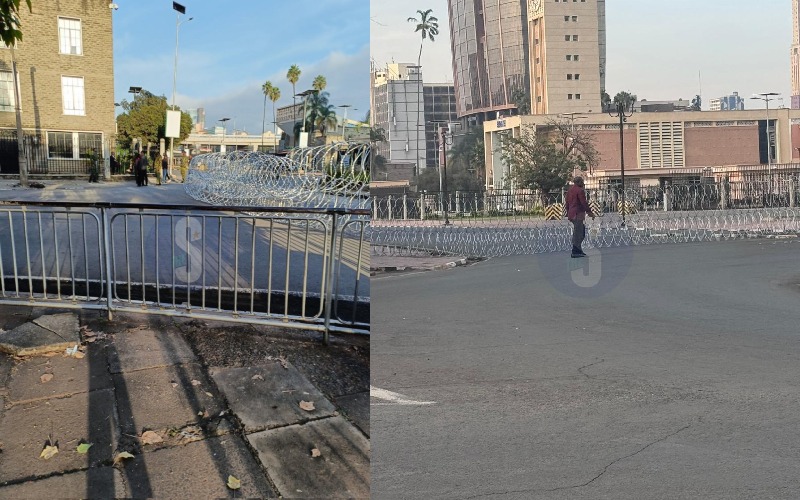
A razor wire erected around Parliament Road on June 25, 2025/CYRUS OMBATI
Razor wire is a type of security barrier made of sharp-edged metal strips designed to cause injury and prevent access. Commonly used around prisons, military installations and high-security zones, its primary role is to create both a psychological and physical deterrent.
But in Kenya today, razor wire is no longer just fencing. It has become a symbol of tension, memory, and state response.
As of Wednesday morning, Nairobi’s Parliament was encircled with glinting coils of razor wire, barricades, and a heavy police presence.
Streets such as Parliament Road, Harambee Avenue, and Kenyatta Avenue have been sealed off using layers of wire, iron fencing, and concrete slabs.
Why is Parliament blocked with Razor wire
June 25, 2024, remains etched in national memory.
On that day, thousands of young protesters marched against the Finance Bill, which introduced new taxes on basic goods.
What began as online mobilisation turned into a massive street protest.
Demonstrators broke through security barriers, entered Parliament, and caused extensive damage.
In the response, police opened fire. The violence led to several deaths, shocking the nation.
Now, one year later, authorities are keen to avoid a repeat.
“We are prepared and will not allow any unlawful entry into state institutions,” Inspector General of Police Douglas Kanja said on June 24, 2025.
“Any contrary conduct constitutes an unlawful and riotous assembly. The National Police Service shall at all times lawfully and firmly prevent any breach of peace by any group or groups of persons, acting contrary to the provisions of the law. Additionally, it is important to note that unauthorised persons must refrain from accessing protected areas under the Protected Areas Act (Cap 204, Laws of Kenya),” he said.
He urged Kenyans to refrain from provoking police officers while executing their duties.
Kanja said the Constitution, under Article 37, guarantees every person the right, peaceably and unarmed, to assemble, to demonstrate, to picket, and to present petitions to public authorities.
The IG called on protesters to cooperate and coordinate with the police, adding that any contrary conduct constitutes an unlawful and riotous assembly.
He appreciated the patriotism and dedication to duty of all police officers, who put their lives on the line for the defence of the country.
“These are the unsung sons and daughters of Kenya, who work hand in hand with other agencies for the common good of the country,” he said.
He appealed to Kenyans to continue supporting police efforts, and to report suspicious activities to the nearest police station, or via the provided channels (999, 911, 112, 0800 722 203 or #FichuakwaDCI). #FichuakwaDCI).
He said all the information will be treated with utmost confidentiality.
Where the wire has been placed
The razor wire is not placed randomly. It lines key routes that lead directly to Parliament and surrounding ministries, City Hall Way, Harambee Avenue, Parliament Road and others.
By sealing off these strategic corridors, authorities hope to prevent demonstrators from reaching state buildings.
The setup includes not just razor wire, but barricades and a heavy police presence.
Riot control vehicles are stationed at multiple intersections, creating layers of resistance meant to slow, scatter or stop advancing crowds.
This morning, surveillance drones, sniffer dogs and plainclothes officers were also seen patrolling the city centre.
Roadblocks extended as far as Haile Selassie Avenue.
While the state insists the measures are necessary, civil society groups have raised alarm over the optics and message being sent.
Photos of the razor wire, now viral, have drawn mixed reactions. Some say it’s a justifiable shield. Others call it a wall between the government and citizens.
The Kenya Human Rights Commission (KHRC) questioned whether razor wire reflects a government securing its institutions or distancing itself from the people.
“Public institutions must not become fortresses. The real protection lies in dialogue, not wire,” it said in a statement.
As Gen Z protesters chant, grieve, and demand reform today, one image dominates: the silver coils wrapped tightly around Parliament. A security tool. A political statement. A national metaphor.