On a sunny Friday, March 7, under beautiful clear blue skies portending a brilliant day, President William Ruto, ODM boss Raila Odinga and their key lieutenants signed a cooperation deal to give the already-formed broad-based government a semblance of cross-aisle legitimacy.
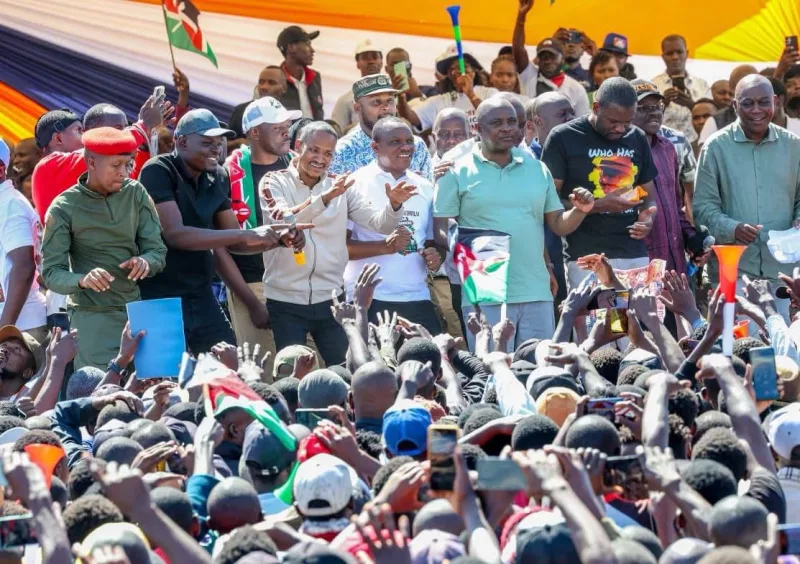
Typically, pro-Raila crowds thronged the KICC grounds in anticipation and predictably chanted their support.
Inside, when his opportunity to speak came, Raila obviously tried to bridge the gap between his centre-left pro-people ideology with those of the right-wing sharks the President had dragged along.
Raila stated his conditions for the deal to pacify and anaesthetise his supporters. He assured them that they were not the small-time riders that lesser operatives in ODM would generally seek: like a road here and a fish market there.
It was vintage Raila, targeting key national issues. First, he demanded compensation for protesters killed or injured in the June 2024 Gen Z protests. Then he stated that police brutality would be unwelcome in the new dispensation.
Then he crowned it with a very Raila-esque devolution demand: that the revenue share for counties in 2025-26 be increased to Sh450 billion, at the very minimum.
A friend who keeps tabs on Kenya’s politics immediately remarked, cheekily, that Raila was giving Ruto the conditions the President wouldn’t be able to meet as a way of keeping one foot out of the deal, awaiting the exit day.
So far, little more than three months later, there has been no indication from the government that any form of compensation will be given to protest victims for deaths and injuries caused directly by police brutality.
The Kenya National Commission on Human Rights reported on July 1 that 39 people died and 361 were injured in protests countrywide, from June 18 to July 1.
On the sticky issue of revenue share, the Senate, to its collective credit, proposed a revolutionary Sh465 billion, but the National Assembly stuck with Sh405 billion, which Treasury CS John Mbadi read in his budget estimates.
If you intend to kick Raila, the ‘father of devolution’, in the teeth, this would be the worst form of kick.
At the March signing ceremony, ODM secretary general Edwin Sifuna, who has styled himself as a critic of both the broad-based arrangement and the signed deal, also appointed himself auditor of the deal’s progress.
He said if police abductions and brutality continued, it would render the deal null and void. This past weekend, at separate functions in his native Western, Sifuna declared the framework dead and buried, on account of the killing of teacher and blogger-critic Albert Ojwang while in custody at the Central police station cells.
At the time this piece was filed, police Deputy Inspector General Eliud Lagat, had “stepped aside”, following his adverse mention in the Ojwang’ saga, as being the origin of the complaint that kicked off the chain of events leading to Ojwang’s death.
Ojwang had criticised Lagat’s behaviour in the National Police Service. I don’t really know what stepping aside means in the Kenyan context, but public figures facing deep scrutiny love to hide behind this phrase when they want to avoid resigning in plain and simple terms. It is the dubious space between staying put on the job and totally exiting to allow real, credible and proper investigations to take place.
Of all the conditions that Raila gave at KICC during the signing ceremony, the insistence on ending police brutality, I think, should worry him the most, because no statement of impunity comes bigger than Ojwang’s death.
Members of the larger Odinga clan have been lifelong victims of police brutality, running so obviously through nearly all of Kenya’s presidencies, that no one can educate the former PM on the vagaries of a brutal police force.
For Raila, Ojwang’s death is an even deeper cause for reflection, because no community over the decades has suffered at the hands of the police, as much as his Luo community.
For Ojwang to be killed with such impunity, when the community supposedly is joined at the hip with the government, must be a devastating blow.
Over the years, there have been deeply disturbing police actions that make the National Police Service at times a dangerous relic from a gone era. But in the case of Raila, I wish to point out two incidents at the extreme ends of his encounters with police, which may not be the worst, but they illustrate how low the security forces can sink.
Those who have read Kenya’s history and Raila’s biography, The Flame of Freedom, will remember the anecdote of then Police Commissioner Ben Gethi, stone drunk and chewing a roasted leg of goat, personally interrogating Raila and demanding he confess to taking part in the 1982 attempted coup. And those who haven’t read much history will easily remember the street birthday party organised by Raila supporters in Nairobi’s CBD in January last year, when police promptly arrived and lobbed teargas canisters at the birthday cake!
I cite these two incidents to demonstrate that the problem with the police service is not just brutality, but in many instances, a level of pettiness and vindictiveness that mirrors the political and tribal divisions in the country.
Police reforms may be a trendy phrase, but when there is a large force, poorly remunerated and poorly housed, and which makes itself readily available as a tool for settling political scores, then the cancer is much worse than anyone thinks.
Before DIG Lagat 'stepped aside’ this week, the system had done everything possible to save him, including telling embarrassing lies about the circumstances surrounding the death of Ojwang, initially calling it suicide.
Lagat has been described as a long-serving, diligent and professional officer. Which makes one wonder how someone of that calibre lacked the political nose to notice that when his complaint against the activist teacher arose, the President and Raila were barely out of Homa Bay county, where they enjoyed some renewed support for their cooperation framework.
Raiding that same county to arrest the blogger immediately the President departed, even if he hadn’t yet turned up dead, was naivety beyond measure.
Surprisingly, no one seems to know exactly what Ojwang posted, which means his post either had a tiny audience or never had the impact the complainant feared it did. But in a country where social media users have liberally generated AI images of the President in caskets, and caricatured his family in strange ways, it beats logic why the DIG was so spooked by supposedly false accusations posted by the blogger. A thick skin in a public office should be a candidate’s prerequisite during job interviews.
I submit that the ODM boss should present political divorce papers to Ruto on the grounds of infidelity to the ideals of democracy and freedom, neglect of the financial responsibilities of devolution and the brutality meted out to citizens by the police.
The brutality is the worst, because a nation whose fabric is easily torn apart by politics and inter-ethnic tensions cannot afford an arbiter in the form of a police service that wrongly imagines its mandate is to protect the people in power from the citizens.
Besides, as long as the police haven’t internalised the very simple fact that it is impossible to beat an entire population into submitting to any authority in this day and age, then the impeccable record of struggle against oppression attached to Raila’s name should not be blotted by this regime.

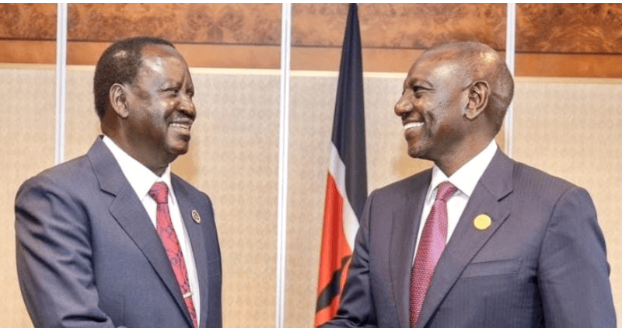
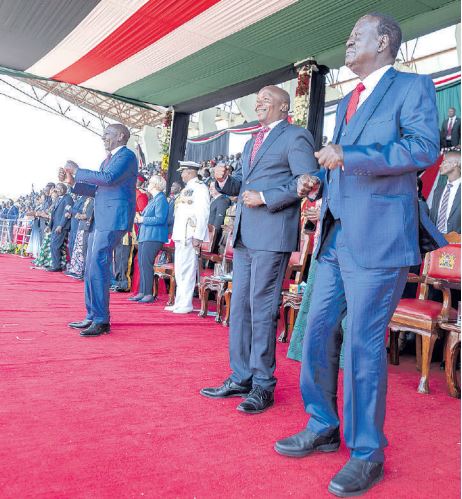 President William Ruto, Deputy President kithure Kindiki and ODM leader Raila Odinga at the 62nd Madaraka celebrations at Raila Odinga Stadium in Homa Bay county /PCS