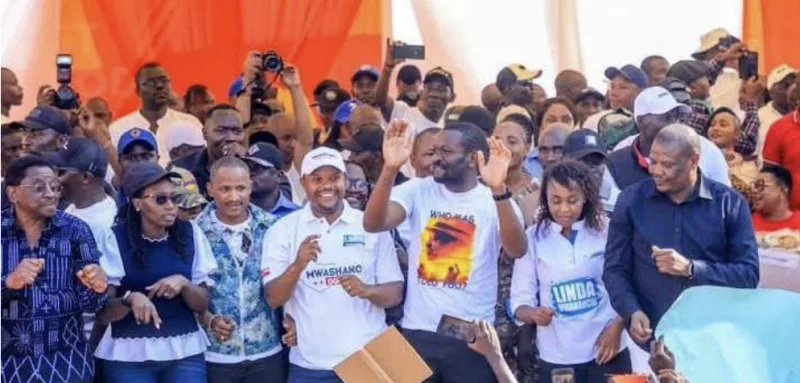
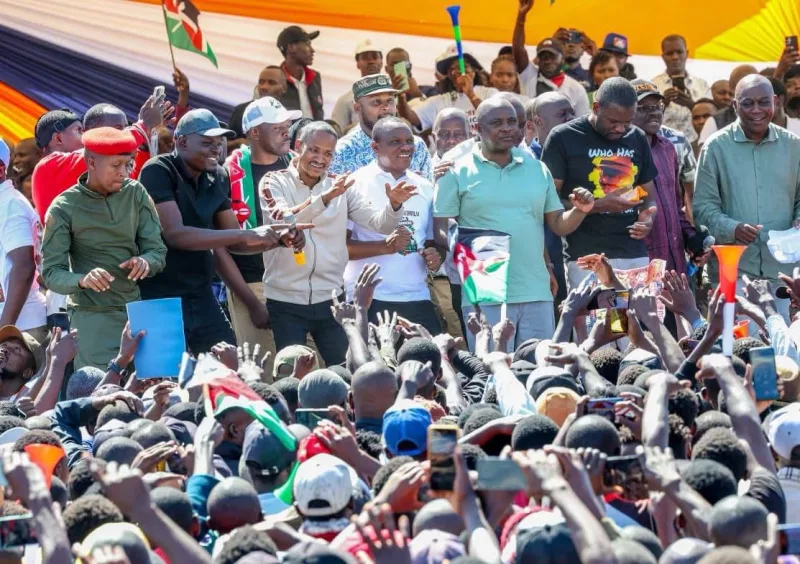
The next general election is two years away by this August. Yet there are already frenzied activities by opposition figures to galvanise their forces into one formation. This is in the hope that they will benefit from the old adage that the early bird catches the worm. And the big worm here is the GenZ.
Political leaders outside the broad based-government are frantically seeking dry ground from where they can settle as they find their footing.
They have gone through a political hailstorm since Raila Odinga joined forces with President William Ruto. Their hopes for the deal after the GenZ protests was a fleeting bad dream and turned out to be false.
Then they attempted to paint Baba in bad light as a traitor to ingratiate themselves with the young generation.
This also fell flat. As the coalition government rolled on, opposition leaders individually became confused and did not know whether to join or stay put. Secretly, some made efforts to be allowed to board. Publicly, they appeared steadfast as the people’s watchmen.
The building blocks for the opposition movement have been hinged on the stillborn revolution of the Gen Z protests in June last year. When the demonstrations begun, it was billed as opposition to the Finance Bill, 2024.
However, as the days progressed and the frequency increased, new demands were made on the government and Ruto. Until Ruto made an unexpected about turn and rejected the Bill with all its recommendations, the government faced an imminent collapse.
All indications were that the opposition had the grand opportunity to take over the reins of government.
They were blinded by the raging resistance and temporarily forgot the constitutional provisions of government self-succession. The deputy president assumes office in the event the president is removed from power.
Over three months, things moved so rapidly, as if Kenya was on a rollercoaster. Ruto dissolved and reconstituted the Cabinet and Deputy President Rigathi Gachagua got impeached. Then followed anguish in the Mt Kenya region and ecstasy in the ODM strongholds.
As the dust settled on both sides of the political divides, the realisation dawned that the political formations were on shaky ground. While the Ruto-Raila side could afford to rely on the largesse of the government to cement their newfound bromance, the Gachagua front had to sweat it out.
The UDA party leadership moved fast to ink an agreement with the opposition ODM at KICC. This effectively locked out the other Azimio coalition partner party leaders.
They had no way out of the opposition formation. For once they had to roll up their sleeves and get their hands dirty in the trenches of real opposition politics.
They then resorted to funerals and the comfort of church pulpits.
They have been utilising the opportunity to convey antigovernment propaganda couched as solemn condolence messages. In the churches, their pliant clergy wittingly invite them regularly to greet the congregation.
Such occasions are used to remind the faithful how Ruto has reneged on his pledges to Christians. Initially these events were sporadic and not well coordinated. It soon dawned on the opposition leaders that if they acted individually, they would be scattered to the four winds.
As the ODM members settled in their ministerial roles with gusto, Ruto reached out to his erstwhile nemesis and former boss, Uhuru Kenyatta. The rapprochement paid off for both sides as Ruto got some reprieve from the Mountain. Jubilee honchos and Uhuru’s close associates also got into government.
This led Gachagua and team to formulate ways of forging a united alliance to counter the government. He immediately set out on a mission to consolidate his influence on Central Kenya politics. His objective was to repeat what the John Michuki orchestrated around Uhuru Kenyatta as President Mwai Kibaki approached retirement.
Michuki organised events that culminated in the Limuru 2 conference. The meeting endorsed and anointed Uhuru as the undisputed leader of the Kikuyu community in matters politics.
The events surrounding the ICC trials helped to further consolidate the Kikuyu political base around Uhuru. In copycat style, Gachagua therefore began receiving delegations at his Wamunyoro rural homestead in droves.
The delegations were comprised mostly of political leaders from the central Kenya region. He occasionally visited and took part in events near his home turf, mostly in Upper and Lower Eastern region. He unsuccessfully tried to cajole the Kamba political leadership into the Gema.
He deftly revised the acronym to include them by suggesting that the ‘A’ should denote Akamba. The plot went further to suggest that Wiper’s Kalonzo Musyoka was the natural leader of the pack.
This was reinforced by pronouncements from Jeremiah Kioni, secretary general of the Jubilee Party.
Things changed dramatically when Uhuru got into the fold of the broad-based government. He revamped and rejuvenated his political networks. The Jubilee Party sprang back into life. The deserters led by Sabina Chege fell dumbfounded and have never recovered from the shock.
Quickly, Kioni took over the Fred Matiang’i presidential song from Senator Richard Onyonka. The self-exiled former Interior Cabinet Secretary was coming back and would be the presidential candidate for Jubilee Party.
As in 2013, the Kikuyu political elite threw Kalonzo under the bus once again. Martha Karua was not in the equation. Eugene Wamalwa continued to perform his master of ceremonies role in events where opposition leaders were to address the public.
Gachagua’s grand project against Ruto risked falling apart. Some key leaders of ODM strived to foment a revolt from within by opposing the broad-based government.
This gave some impetus and hope to the opposition movement. But it was short-lived. Governors James Orengo and Anyang’ Nyong’o have not found it smooth going ever since. Their supposed sidekicks in the national assembly and senate always suffer the same fate in public functions.
However, the most gruelling task for the opposition alliance has been to find a nexus with the Gen Z movement. The two groups have not jelled and there is no indication that they will find a common ground soon. The opposition seems not to have the gravitas to attract the restive youthful population.
Without this crucial vote block, beating Ruto in 2027 is a herculean task. This generation is not as gullible as many political leaders may think. They have serious reservations with the current administration. The issues are not personal but policy based. They are well educated and skilled.
Therefore, they are less primitive than the average voter of ten years ago. They employ technology in the use of English, Kiswahili and their respective mother tongues to develop coded languages. They listen more but speak less to the older generation. They communicate succinctly amongst themselves.
Their bitterness with Ruto’s government arises from a feeling of betrayal. They were in sync with the hustler philosophy on the eve of 2022 election. Ruto spoke their language and they felt him.
They poured out into the polling stations in their numbers and delivered the victory.
Does the opposition leadership in its current configuration understand this generation? They are poor in communication and none is known for any inspiring social agenda. Nobody remembers any of them with remarkable or radical policy position in politics.
Their politics has always been behind the big wigs and in the safety of the go-getters. All of them unfortunately have been associated with a dark epoch of Kenya’s history at one stage or the other.
Gachagua today claims to be the truthful man of Kenya’s politics. Yet the former provincial administration officer in the Daniel Moi regime cannot account for his stint during the infamous tribal clashes of Molo and relief food distribution in Nyandarua. His lowest moment was as deputy president when he aggressively sought to divide the country into the shareholders and none shareholders.
Kalonzo Musyoka has never had spine to go to the wire except in 2007 when he seemed to have lost all options. He is reputed to take no position on serious national challenges earning him the moniker of watermelon.
Matiang’i has since joined the team and convincingly had a successful homecoming. He has cultivated a dual character that the Gen Z would find difficult to trust.
On one hand his ruthlessness in government administration is admirable and desirable in stamping out lethargy and sloth in the public service. On the other hand, the corruption cases involving land and other questionable grand transactions of Uhuru regime taints his image as the redeemer.
He thus enjoys a legacy of contradictions. The ghost of the 2007 post-election violence has never left Martha Karua. Her weak grassroots mobilization was exposed in 2022. She could not deliver Gichugu constituency to Raila even as her running mate. Justine Muturi and Mithika Linturi carry the burden of jilted lovers.
They are questioning the Ruto regime maladministration only after being sacked from the cabinet. Honour and their character is difficult to be in one sentence.
Kenyans agree that Eugene Wamalwa has no political capital to his name. He has lived off the inheritance of the late Kijana Wamalwa ever since the eighth vice president passed on in August 2003. He has neither grown the inheritance as well. Mukhisa Kituyi’s chequered career in the second liberation movement was seriously dented by his failed presidential attempt in 2022. This constellation of opposition leaders has little if not nothing in common with the Gen Z movement.