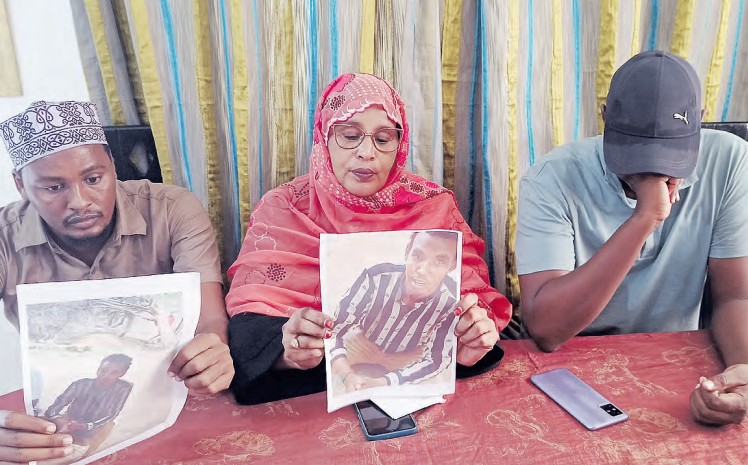
As the country observes the tenth
anniversary of the Garissa University College terrorist attack on April
2, 2015, that left 148 people dead,
two families in Kitui county who lost
their daughters are still struggling
with closure.
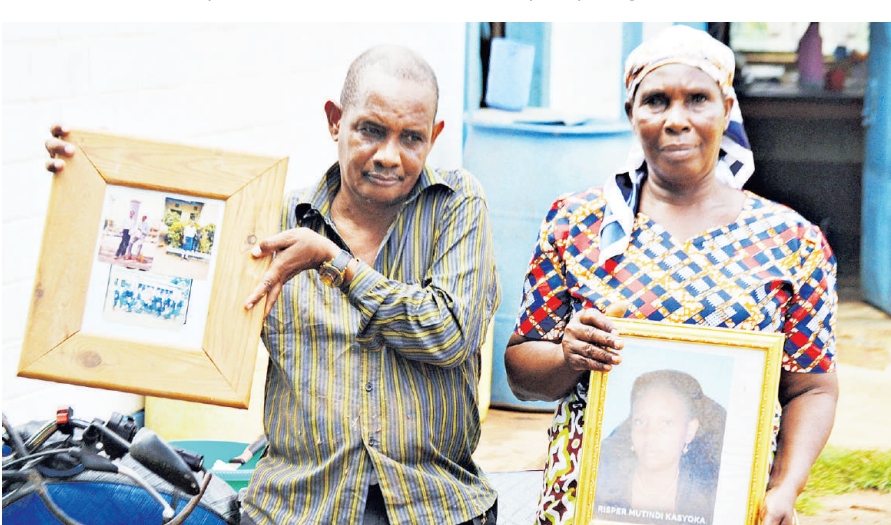
The family of Peter Isombo of
Itivanzou in Mwingi North sub-county and that of Isaac Mutua of
Ndonguni village, Nzambani in Kitui East sub-county, have not come to
terms with the loss.
Their daughters Philomena
Kasyoka and Risper Mutindi respectively, who were students at the university, were felled by the gunmen’s
bullets.
During an interview at his home
on Thursday, Isombo, who was
joined by his wife Beatrice Kuthi,
said police laxity was to blame for
the bloodbath.
“We blame the government. The
blame falls squarely on the government personnel. Not only that the
government had the capacity to forestall the attack, it had the wherewithal to respond swiftly and save lives,”
he said.
He told the Star the tragedy should
serve as a wake-up call to ensure the
security of students in all learning
institutions.
“The government should put
into place mechanisms, in learning
institutions, where security of the
students is considered paramount
and key and also given priority for
students to feel secure as they study,”
Isombo said.
“The government must assure
them of their safety and security. It
is a right that is guaranteed in our
constitution.”
All persons in institutions of higher learning should go about their
business without feeling threatened,
he said, adding that it was imperative to consider embedding police
stations inside these institutions.
To date, the government has not
compensated those who lost their
loved ones despite the pledge made
soon after the raid.
“I am sure just like us, many families that lost their children during
the attack have not gotten closure
because the government had not fulfilled the promise it made to compensate them for children whose lives
were snuffed out,” the father of three said.
After the court last year gave direction on the issue, the expectation
of the affected was that the government would move with speed to pay
up.
Waiting 10 years for compensation
was too long, he added, while noting
that no amount would be equivalent
to the life of a human being.
“Since the court deemed it fit to
award compensation payments to
the surviving victims and for the lives
lost, we accept the awards and it is
time for the government to honour
the court decree.”.
Isombo said it would be prudent
for the government to comply.
“Compensation would definitely
make the families affected during the
attack have closure once and for all.
The kind of stagnation we have witnessed in the past is depressing.”
Mutisya, whose daughter’s body
was initially collected from the
morgue and buried by the Isombo
family due to a mix-up, shared similar sentiments.
“The government and the university authorities made a big blunder.
They had intelligence information
indicating that there was a likely attack on the institution by terrorists
but they ignored it,” he claimed.
On the other hand, there was a lacklustre response by the security
apparatus to preclude the massacre
that occurred between 5 and 6 am.
“Garissa being a big town with
Kenya Defence Forces, Kenya Police
and Administration Police camps,
counter-attack and rescue should
have been swift. There was an unexplained negligence.”
The flat rate compensation was
not the best decision and his case
should have been treated differently.
“The award of three million shillings for every student who died in
the attack would not commensurately cover the expense and damage
incurred. They should have considered at least five million for me because of the strenuous period I went
through,” he said.
He spent months looking for the
body of his daughter, who had been
buried elsewhere.
“I went through a lot of trauma
for the eight months I was searching for my daughter - not knowing
whether she was alive or dead. I later
and sadly realised her body had been
buried in Kyuso. I went through a
long period of hell.”
The process involved a lot of travelling and was financially, physically
and psychologically draining and
the retired high school teacher was
lucky he had some savings, which he
poured into the search.
Financial support from brothers, cousins and colleagues came
in handy, otherwise he would have
abandoned the mission, Mutisya
said.
In August 2024, the High court
ordered the government to pay damages amounting to Sh 496 million to
students who were injured and parents who lost their children in the al
Shabaab attack.
Justice Anthony Ndung’u, Mugure Thande and David Kemei observed that the government failed to
prevent the loss of lives as there was
evidence of the imminent attack on the
university.
The court awarded every injured
student between Sh1.2 million and
Sh20 million, depending on the degree of injuries.
The government was also ordered
to pay Sh 3 million for every life lost
in the raid.
The case had been filed by Kituo
cha Sheria on behalf of the parents
and those who were injured.